Saleh Irsan, Maritska Ziske, Parisa Nita, Hidayat Rachmat
Department of Pharmacology, Faculty of Medicine, Universitas Sriwijaya, Palembang, Indonesia.
Department of Biology, Faculty of Medicine, Universitas Sriwijaya, Palembang, Indonesia.
Open Access Maced J Med Sci. 2019 Oct 14;7(23):3921-3924. doi: 10.3889/oamjms.2019.759. eCollection 2019 Dec 15.
Extensive intracellular and extracellular formation of advanced glycation end-products (AGEs) is considered a causative factor for vascular injury triggered by hyperglycemia in diabetes. The hyperglycemia will cause accumulation of AGEs, damage to pericytes, nerve growth factor (NGF), glial acid fibrillary protein (GFAP) and increase in vascular endothelial growth factor (VEGF).
This study aimed to assess the efficacy of RAGE inhibition in suppressing the development and progression of diabetic retinopathy through modulation of the inflammatory pathway involving NGF, GFAP, and VEGF.
The design was in vivo experimental study. Thirty white rats were induced with Alloxan monohydrate. Rats were divided into 5 groups, normal, negative control, groups with an anti-RAGE dose of 1 μg/uL, the dose of 10 μg/uL and 100 μg/uL. After 4 weeks of treatment, HbA1c, NGF, and GFAP levels were measured using ELISA. Quantification of VEGF expression was done using the ImageJ® application. Data was expressed with mean ± SD. Independent T-test with ANOVA and Tukey's post hoc was done.
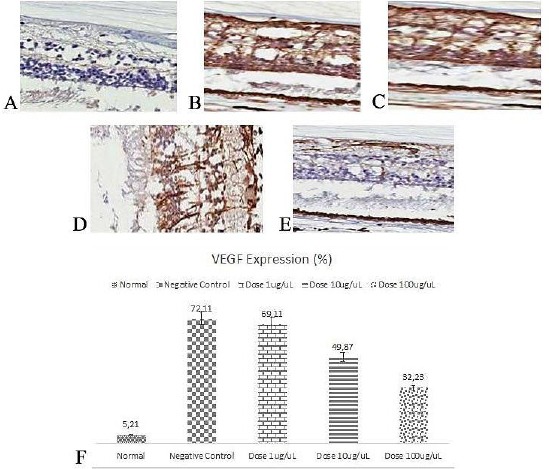
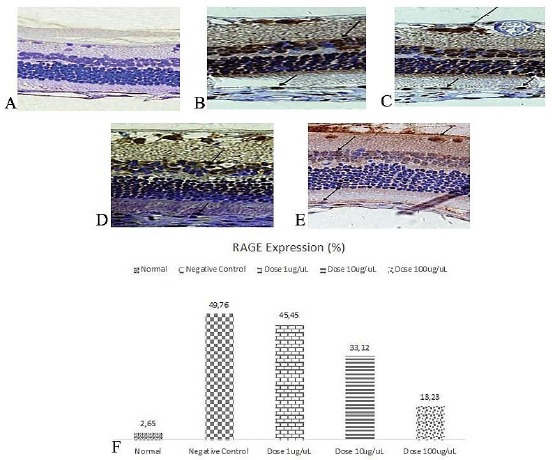
RAGE inhibitors yielded a significant decrease in blood glucose and HbA1c levels. VEGF and RAGE expression were reduced in anti-RAGE groups in various doses. Inhibition of RAGE reduced the damage of retinal pericytes, by reducing GFAP and increasing NGF, and reduced the formation of new blood vessels, by decreasing VEGF expression, in diabetic retinopathy.
Inhibition of receptor for advanced glycation end-products (RAGE) was effective in suppressing the development and progression of diabetic retinopathy.
晚期糖基化终产物(AGEs)在细胞内和细胞外大量形成被认为是糖尿病高血糖引发血管损伤的一个致病因素。高血糖会导致AGEs积累、周细胞损伤、神经生长因子(NGF)、胶质纤维酸性蛋白(GFAP)受损以及血管内皮生长因子(VEGF)增加。
本研究旨在评估抑制晚期糖基化终产物受体(RAGE)通过调节涉及NGF、GFAP和VEGF的炎症途径来抑制糖尿病视网膜病变发展和进展的疗效。
采用体内实验研究设计。30只白色大鼠用一水合阿脲诱导糖尿病。大鼠分为5组,正常组、阴性对照组、抗RAGE剂量为1μg/μL组、10μg/μL组和100μg/μL组。治疗4周后,采用酶联免疫吸附测定法(ELISA)测量糖化血红蛋白(HbA1c)、NGF和GFAP水平。使用ImageJ®应用程序对VEGF表达进行定量分析。数据以平均值±标准差表示。采用独立样本t检验、方差分析(ANOVA)和Tukey事后检验。
RAGE抑制剂使血糖和HbA1c水平显著降低。不同剂量抗RAGE组的VEGF和RAGE表达均降低。在糖尿病视网膜病变中,抑制RAGE可通过降低GFAP和增加NGF减少视网膜周细胞损伤,并通过降低VEGF表达减少新生血管形成。
抑制晚期糖基化终产物受体(RAGE)可有效抑制糖尿病视网膜病变的发展和进展。