Gaspar Hugo, Figueira Flávio, Strutyński Karol, Melle-Franco Manuel, Ivanou Dzmitry, Tomé João P C, Pereira Carlos M, Pereira Luiz, Mendes Adélio, Viana Júlio C, Bernardo Gabriel
IPC/i3N-Institute for Polymers and Composites, University of Minho, Campus de Azurém, 4800-058 Guimarães, Portugal.
QOPNA & LAQV-REQUIMTE, Department of Chemistry, University of Aveiro, 3810-193 Aveiro, Portugal.
Materials (Basel). 2020 Mar 11;13(6):1267. doi: 10.3390/ma13061267.
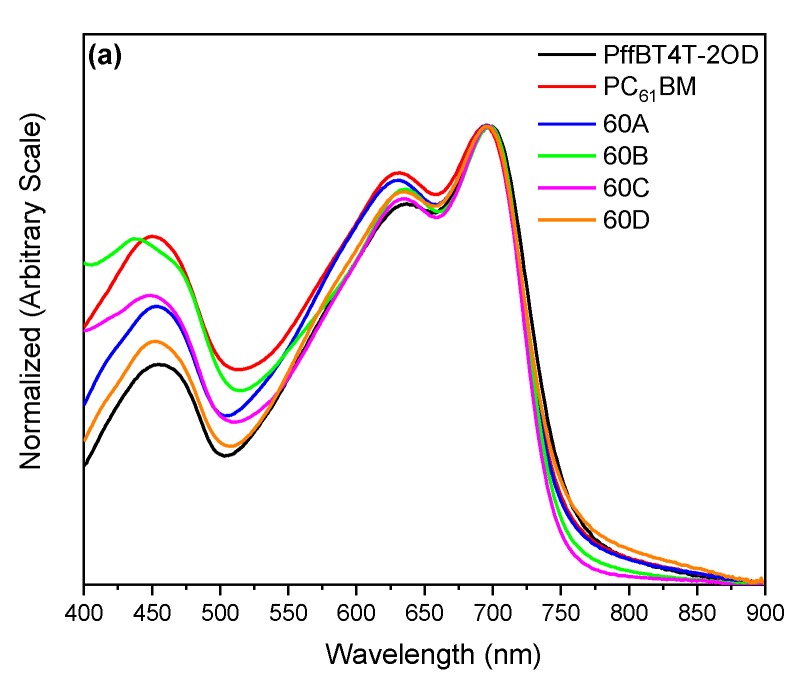
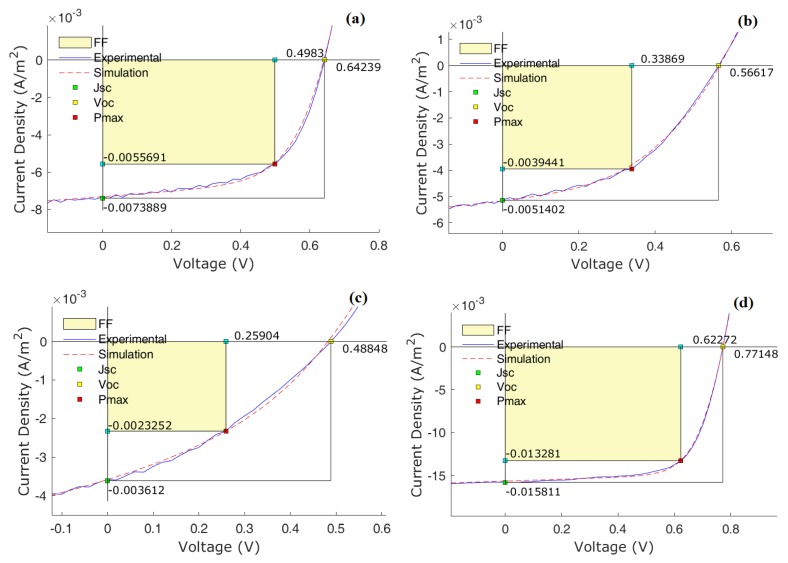
The impact of fullerene side chain functionalization with thiophene and carbazole groups on the device properties of bulk-heterojunction polymer:fullerene solar cells is discussed through a systematic investigation of material blends consisting of the conjugated polymer poly[(5,6-difluoro-2,1,3-benzothiadiazol-4,7-diyl)-alt-(3,3‴-di(2-octyldodecyl)-2,2';5',2″;5″,2‴-quaterthiophen-5,5‴-diyl)] (PffBT4T-2OD) as donor and C or C fulleropyrrolidines as acceptors. The photovoltaic performance clearly depended on the molecular structure of the fulleropyrrolidine substituents although no direct correlation with the surface morphology of the photoactive layer, as determined by atomic force microscopy, could be established. Although some fulleropyrrolidines possess favorable lowest unoccupied molecular orbital levels, when compared to the standard PCBM, they originated OPV cells with inferior efficiencies than PCBM-based reference cells. Fulleropyrrolidines based on C produced, in general, better devices than those based on C, and we attribute this observation to the detrimental effect of the structural and energetic disorder that is present in the regioisomer mixtures of C-based fullerenes, but absent in the C-based fullerenes. These results provide new additional knowledge on the effect of the fullerene functionalization on the efficiency of organic solar cells.
通过对由共轭聚合物聚[(5,6-二氟-2,1,3-苯并噻二唑-4,7-二亚基)-alt-(3,3‴-二(2-辛基十二烷基)-2,2';5',2″;5″,2‴-四噻吩-5,5‴-二亚基)] (PffBT4T-2OD)作为供体和C或C富勒烯吡咯烷作为受体组成的材料共混物进行系统研究,讨论了噻吩和咔唑基团对富勒烯侧链进行功能化修饰对本体异质结聚合物:富勒烯太阳能电池器件性能的影响。尽管通过原子力显微镜确定的光活性层的表面形态与之没有直接关联,但光伏性能显然取决于富勒烯吡咯烷取代基的分子结构。与标准的PCBM相比,尽管一些富勒烯吡咯烷具有有利的最低未占据分子轨道能级,但它们所制备的有机光伏电池的效率却低于基于PCBM的参比电池。一般来说,基于C的富勒烯吡咯烷所制备的器件比基于C的更好,我们将这一观察结果归因于基于C的富勒烯区域异构体混合物中存在的结构和能量无序的不利影响,而基于C的富勒烯中不存在这种影响。这些结果为富勒烯功能化对有机太阳能电池效率的影响提供了新的额外知识。