Wang Jiakun, He Aoxiao, Feng Qian, Hou Ping, Wu Junjun, Huang Zhihao, Xiao Zhouqing, Sun Chi, Liao Wenjun, Wu Linquan
Department of General Surgery, The Second Affiliated Hospital of Nanchang University, No. 1, Minde Road, Nanchang, 330006, China.
Department of Emergency, The Second Affiliated Hospital of Nanchang University, No. 1, Minde Road, Nanchang, 330006, China.
J Transl Med. 2020 Mar 14;18(1):128. doi: 10.1186/s12967-020-02293-0.
The rise in incidence and mortality of gastrointestinal mixed adenoneuroendocrine carcinoma (MANEC) has not been well focused. The aim of our study was to examine epidemiological trends in incidence and incidence-based (IB) mortality of gastrointestinal MANEC at a population level.
The incidence and IB mortality of gastrointestinal MANEC as well as data on affected patients from 2000 to 2016 were obtained from the Surveillance, Epidemiology, and End Results database. Trends in incidence and IB mortality were assessed using Joinpoint regression. The Kaplan-Meier method and log-rank test were used for survival analysis. Cox proportional hazards regression was used to identify independent predictors of mortality.
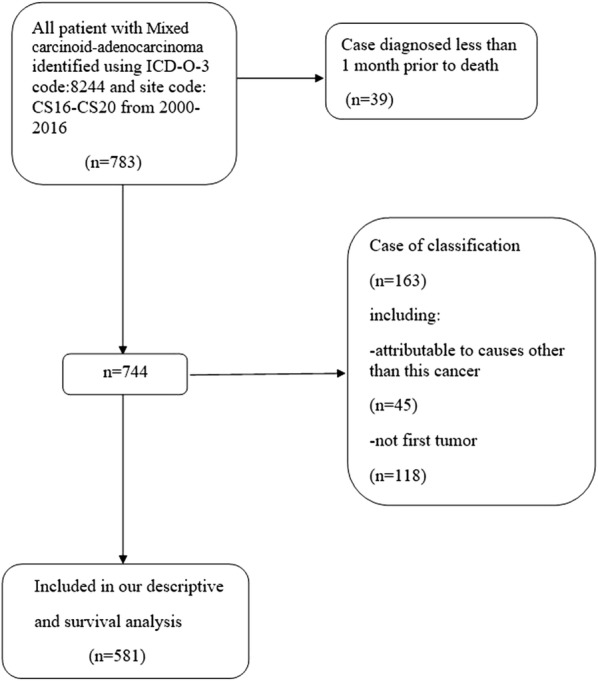
581 patients diagnosed with gastrointestinal MANEC were enrolled. Gastrointestinal MANEC incidence was 0.23 cases per 1,000,000 individuals in 2000 and 1.16 cases per 1,000,000 individuals in 2016, with an annual percent change (APC) of 8.0% (95% CI 5.7-10.3%, P < 0.05). IB mortality also showed a sustained increase (APC 12.9%, 95% CI 9.0-16.8%, P < 0.05). In Cox regression analysis, age at diagnosis, tumor grade and stage, lymph node metastasis, surgery, and tumor size were independently associated with mortality. Median survival was 75 months (95% CI 60-128 months). Median survival of appendiceal MANEC was significantly longer than that of cecal MANEC (115 vs. 31 months; P < 0.001).
We found a sustained and rapid increase both in incidence and IB mortality of gastrointestinal MANEC, manifesting that there has been no significant improvement in patient outcomes, nor progress in prevention and treatment. Additional resources should be devoted to gastrointestinal MANEC research.
胃肠道混合性腺神经内分泌癌(MANEC)的发病率和死亡率上升情况尚未得到充分关注。我们研究的目的是在人群水平上研究胃肠道MANEC的发病率和基于发病率的(IB)死亡率的流行病学趋势。
从监测、流行病学和最终结果数据库中获取2000年至2016年胃肠道MANEC的发病率和IB死亡率以及受影响患者的数据。使用Joinpoint回归评估发病率和IB死亡率的趋势。采用Kaplan-Meier法和对数秩检验进行生存分析。使用Cox比例风险回归来确定死亡率的独立预测因素。
纳入了581例诊断为胃肠道MANEC的患者。2000年胃肠道MANEC的发病率为每100万人0.23例,2016年为每100万人1.16例,年变化百分比(APC)为8.0%(95%CI 5.7-10.3%,P<0.05)。IB死亡率也呈持续上升趋势(APC 12.9%,95%CI 9.0-16.8%,P<0.05)。在Cox回归分析中,诊断时的年龄、肿瘤分级和分期、淋巴结转移、手术和肿瘤大小与死亡率独立相关。中位生存期为75个月(95%CI 60-128个月)。阑尾MANEC的中位生存期明显长于盲肠MANEC(115个月对31个月;P<0.001)。
我们发现胃肠道MANEC的发病率和IB死亡率均持续快速上升,这表明患者的预后没有显著改善,预防和治疗也没有进展。应投入更多资源用于胃肠道MANEC的研究。