'Gynaecology' and 'Pathology', Leiden Universitair Medisch Centrum, Leiden, Zuid-Holland, The Netherlands.
Pathology, Leiden University Medical Center, Leiden, Zuid-Holland, The Netherlands.
J Immunother Cancer. 2020 Mar;8(1). doi: 10.1136/jitc-2020-000563.
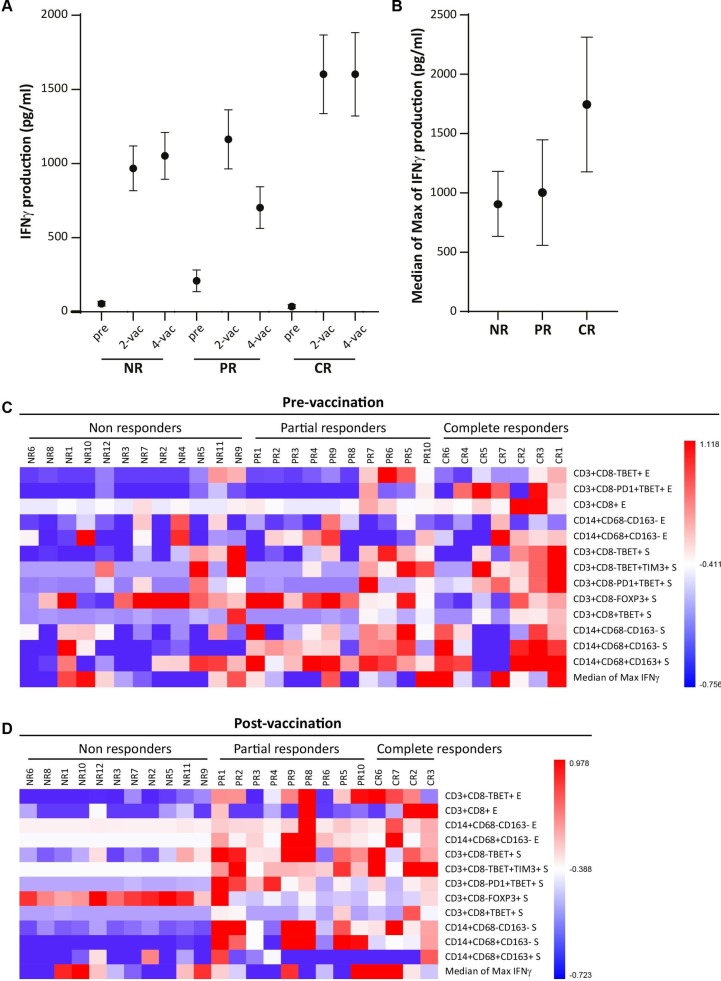
Vulvar high-grade squamous intraepithelial lesion (vHSIL) is predominantly induced by high-risk human papilloma virus type 16 (HPV16). In two independent trials, therapeutic vaccination against the HPV16 E6 and E7 oncoproteins resulted in objective partial and complete responses (PRs/CRs) in half of the patients with HPV16 vHSIL at 12-month follow-up. Here, the prevaccination and postvaccination vHSIL immune microenvironment in relation to the vaccine-induced clinical response was investigated.
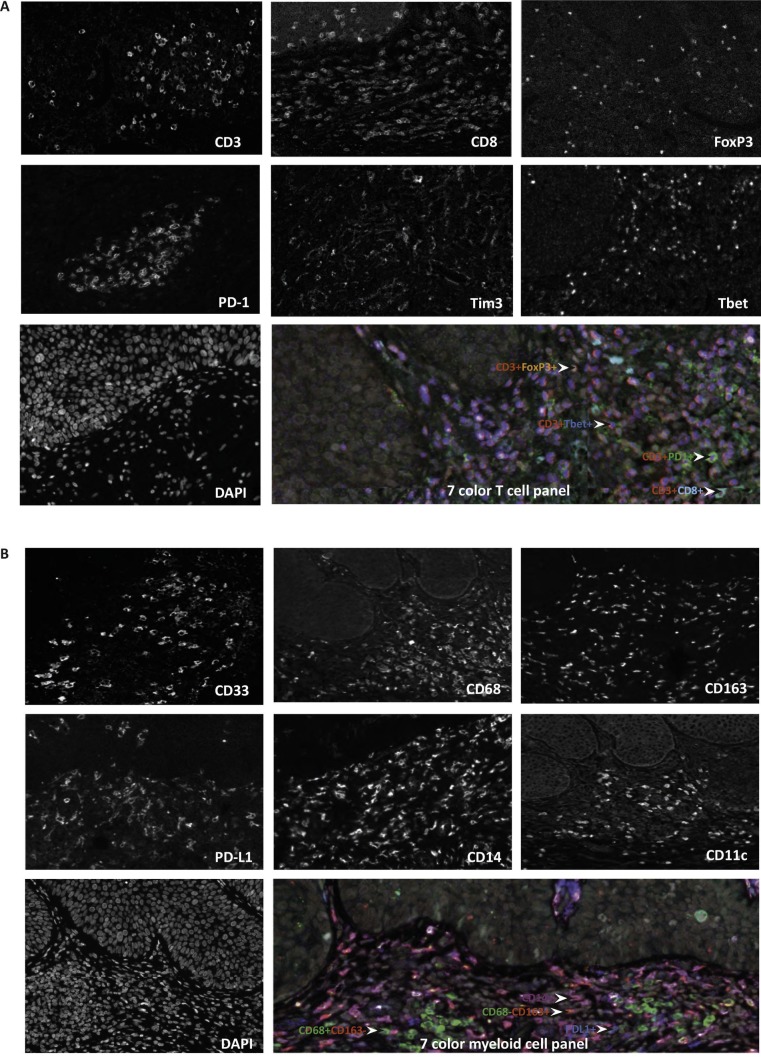
Two novel seven-color multiplex immunofluorescence panels to identify T cells (CD3, CD8, Foxp3, Tim3, Tbet, PD-1, DAPI) and myeloid cells (CD14, CD33, CD68, CD163, CD11c, PD-L1, DAPI) were designed and fully optimized for formalin-fixed paraffin-embedded tissue. 29 prevaccination and 24 postvaccination biopsies of patients with vHSIL, and 27 healthy vulva excisions, were stained, scanned with the Vectra multispectral imaging system, and automatically phenotyped and counted using inForm advanced image analysis software.
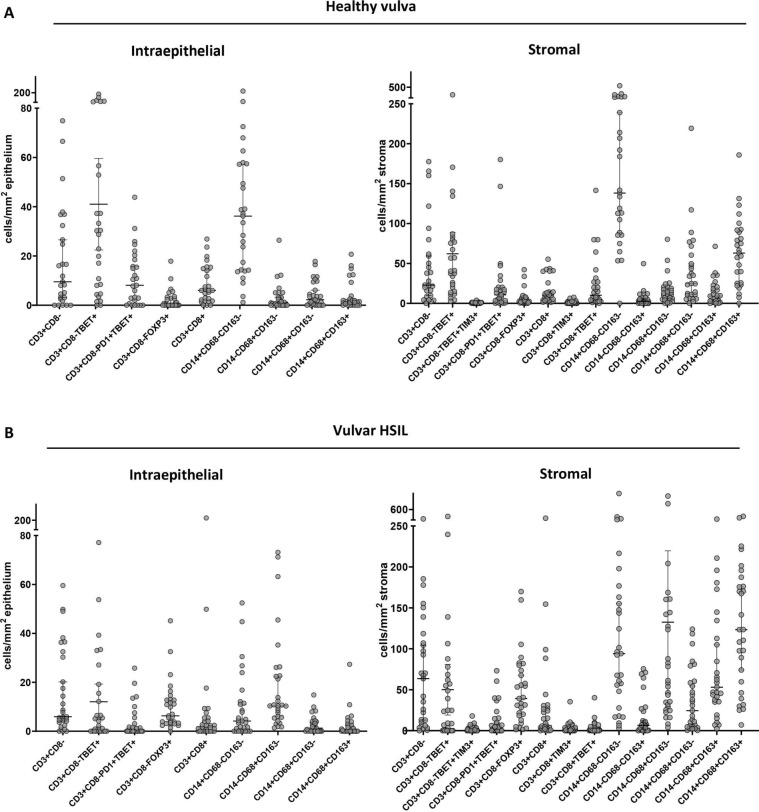
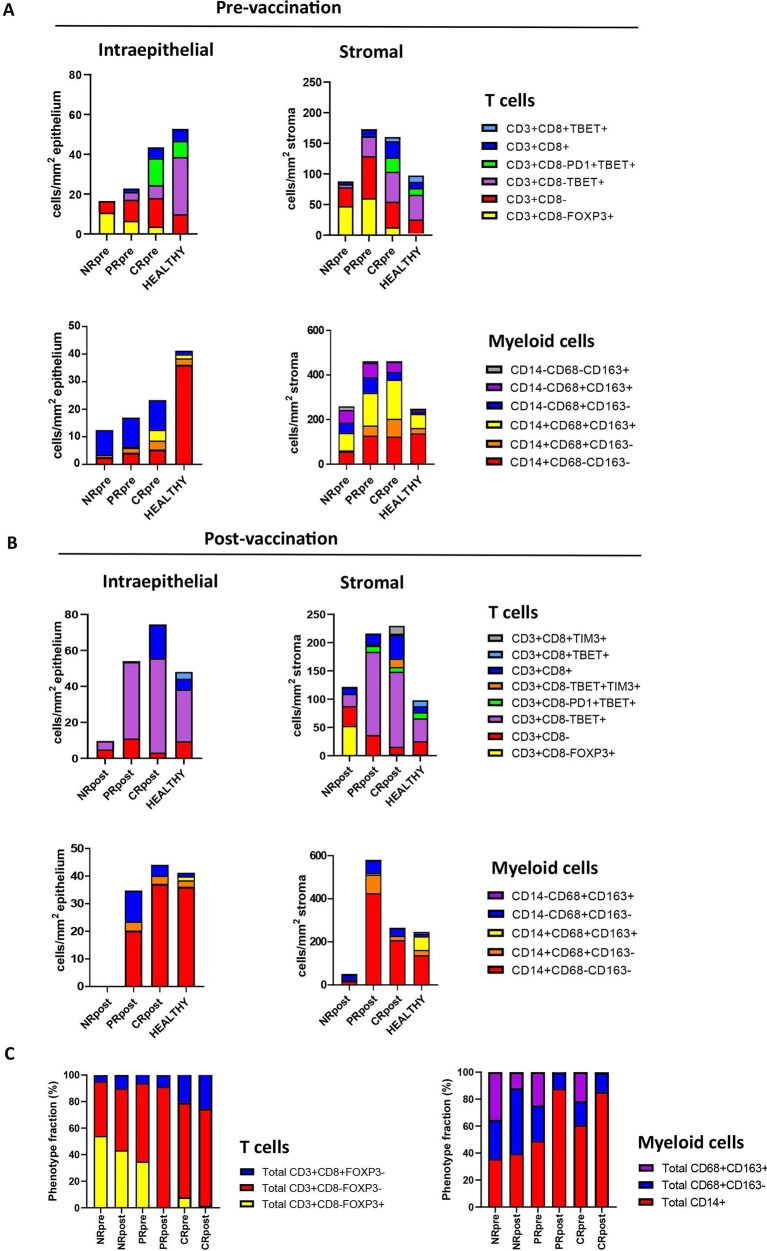
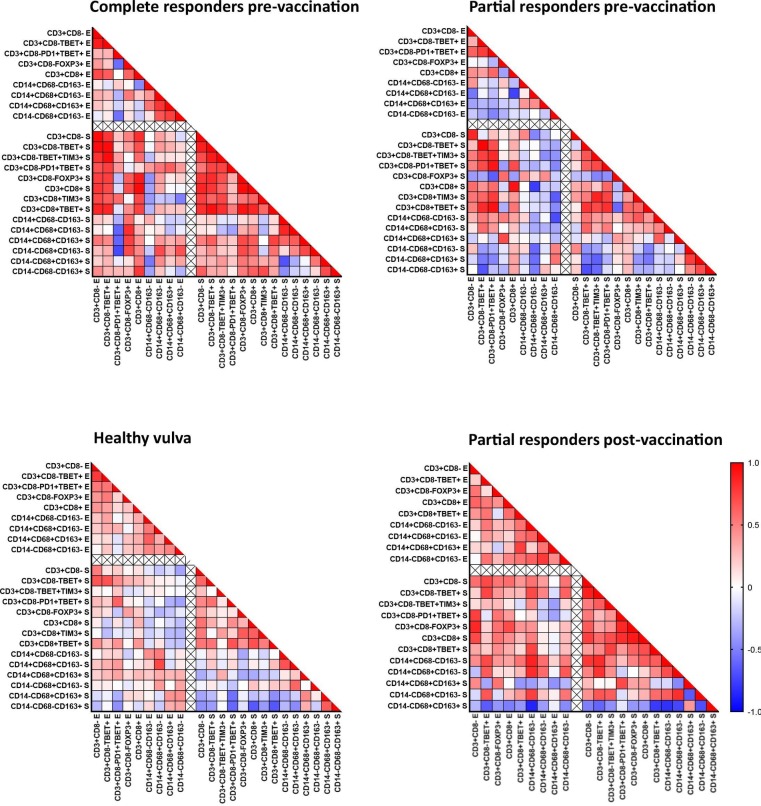
Healthy vulvar tissue is strongly infiltrated by CD4 and CD8 T cells expressing Tbet and/or PD-1 and CD14HLA-DR inflammatory myeloid cells. The presence of such a coordinated pre-existing proinflammatory microenvironment in HPV16 vHSIL is associated with CR after vaccination. In partial responders, a disconnection between T cell and CD14 myeloid cell infiltration was observed, whereas clinical non-responders displayed overall lower immune cell infiltration. Vaccination improved the coordination of local immunity, reflected by increased numbers of CD4Tbet T cells and HLA-DRCD14 expressing myeloid cells in patients with a PR or CR, but not in patients with no response. CD8 T cell infiltration was not increased after vaccination.
A prevaccination inflamed type 1 immune contexture is required for stronger vaccine-induced immune infiltration and is associated with better clinical response. Therapeutic vaccination did not overtly increase immune infiltration of cold lesions.
外阴高级别鳞状上皮内病变(vHSIL)主要由高危型人乳头瘤病毒 16 型(HPV16)引起。在两项独立的试验中,针对 HPV16 E6 和 E7 癌蛋白的治疗性疫苗接种在 12 个月随访时导致一半 HPV16 vHSIL 患者出现客观的部分和完全缓解(PR/CR)。在这里,研究了与疫苗诱导的临床反应相关的接种前和接种后 vHSIL 免疫微环境。
设计了两个新的七色多重免疫荧光面板来鉴定 T 细胞(CD3、CD8、Foxp3、Tim3、Tbet、PD-1、DAPI)和髓样细胞(CD14、CD33、CD68、CD163、CD11c、PD-L1、DAPI),并针对福尔马林固定石蜡包埋组织进行了全面优化。对 29 例 vHSIL 患者的 29 例接种前和 24 例接种后活检,以及 27 例健康外阴切除术进行了染色,用 Vectra 多光谱成像系统进行扫描,并使用 inForm 高级图像分析软件自动进行表型和计数。
健康的外阴组织被表达 Tbet 和/或 PD-1 的 CD4 和 CD8 T 细胞以及 CD14HLA-DR 炎症性髓样细胞强烈浸润。在 HPV16 vHSIL 中存在这种协调的预先存在的促炎微环境与接种后的 CR 相关。在部分反应者中,观察到 T 细胞和 CD14 髓样细胞浸润之间的脱节,而临床无反应者显示总体免疫细胞浸润较低。接种疫苗改善了局部免疫的协调性,表现在 PR 或 CR 患者中 CD4Tbet T 细胞和 HLA-DRCD14 表达的髓样细胞数量增加,但在无反应者中没有增加。接种疫苗后 CD8 T 细胞浸润没有增加。
接种前的炎症 1 型免疫结构是更强的疫苗诱导免疫浸润所必需的,并与更好的临床反应相关。治疗性疫苗接种并没有明显增加冷病变的免疫浸润。