Department of Oncology, St Jude Children's Research Hospital, Memphis, TN, USA.
Department of Pediatrics, University of North Carolina, Chapel Hill, NC, USA.
Lancet Oncol. 2020 Apr;21(4):551-560. doi: 10.1016/S1470-2045(20)30060-7. Epub 2020 Mar 11.
Outcomes for children with relapsed or refractory acute myeloid leukaemia remain poor. The BCL-2 inhibitor, venetoclax, has shown promising activity in combination with hypomethylating agents and low-dose cytarabine in older adults for whom chemotherapy is not suitable with newly diagnosed acute myeloid leukaemia. We aimed to determine the safety and explore the activity of venetoclax in combination with standard and high-dose chemotherapy in paediatric patients with relapsed or refractory acute myeloid leukaemia.
We did a phase 1, dose-escalation study at three research hospitals in the USA. Eligible patients were aged 2-22 years with relapsed or refractory acute myeloid leukaemia or acute leukaemia of ambiguous lineage with adequate organ function and performance status. During dose escalation, participants received venetoclax orally once per day in continuous 28-day cycles at either 240 mg/m or 360 mg/m, in combination with cytarabine received intravenously every 12 h at either 100 mg/m for 20 doses or 1000 mg/m for eight doses, with or without intravenous idarubicin (12 mg/m) as a single dose, using a rolling-6 accrual strategy. The primary endpoint was the recommended phase 2 dose of venetoclax plus chemotherapy and the secondary endpoint was the proportion of patients treated at the recommended phase 2 dose who achieved complete remission or complete remission with incomplete haematological recovery. Analyses were done on patients who received combination therapy. The study is registered with ClinicalTrials.gov (NCT03194932) and is now enrolling to address secondary and exploratory objectives.
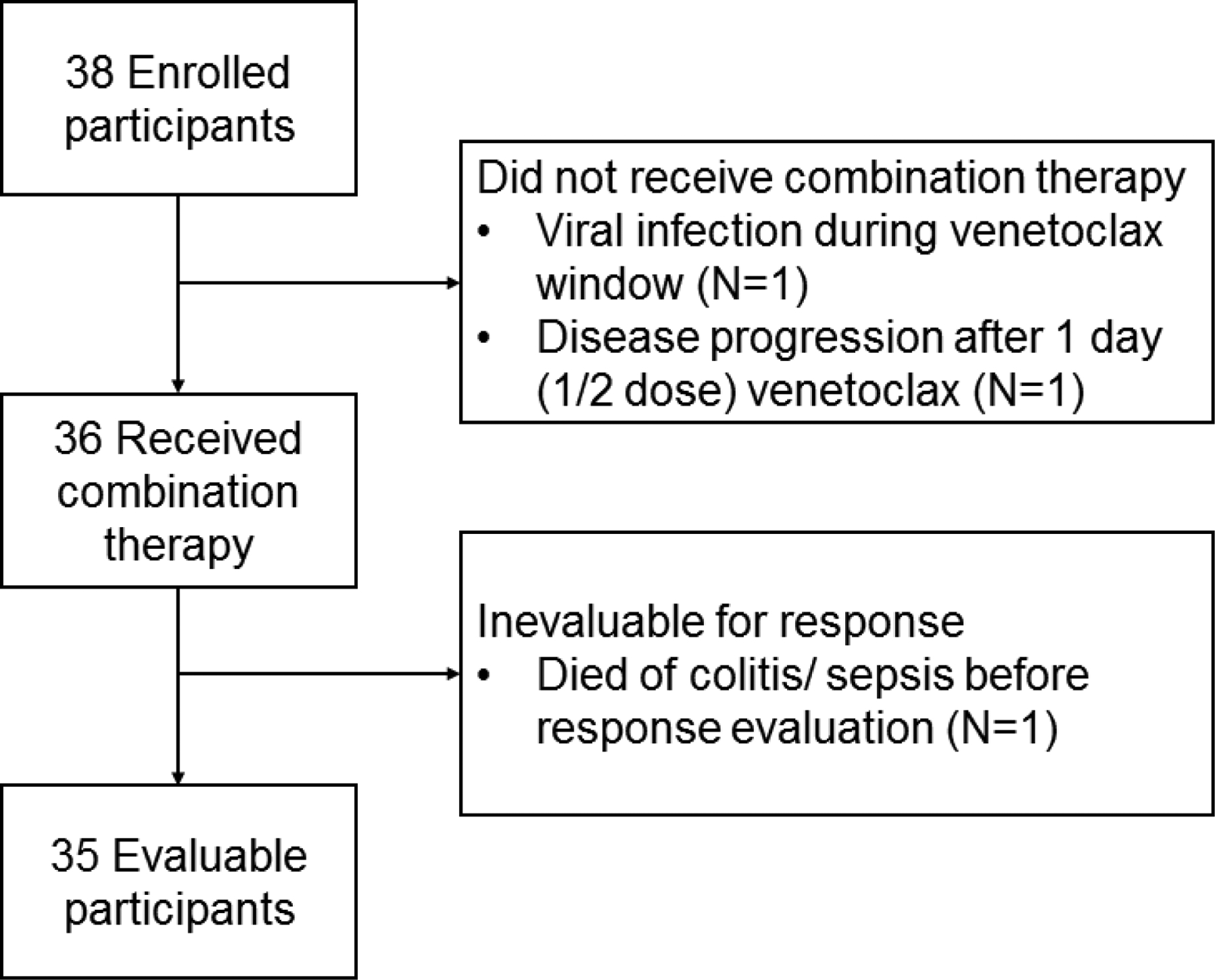
Between July 1, 2017, and July 2, 2019, 38 patients were enrolled (aged 3-22 years; median 10 [IQR 7-13]), 36 of whom received combination therapy with dose escalation, with a median follow-up of 7·1 months (IQR 5·1-11·2). The recommended phase 2 dose of venetoclax was found to be 360 mg/m (maximum 600 mg) combined with cytarabine (1000 mg/m per dose for eight doses), with or without idarubicin (12 mg/m as a single dose). Overall responses were observed in 24 (69%) of the 35 patients who were evaluable after cycle 1. Among the 20 patients treated at the recommended phase 2 dose, 14 (70%, 95% CI 46-88) showed complete response with or without complete haematological recovery, and two (10%) showed partial response. The most common grade 3-4 adverse events were febrile neutropenia (22 [66%]), bloodstream infections (six [16%]), and invasive fungal infections (six [16%]). Treatment-related death occurred in one patient due to colitis and sepsis.
The safety and activity of venetoclax plus chemotherapy in paediatric patients with heavily relapsed and refractory acute myeloid leukaemia suggests that this combination should be tested in newly diagnosed paediatric patients with high-risk acute myeloid leukaemia.
US National Institutes of Health, American Lebanese Syrian Associated Charities, AbbVie, and Gateway for Cancer Research.
儿童复发性或难治性急性髓系白血病的预后仍然较差。BCL-2 抑制剂 venetoclax 与低剂量阿糖胞苷联合低甲基化剂在不适合化疗的新诊断为急性髓系白血病的老年患者中显示出良好的疗效。我们旨在确定 venetoclax 联合标准和高剂量化疗治疗复发性或难治性急性髓系白血病患儿的安全性和探索其疗效。
我们在美国的三家研究医院进行了一项 I 期、剂量递增研究。入组标准为年龄在 2-22 岁的复发性或难治性急性髓系白血病或具有明确血统的急性白血病患者,其器官功能和表现状态良好。在剂量递增期间,参与者每天口服 venetoclax 一次,连续 28 天周期,剂量为 240mg/m 或 360mg/m,联合阿糖胞苷每 12 小时静脉滴注一次,剂量为 100mg/m 共 20 剂或 1000mg/m 共 8 剂,可与或不与单剂量静脉注射伊达比星(12mg/m)联合使用,采用滚动 6 例入组策略。主要终点为 venetoclax 联合化疗的推荐 II 期剂量,次要终点为接受推荐 II 期剂量治疗的患者中有多少比例达到完全缓解或不完全血液学恢复的完全缓解。分析仅纳入接受联合治疗的患者。该研究在 ClinicalTrials.gov (NCT03194932)上注册,目前正在招募以解决次要和探索性目标。
2017 年 7 月 1 日至 2019 年 7 月 2 日期间,共纳入 38 例患者(年龄 3-22 岁;中位数 10[IQR 7-13]),其中 36 例接受联合治疗进行剂量递增,中位随访时间为 7.1 个月(IQR 5.1-11.2)。发现 venetoclax 的推荐 II 期剂量为 360mg/m(最大 600mg)联合阿糖胞苷(8 剂剂量为 1000mg/m),可与或不与伊达比星(单剂量 12mg/m)联合使用。在第 1 个周期后可评估的 35 例患者中,24 例(69%)观察到总体缓解。在 20 例接受推荐 II 期剂量治疗的患者中,14 例(70%,95%CI 46-88)表现出完全缓解伴或不伴完全血液学恢复,2 例(10%)表现出部分缓解。最常见的 3-4 级不良事件为发热性中性粒细胞减少症(22 例[66%])、血流感染(6 例[16%])和侵袭性真菌感染(6 例[16%])。1 例患者因结肠炎和败血症导致治疗相关死亡。
venetoclax 联合化疗在复发性和难治性急性髓系白血病患儿中的安全性和疗效表明,该联合疗法应在新诊断为高危急性髓系白血病的患儿中进行测试。
美国国立卫生研究院、美国黎巴嫩叙利亚联合慈善协会、艾伯维公司和癌症治疗门户基金会。