Department of Parasitology, Faculty of Science, Charles University, Prague, Czechia.
Department of Pharmaceutical Chemistry, School of Pharmacy, University of California, San Francisco, San Francisco, CA, United States.
Front Cell Infect Microbiol. 2020 Feb 26;10:66. doi: 10.3389/fcimb.2020.00066. eCollection 2020.
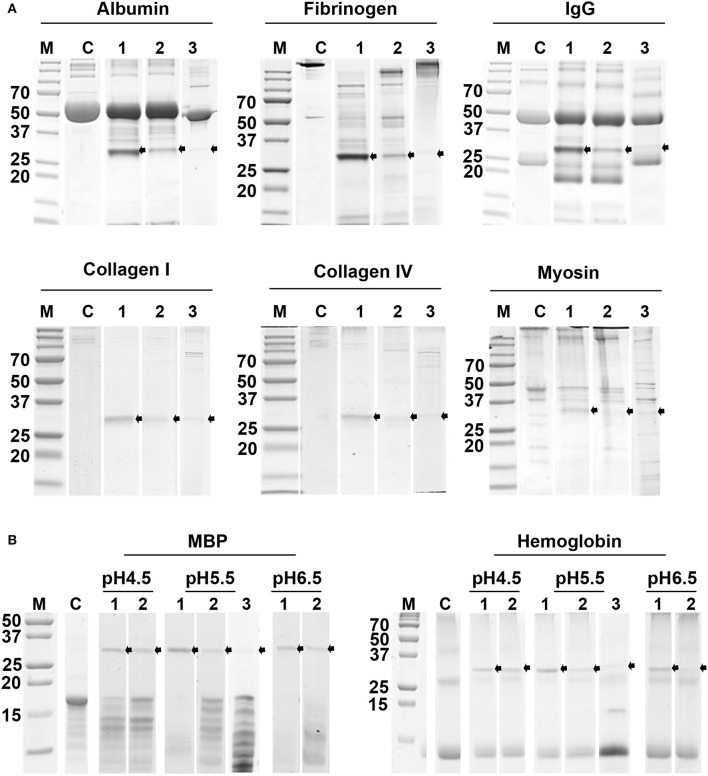
Schistosomula (the post-infective stages) of the neurotropic schistosome possess multiple isoforms of cathepsin B1 peptidase (TrCB1.1-TrCB1.6) with involvement in nutrient digestion. The comparison of substrate preferences of TrCB1.1 and TrCB1.4 showed that TrCB1.4 had a very narrow substrate specificity and after processing it was less effective toward protein substrates when compared to TrCB1.1. Self-processing of both isoforms could be facilitated by sulfated polysaccharides due to a specific binding motif in the pro-sequence. Trans-activation by heterologous enzymes was also successfully employed. Expression profiling revealed a high level of transcription of genes encoding the enzymatically inactive paralogs TrCB1.5 and TrCB1.6. The transcription level of TrCB1.6 was comparable with that of TrCB1.1 and TrCB1.2, the most abundant active isoforms. Recombinant TrCB1.6wt, a wild type paralog with a Cys-to-Gly substitution in the active site that renders the enzyme inactive, was processed by the active TrCB1 forms and by an asparaginyl endopeptidase. Although TrCB1.6wt lacked hydrolytic activity, endopeptidase, but not dipeptidase, activity could be restored by mutating Gly to Cys. The lack of exopeptidase activity may be due to other mutations, such as His-to-Asn in the occluding loop and Asp-to-Gly in the main body of the mature TrCB1.6, which do not occur in the active isoforms TrCB1.1 and TrCB1.4 with exopeptidase activity. The catalytically active enzymes and the inactive TrCB1.6 paralog formed complexes with chicken cystatin, thus supporting experimentally the hypothesis that inactive paralogs could potentially regulate the activity of the active forms or protect them from being inhibited by host inhibitors. The effect on cell viability and nitric oxide production by selected immune cells observed for TrCB1.1 was not confirmed for TrCB1.6. We show here that the active isoforms of TrCB1 have different affinities for peptide substrates thereby facilitating diversity in protein-derived nutrition for the parasite. The inactive paralogs are unexpectedly highly expressed and one of them retains the ability to bind cystatins, likely due to specific mutations in the occluding loop and the enzyme body. This suggests a role in sequestration of inhibitors and protection of active cysteine peptidases.
神经嗜性血吸虫的尾蚴(感染后阶段)具有多种组织蛋白酶 B1 肽酶(TrCB1.1-TrCB1.6)同工型,参与营养消化。TrCB1.1 和 TrCB1.4 的底物偏好比较表明,TrCB1.4 的底物特异性非常狭窄,与 TrCB1.1 相比,加工后对蛋白质底物的效果较差。由于前导序列中存在特定的结合基序,两种同工型的自我加工都可以通过硫酸化多糖来促进。通过异源酶的转激活也成功地进行了实验。表达谱分析显示,编码无酶活性的基因的转录水平很高。TrCB1.5 和 TrCB1.6 的转录水平与最丰富的活性同工型 TrCB1.1 和 TrCB1.2 相当。重组 TrCB1.6wt 是一种具有 Cys-to-Gly 取代的野生型同工型,该取代使酶失活,它可被活性 TrCB1 形式和天冬酰胺内肽酶加工。尽管 TrCB1.6wt 缺乏水解活性,但通过将 Gly 突变为 Cys 可以恢复内肽酶,但不是二肽酶活性。缺乏外肽酶活性可能是由于其他突变,例如在封闭环中的 His-to-Asn 和在成熟的 TrCB1.6 主体中的 Asp-to-Gly,这些突变不会发生在具有外肽酶活性的活性同工型 TrCB1.1 和 TrCB1.4 中。具有催化活性的酶和无活性的 TrCB1.6 同工型与鸡半胱氨酸蛋白酶抑制剂形成复合物,从而实验上支持了无活性同工型可能潜在调节活性形式的活性或保护它们免受宿主抑制剂抑制的假说。观察到的对细胞活力和选定免疫细胞中一氧化氮产生的 TrCB1.1 的影响未在 TrCB1.6 中得到证实。我们在这里表明,TrCB1 的活性同工型对肽底物具有不同的亲和力,从而促进了寄生虫蛋白质衍生营养的多样性。令人意外的是,无活性的同工型高度表达,其中一个同工型保留与半胱氨酸蛋白酶抑制剂结合的能力,可能是由于在封闭环和酶体中存在特定的突变。这表明它在抑制剂的隔离和活性半胱氨酸肽酶的保护中起作用。