Souza Felipe Rodrigues de, Rodrigues Garcia Danielle, Cuya Teobaldo, Pimentel André Silva, Gonçalves Arlan da Silva, Alencastro Ricardo Bicca de, França Tanos Celmar Costa
Laboratory of Molecular Modeling Applied to Chemical and Biological Defense (LMCBD), Military Institute of Engineering, 22290-270 Rio de Janeiro/RJ, Brazil.
Department of Chemistry, Pontifical Catholic University of Rio de Janeiro, 22451-900 Rio de Janeiro/RJ, Brazil.
ACS Omega. 2020 Feb 26;5(9):4490-4500. doi: 10.1021/acsomega.9b03737. eCollection 2020 Mar 10.
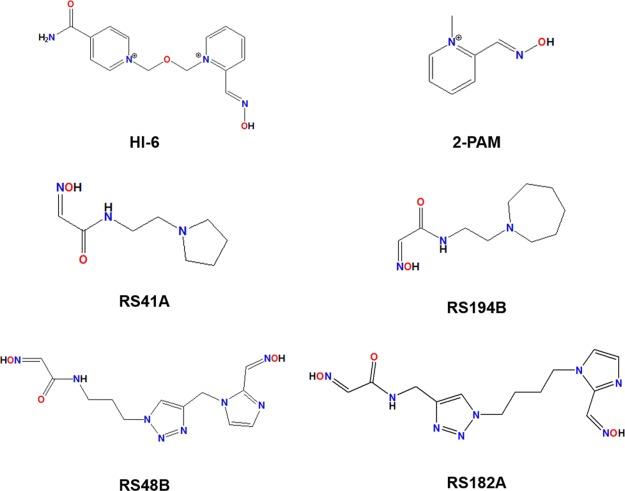
The deleterious effects of nerve agents over the enzymes acetylcholinesterase (AChE) and butyrylcholinesterase (BChE) turned these compounds into the most dangerous chemical weapons known. Among the antidotes in use today against these agents, oximes in combination with other drugs are the only treatment with any action. HI-6 and 2-PAM are cationic oximes proved to be effective for the reactivation of AChE inhibited by the nerve agents VX and sarin (GB). However, when it comes to reactivation of AChE inside the central or peripheral nervous systems, charged molecules present low diffusion due to low penetration through the blood-brain barrier. Uncharged oximes appear as an interesting alternative to solve this problem, but the development and enhancement of more efficient uncharged oximes capable of reactivating human AChE is still necessary. Given the limitations for in vivo and in vitro experimental studies with nerve agents, modeling is an important tool that can contribute to a better understanding of factors that may affect the efficiency of uncharged oximes. In order to investigate the interaction and behavior of cationic and uncharged oximes, we performed here molecular docking, molecular dynamics simulations, and binding energies calculations of the known cationic oximes HI-6 and 2-PAM plus four uncharged oximes found in the literature, complexed with human AChE (ACHE) conjugated with the nerve agents VX and GB. The uncharged oximes showed different behaviors, especially RS194B, which presented stability inside AChE-VX, but presented free binding energy lower than cationic oximes, suggesting that structural alterations could favor its interactions with these complexes. In contrast, HI-6 and 2-PAM showed higher affinities with more negative binding energy values and larger contribution of the amino acid Asp74, demonstrating the importance of the quaternary nitrogen to the affinity and interaction of oximes with AChE-GB and AChE-VX conjugates.
神经毒剂对乙酰胆碱酯酶(AChE)和丁酰胆碱酯酶(BChE)的有害作用,使这些化合物成为已知的最危险的化学武器。在当今用于对抗这些毒剂的解毒剂中,肟类与其他药物联合使用是唯一有效的治疗方法。HI-6和2-PAM是阳离子肟,已被证明可有效使被神经毒剂VX和沙林(GB)抑制的AChE重新活化。然而,当涉及到中枢或外周神经系统内AChE的重新活化时,带电分子由于难以穿透血脑屏障而扩散性较低。不带电的肟似乎是解决这一问题的一个有趣选择,但仍有必要开发和改进更高效的能够重新活化人AChE的不带电肟。鉴于使用神经毒剂进行体内和体外实验研究存在局限性,建模是一种重要工具,有助于更好地理解可能影响不带电肟效率的因素。为了研究阳离子和不带电肟的相互作用及行为,我们在此进行了分子对接、分子动力学模拟,并计算了已知阳离子肟HI-6和2-PAM以及文献中发现的四种不带电肟与结合了神经毒剂VX和GB的人AChE(ACHE)形成的复合物的结合能。不带电的肟表现出不同的行为,尤其是RS194B,它在AChE-VX内部表现出稳定性,但其自由结合能低于阳离子肟,这表明结构改变可能有利于其与这些复合物的相互作用。相比之下,HI-6和2-PAM表现出更高的亲和力,结合能值更负,且氨基酸Asp74的贡献更大,这证明了季铵氮对肟与AChE-GB和AChE-VX缀合物的亲和力和相互作用的重要性。