Bosch Xavier, Moreno Pedro, Guerra-García Mar, Guasch Neus, López-Soto Alfons
Quick Diagnosis Unit, Adult Day Care Center, Hospital Clínic, University of Barcelona.
Department of Internal Medicine, Hospital Clínic, University of Barcelona.
Medicine (Baltimore). 2020 Mar;99(11):e19009. doi: 10.1097/MD.0000000000019009.
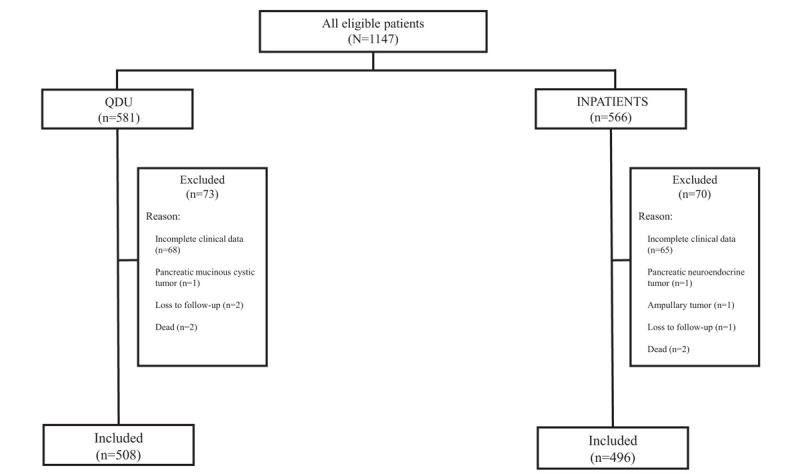
Quick diagnosis units (QDU) have become an alternative hospital-based ambulatory medicine strategy to inpatient hospitalization for potentially serious illnesses in Spain. Whether diagnosis of pancreatic cancer is better accomplished by an ambulatory or inpatient approach is unknown. The main objective of this retrospective study was to examine and compare the diagnostic effectiveness of a QDU or inpatient setting in patients with pancreatic cancer.Patients with a diagnosis of pancreatic adenocarcinoma who had been referred to a university, tertiary hospital-based QDU or hospitalized between 2005 and 2018 were eligible. Presenting symptoms and signs, risk and prognostic factors, and time to diagnosis were compared. The costs incurred during the diagnostic assessment were analyzed with a microcosting method.A total of 1004 patients (508 QDU patients and 496 inpatients) were eligible. Admitted patients were more likely than QDU patients to have weight loss, asthenia, anorexia, abdominal pain, jaundice, and palpable hepatomegaly. Time to diagnosis of inpatients was similar to that of QDU patients (4.1 [0.8 vs 4.3 [0.6] days; P = .163). Inpatients were more likely than QDU patients to have a tumor on the head of the pancreas, a tumor size >2 cm, a more advanced nodal stage, and a poorer histological differentiation. No differences were observed in the proportion of metastatic and locally advanced disease and surgical resections. Microcosting revealed a cost of &OV0556;347.76 (48.69) per QDU patient and &OV0556;634.36 (80.56) per inpatient (P < .001).Diagnosis of pancreatic cancer is similarly achieved by an inpatient or QDU clinical approach, but the latter seems to be cost-effective. Because the high costs of hospitalization, an ambulatory diagnostic assessment may be preferable in these patients.
在西班牙,快速诊断单元(QDU)已成为一种替代住院治疗的医院门诊医疗策略,用于处理可能患有严重疾病的患者。目前尚不清楚胰腺癌的诊断采用门诊还是住院方式更好。这项回顾性研究的主要目的是检查和比较QDU或住院环境对胰腺癌患者的诊断效果。
2005年至2018年间被转诊至一所大学附属的三级医院QDU或住院治疗的胰腺腺癌患者符合条件。比较了患者的症状和体征、风险及预后因素以及诊断时间。采用微观成本核算方法分析诊断评估期间产生的费用。
共有1004名患者符合条件(508名QDU患者和496名住院患者)。住院患者比QDU患者更易出现体重减轻、乏力、厌食、腹痛、黄疸和可触及的肝肿大。住院患者的诊断时间与QDU患者相似(4.1[0.8]天对4.3[0.6]天;P = 0.163)。住院患者比QDU患者更易出现胰腺头部肿瘤、肿瘤大小>2 cm、淋巴结分期更晚以及组织学分化更差。在转移和局部晚期疾病的比例以及手术切除方面未观察到差异。微观成本核算显示,每名QDU患者的费用为347.76欧元(48.69),每名住院患者的费用为634.36欧元(80.56)(P < 0.001)。
胰腺癌的诊断通过住院或QDU临床方法同样可以实现,但后者似乎更具成本效益。由于住院费用高昂,对于这些患者,门诊诊断评估可能更可取。