Department of Bioengineering, Universidad Carlos III de Madrid, 28911 Leganés, Spain.
Hospital Fundación Jiménez Díaz e Instituto de Investigación FJD, 28040 Madrid, Spain.
Int J Mol Sci. 2020 Mar 12;21(6):1951. doi: 10.3390/ijms21061951.
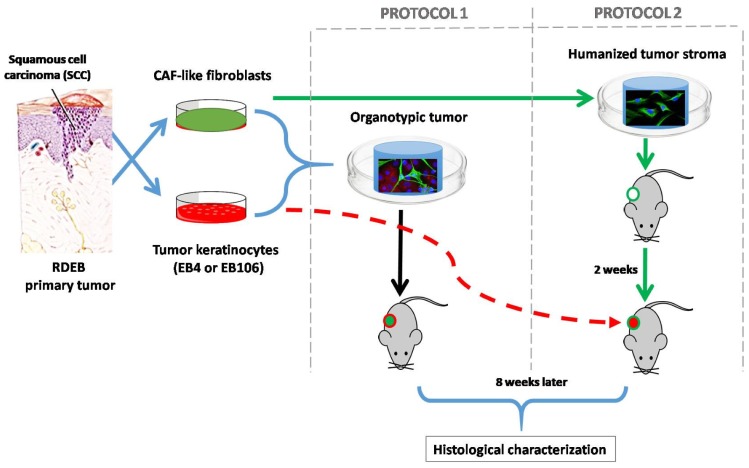
The role of stroma is fundamental in the development and behavior of epithelial tumors. In this regard, limited growth of squamous cell carcinomas (SCC) or cell-lines derived from them has been achieved in immunodeficient mice. Moreover, lack of faithful recapitulation of the original human neoplasia complexity is often observed in xenografted tumors. Here, we used tissue engineering techniques to recreate a humanized tumor stroma for SCCs grafted in host mice, by combining CAF (cancer associated fibroblasts)-like cells with a biocompatible scaffold. The stroma was either co-injected with epithelial cell lines derived from aggressive SCC or implanted 15 days before the injection of the tumoral cells, to allow its vascularization and maturation. None of the mice injected with the cell lines without stroma were able to develop a SCC. In contrast, tumors were able to grow when SCC cells were injected into previously established humanized stroma. Histologically, all of the regenerated tumors were moderately differentiated SCC with a well-developed stroma, resembling that found in the original human neoplasm. Persistence of human stromal cells was also confirmed by immunohistochemistry. In summary, we provide a proof of concept that humanized tumor stroma, generated by tissue engineering, can facilitate the development of epithelial tumors in immunodeficient mice.
基质在上皮性肿瘤的发生和行为中起着至关重要的作用。在这方面,在免疫缺陷小鼠中,有限地实现了鳞状细胞癌(SCC)或源自它们的细胞系的生长。此外,在异种移植肿瘤中经常观察到对原始人类肿瘤复杂性的忠实再现缺失。在这里,我们使用组织工程技术通过将类似成纤维细胞(CAF)样细胞与生物相容性支架相结合,为移植到宿主小鼠中的 SCC 重现了一种人源化的肿瘤基质。基质要么与源自侵袭性 SCC 的上皮细胞系一起注射,要么在注射肿瘤细胞前 15 天植入,以允许其血管生成和成熟。没有基质的细胞系注射的小鼠均不能形成 SCC。相比之下,当将 SCC 细胞注入先前建立的人源化基质中时,肿瘤能够生长。组织学上,所有再生的肿瘤均为中度分化 SCC,具有发达的基质,类似于原始人类肿瘤中的基质。免疫组织化学也证实了人基质细胞的持续存在。总之,我们提供了一个概念验证,即通过组织工程生成的人源化肿瘤基质可以促进免疫缺陷小鼠中上皮性肿瘤的发展。