Wang Hongyan, Wu Bin, Yao Zichuan, Zhu Xianqing, Jiang Yunzhong, Bai Song
Department of Urology, Shengjing Hospital of China Medical University, Shenyang, China.
Endocr Connect. 2020 Apr;9(4):309-317. doi: 10.1530/EC-20-0004.
Although resection is the primary treatment strategy for pheochromocytoma, surgery is associated with a high risk of morbidity. At present, there is no nomogram for prediction of severe morbidity after pheochromocytoma surgery, thus the aim of the present study was to develop and validate a nomogram for prediction of severe morbidity after pheochromocytoma surgery.
The development cohort consisted of 262 patients who underwent unilateral laparoscopic or open pheochromocytoma surgery at our center between 1 January 2007 and 31 December 2016. The patients' clinicopathological characters were recorded. The least absolute shrinkage and selection operator (LASSO) binary logistic regression model was used for data dimension reduction and feature selection, then multivariable logistic regression analysis was used to develop the predictive model. An independent validation cohort consisted of 128 consecutive patients from 1 January 2017 and 31 December 2018. The performance of the predictive model was assessed in regards to discrimination, calibration, and clinical usefulness.
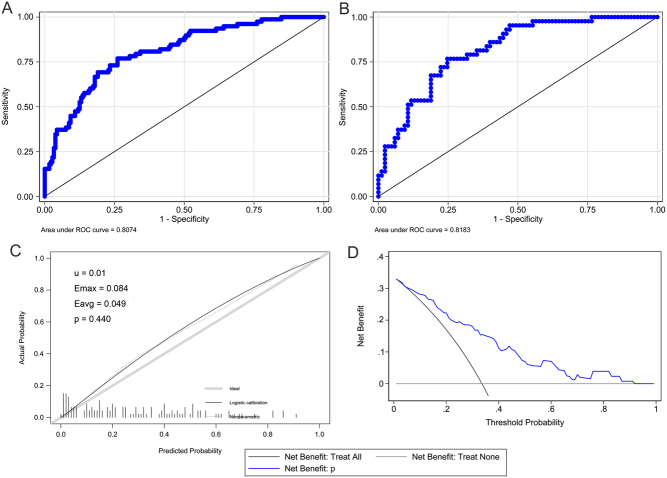
Predictors of this model included sex, BMI, coronary heart disease, arrhythmia, tumor size, intraoperative hemodynamic instability, and surgical duration. For the validation cohort, the model showed good discrimination with an AUROC of 0.818 (95% CI, 0.745, 0.891) and good calibration (Unreliability test, P = 0.440). Decision curve analysis demonstrated that the model was also clinically useful.
A nomogram was developed to facilitate the individualized prediction of severe morbidity after pheochromocytoma surgery and may help to improve the perioperative strategy and treatment outcome.
虽然手术切除是嗜铬细胞瘤的主要治疗策略,但手术相关的发病风险很高。目前,尚无用于预测嗜铬细胞瘤手术后严重并发症的列线图,因此本研究的目的是开发并验证一种用于预测嗜铬细胞瘤手术后严重并发症的列线图。
开发队列包括2007年1月1日至2016年12月31日期间在本中心接受单侧腹腔镜或开放性嗜铬细胞瘤手术的262例患者。记录患者的临床病理特征。采用最小绝对收缩和选择算子(LASSO)二元逻辑回归模型进行数据降维和特征选择,然后使用多变量逻辑回归分析建立预测模型。独立验证队列包括2017年1月1日至2018年12月31日期间连续的128例患者。从区分度、校准度和临床实用性方面评估预测模型的性能。
该模型的预测因素包括性别、体重指数、冠心病、心律失常、肿瘤大小、术中血流动力学不稳定和手术时长。对于验证队列,该模型显示出良好的区分度,曲线下面积(AUROC)为0.818(95%可信区间,0.745,0.891),校准度良好(不可靠性检验,P = 0.440)。决策曲线分析表明该模型也具有临床实用性。
开发了一种列线图,以促进对嗜铬细胞瘤手术后严重并发症的个体化预测,并可能有助于改善围手术期策略和治疗结果。