Department of Medicinal Chemistry, Uppsala University, 751 83 Uppsala, Sweden.
Department of Protein Science, School of Engineering Sciences in Chemistry, Biotechnology and Health, KTH Royal Institute of Technology, 106 91 Stockholm, Sweden.
Int J Mol Sci. 2020 Mar 13;21(6):1972. doi: 10.3390/ijms21061972.
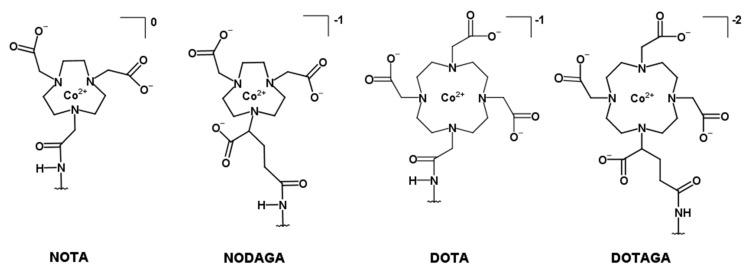
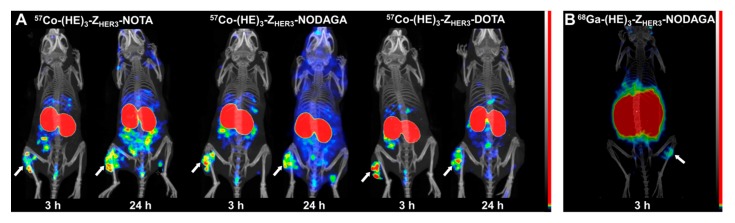
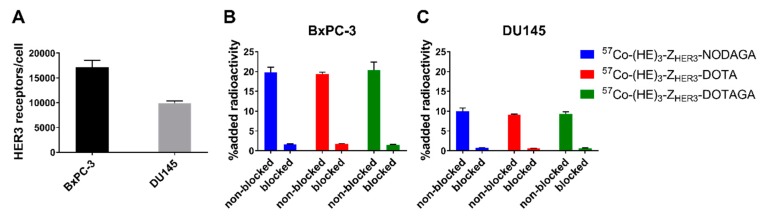
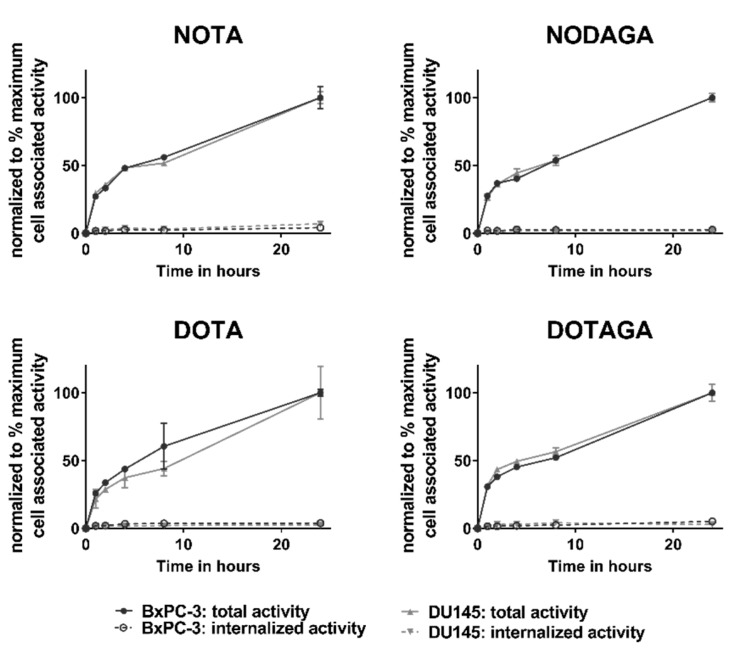
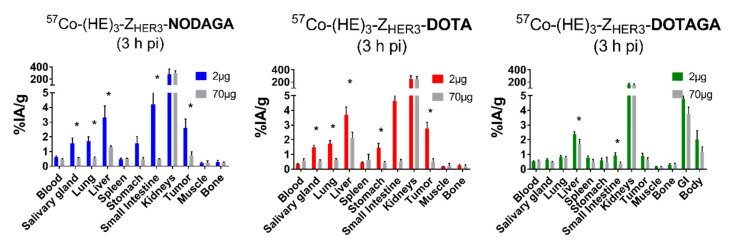
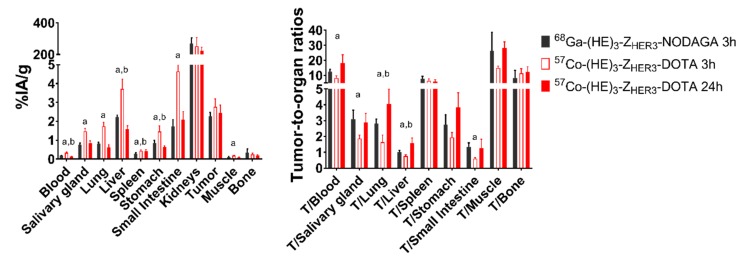
HER3-binding affibody molecules are a promising format for visualization of HER3 expression. Cobalt-55, a positron-emitting isotope, with a half-life of 17.5 h, allows for next-day imaging. We investigated the influence of the charge of the radiocobalt-chelator complex on the biodistribution of anti-HER3 affibody molecule (HE)-Z and compared the best radiocobalt-labeled variant with a recently optimized gallium-labeled variant. Affibody conjugates (HE)-Z-X (X = NOTA, NODAGA, DOTA, DOTAGA) were labeled with [Co]Co (surrogate for Co). Affinity measurements, binding specificity and cellular processing were studied in two HER3-expressing cancer cell lines. Biodistribution was studied 3 and 24 h post-injection (pi) in mice with HER3-expressing BxPC-3 xenografts and compared to [Ga]Ga-(HE)-Z-NODAGA. Micro-single-photon emission tomography/computed tomography (microSPECT/CT) and micro-positron emission tomography/computed tomography (microPET/CT) imaging was performed 3 and 24 h pi. Stably labeled conjugates bound to HER3 with subnanomolar affinity. [Co]Co-(HE)-Z-DOTA had the best tumor retention and a significantly lower concentration in blood than other conjugates, leading to superior tumor-to-blood and tumor-to-liver ratios 24 h pi. Compared to [Ga]Ga-(HE)-Z-NODAGA 3 h pi, [Co]Co-(HE)-Z-DOTA provided superior imaging contrast in liver 24 h pi. Concluding, the composition and charge of the [Co]Co-chelator complex influenced the uptake in tumors and normal tissue. [Co]Co-(HE)-Z-DOTA provided the best imaging properties among the cobalt-labeled conjugates. Delayed imaging of HER3 expression with [Co]Co-(HE)-Z-DOTA improved imaging contrast compared to early-time-point imaging with [Ga]Ga-(HE)-Z-NODAGA.
HER3 结合亲和体分子是可视化 HER3 表达的一种很有前途的形式。钴-55 是一种正电子发射同位素,半衰期为 17.5 小时,允许次日进行成像。我们研究了放射性钴螯合物复合物的电荷对抗 HER3 亲和体分子(HE)-Z 生物分布的影响,并比较了最佳放射性钴标记变体与最近优化的镓标记变体。亲和体缀合物(HE)-Z-X(X = NOTA、NODAGA、DOTA、DOTAGA)用 [Co]Co(Co 的替代物)标记。在两种表达 HER3 的癌细胞系中研究了亲和力测量、结合特异性和细胞处理。在荷有表达 HER3 的 BxPC-3 异种移植物的小鼠中,在注射后 3 和 24 小时(pi)研究了生物分布,并与 [Ga]Ga-(HE)-Z-NODAGA 进行了比较。在注射后 3 和 24 小时进行了微单光子发射断层扫描/计算机断层扫描(microSPECT/CT)和微正电子发射断层扫描/计算机断层扫描(microPET/CT)成像。稳定标记的缀合物以亚纳摩尔亲和力与 HER3 结合。[Co]Co-(HE)-Z-DOTA 具有最佳的肿瘤保留率和血液中浓度显著低于其他缀合物,导致 24 h pi 时肿瘤与血液和肿瘤与肝脏的比值更高。与 [Ga]Ga-(HE)-Z-NODAGA 相比,[Co]Co-(HE)-Z-DOTA 在 24 h pi 时在肝脏中提供了更好的成像对比度。结论是,[Co]Co-螯合物复合物的组成和电荷影响肿瘤和正常组织的摄取。[Co]Co-(HE)-Z-DOTA 在钴标记缀合物中提供了最佳的成像特性。与 [Ga]Ga-(HE)-Z-NODAGA 相比,用 [Co]Co-(HE)-Z-DOTA 进行延迟 HER3 表达成像可提高早期成像时的成像对比度。