Department of Cybernetics and Biomedical Engineering, Faculty of Electrical Engineering and Computer Science, VSB-Technical University of Ostrava, 17. listopadu 15, 708 33 Ostrava, Czech Republic.
Sensors (Basel). 2020 Mar 14;20(6):1618. doi: 10.3390/s20061618.
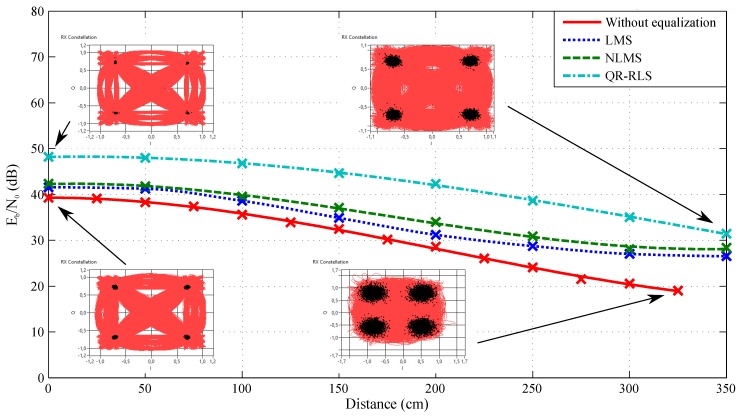
This paper focuses on a channel feed-forward software defined equalization (FSDE) of visible light communication (VLC) multistate quadrature amplitude modulation (M-QAM) based system, implemented in the LabVIEW programming environment. A highly modular platform is introduced; the whole experiment is simulated in software and then thoroughly explored and analyzed during practical measurements in the laboratory, simulating real-world situations. The whole platform is based on modified National Instruments software defined radios (NI SDR) and a commercially available Philips light source, often used in Czech government institutions. Three FSDE algorithms were tested: least mean squares (LMS), normalized least mean squares (NLMS), and QR decomposition based RLS (QR-RLS). Based on measurements, QR-RLS provides the best results, improving measured values by up to 10%. The experiments also show that the simulated results are very similar to real measurements, thus proving the validity of the chosen approach. The whole platform manages to improve measured data simply by making changes to the software side of the testing prototype.
本文主要关注基于可见光通信(VLC)多进制正交幅度调制(M-QAM)的信道前馈软件定义均衡(FSDE)系统,该系统在 LabVIEW 编程环境中实现。引入了一个高度模块化的平台;整个实验在软件中进行模拟,然后在实验室中的实际测量中进行深入探索和分析,模拟真实情况。整个平台基于修改后的 National Instruments 软件定义无线电(NI SDR)和商业上可用的飞利浦光源,该光源常用于捷克政府机构。测试了三种 FSDE 算法:最小均方(LMS)、归一化最小均方(NLMS)和基于 QR 分解的递归最小二乘(QR-RLS)。基于测量结果,QR-RLS 提供了最佳的结果,将测量值提高了 10%。实验还表明,模拟结果与实际测量非常相似,从而证明了所选择方法的有效性。整个平台通过更改测试原型的软件部分,成功地改善了测量数据。