Department of Geriatric Cardiology, Chinese PLA General Hospital, No. 28, Fuxing Road, Beijing, 100853, China.
Chinese People's Liberation Army Medical School, No. 28 Fuxing Road, Beijing, 100853, China.
Stem Cell Res Ther. 2020 Mar 17;11(1):122. doi: 10.1186/s13287-020-01633-7.
Diabetic cardiomyopathy (DCM) is a cardiac complication of long-term uncontrolled diabetes and is characterized by myocardial fibrosis and abnormal cardiac function. Mesenchymal stem cells (MSCs) are multipotent cells with immunoregulatory and secretory functions in diabetes and heart diseases. However, very few studies have focused on the effect and the underlying mechanism of MSCs on myocardial fibrosis in DCM. Therefore, we aimed to explore the therapeutic potential of MSCs in myocardial fibrosis and its underlying mechanism in vivo and in vitro.
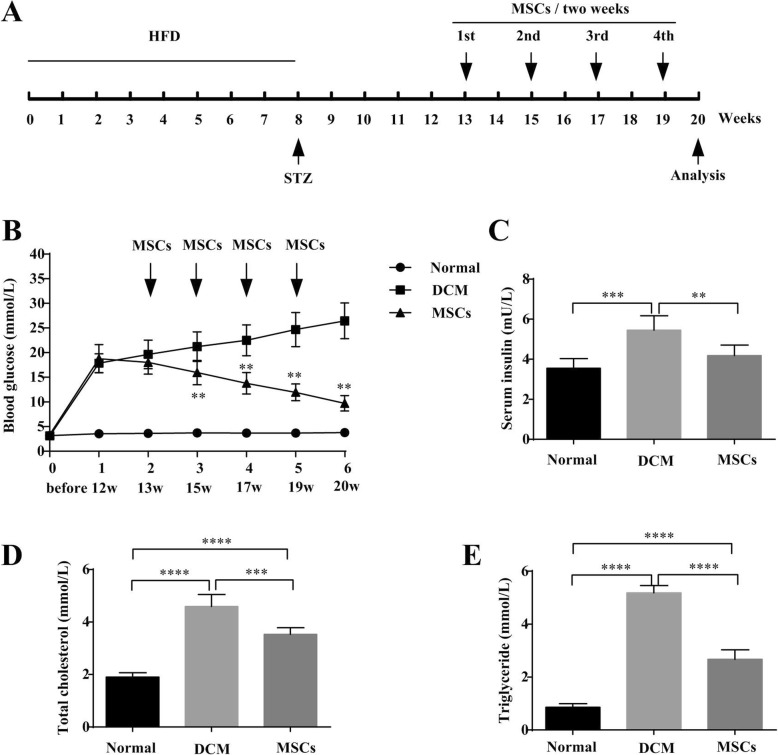
A DCM rat model was induced using a high-fat diet (HFD) combined with a low-dose streptozotocin (STZ) injection. After four infusions of MSCs, rat serum and heart tissues were collected, and the levels of blood glucose and lipid, cardiac structure, and function, and the degree of myocardial fibrosis including the expression levels of pro-fibrotic factor and collagen were analyzed using biochemical methods, echocardiography, histopathology, polymerase chain reaction (PCR), and enzyme-linked immunosorbent assay (ELISA). We infused prostaglandin E2 (PGE2)-deficient MSCs to DCM rats in vivo and established a system mimicking diabetic myocardial fibrosis in vitro by inducing cardiac fibroblasts with high glucose (HG) and coculturing them with MSCs or PGE2-deficient MSCs to further explore the underlying mechanism of amelioration of myocardial fibrosis by MSCs.
Metabolic abnormalities, myocardial fibrosis, and cardiac dysfunction in DCM rats were significantly ameliorated after treatment with MSCs. Moreover, the levels of TGF-β, collagen I, collagen III, and collagen accumulation were markedly decreased after MSC infusion compared to those in DCM hearts. However, PGE2-deficient MSCs had decreased ability to alleviate cardiac fibrosis and dysfunction. In addition, in vitro study revealed that the concentration of PGE2 in the MSC group was enhanced, while the proliferation and collagen secretion of cardiac fibroblasts were reduced after MSC treatment. However, MSCs had little effect on alleviating fibrosis when the fibroblasts were pretreated with cyclooxygenase-2 (COX-2) inhibitors, which also inhibited PGE2 secretion. This phenomenon could be reversed by adding PGE2.
Our results indicated that MSC infusion could ameliorate cardiac fibrosis and dysfunction in DCM rats. The underlying mechanisms might involve the function of PGE2 secreted by MSCs.
糖尿病心肌病(DCM)是长期未控制的糖尿病引起的心脏并发症,其特征为心肌纤维化和心功能异常。间充质干细胞(MSCs)是一种多能细胞,在糖尿病和心脏病中具有免疫调节和分泌功能。然而,很少有研究关注 MSCs 对 DCM 中心肌纤维化的作用及其潜在机制。因此,我们旨在体内和体外探索 MSCs 对心肌纤维化的治疗潜力及其潜在机制。
采用高脂饮食(HFD)联合小剂量链脲佐菌素(STZ)注射诱导 DCM 大鼠模型。给予 MSCs 四次输注后,收集大鼠血清和心脏组织,采用生化方法、超声心动图、组织病理学、聚合酶链反应(PCR)和酶联免疫吸附测定(ELISA)分析血糖和血脂水平、心脏结构和功能以及心肌纤维化程度,包括促纤维化因子和胶原蛋白的表达水平。我们将前列腺素 E2(PGE2)缺乏的 MSCs 输注到 DCM 大鼠体内,并通过高糖(HG)诱导心肌成纤维细胞并与 MSCs 或 PGE2 缺乏的 MSCs 共培养建立体外模拟糖尿病心肌纤维化的系统,进一步探讨 MSCs 改善心肌纤维化的潜在机制。
MSCs 治疗可显著改善 DCM 大鼠的代谢异常、心肌纤维化和心功能障碍。此外,与 DCM 心脏相比,MSCs 输注后 TGF-β、胶原 I、胶原 III 和胶原积累水平明显降低。然而,PGE2 缺乏的 MSCs 减轻心脏纤维化和功能障碍的能力降低。此外,体外研究显示 MSC 组 PGE2 浓度增加,而 MSC 处理后心肌成纤维细胞增殖和胶原分泌减少。然而,当成纤维细胞用环氧化酶-2(COX-2)抑制剂预处理时,MSCs 对减轻纤维化的作用很小,这也抑制了 PGE2 的分泌。添加 PGE2 可逆转这种现象。
我们的研究结果表明,MSC 输注可改善 DCM 大鼠的心肌纤维化和功能障碍。潜在机制可能涉及 MSC 分泌的 PGE2 功能。