Liu Yao-Chung, Lin Ting-An, Wang Hao-Yuan, Ko Po-Shen, Liu Chia-Jen, Hsiao Liang-Tsai, Chien Sheng-Hsuan, Gau Jyh-Pyng
Division of Haematology, Department of Medicine, Taipei Veterans General Hospital, No. 201, Section 2, Shipai Road, Beitou District, Taipei City, 112, Taiwan.
Faculty of Medicine, National Yang-Ming University, No. 155, Section 2, Linong St, Beitou District, Taipei City, 112, Taiwan.
J Med Case Rep. 2020 Mar 17;14(1):43. doi: 10.1186/s13256-020-02363-3.
Extranodal natural killer/T cell lymphoma, nasal type, is one of the more common subtypes of mature T cell lymphoma, especially in the Far East Asian population. This aggressive histologic subtype of peripheral T cell lymphomas is frequently susceptible to exposure of Epstein-Barr virus infection. The optimal treatment is not well elucidated. For stage IV disseminated extranodal natural killer/T cell lymphoma, induction chemotherapy with consolidative autologus or allogeneic hematopoietic stem cell transplantation is recommended as the major first-line treatment. However, there is controversy over which type of chemotherapy is most appropriate and effective as a bridge to autologus or allogeneic hematopoietic stem cell transplantation in patients with newly diagnosed disseminated advanced-stage or relapsed extranodal natural killer/T cell lymphoma because of cancer chemoresistance or associated complications. Pralatrexate is the first US Food and Drug Administration-approved novel agent for the treatment of refractory/recurrent peripheral T cell lymphomas. In our case, pralatrexate was used as a successful bridge to allogeneic hematopoietic stem cell transplantation in a patient with advanced-stage disseminated extranodal natural killer/T cell lymphoma refractory to first-line chemotherapy.
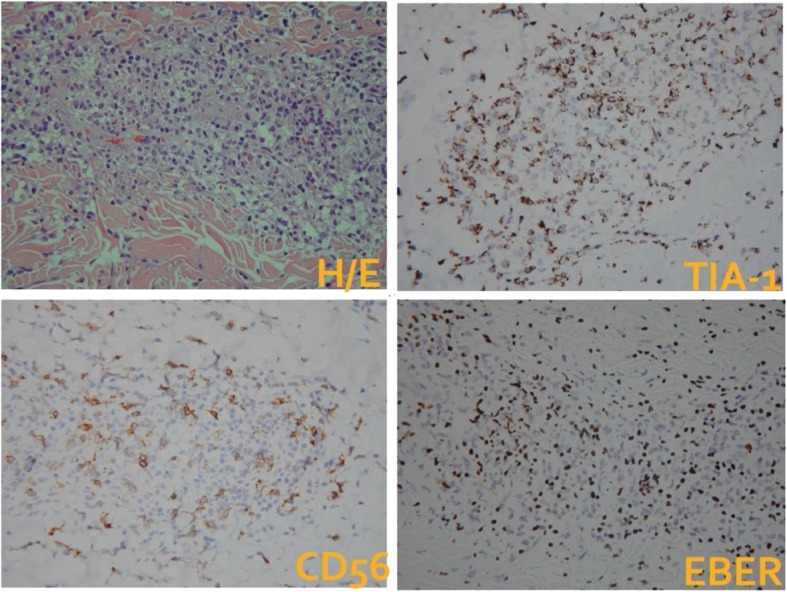
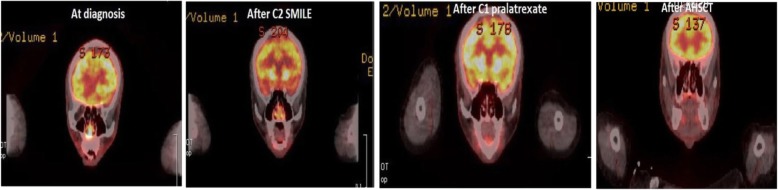
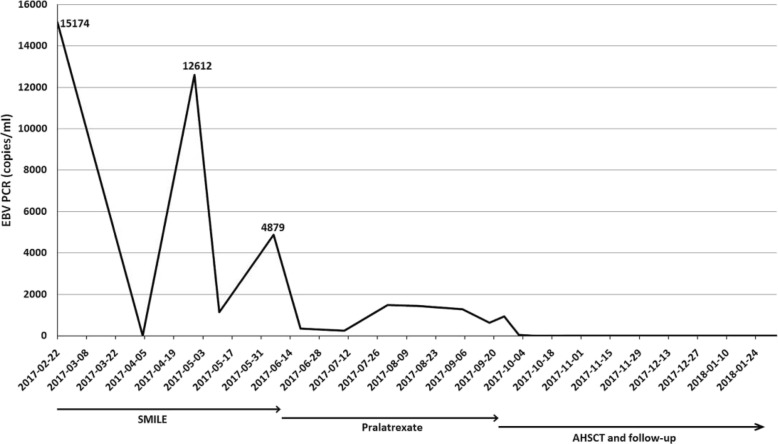
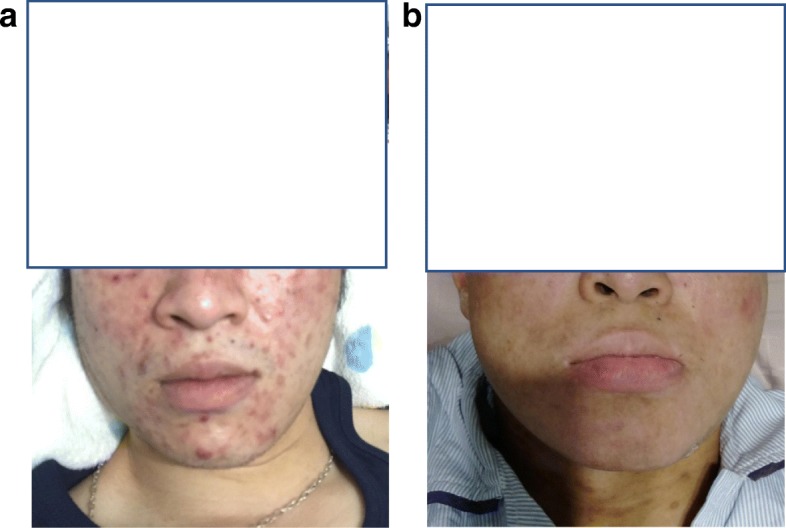
We presented a case report of a 29-year-old Asian man diagnosed as having stage IV disseminated extranodal natural killer/T cell lymphoma, nasal type, with skin and bone marrow involvement, whose disease was primary refractory to first-line dexamethasone, methotrexate, ifosfamide, L-asparaginase, and etoposide chemotherapy, but obviously responded to treatment with two cycles of single-agent pralatrexate treatment. Monitoring Epstein-Barr virus viremia revealed dramatic downregulation. In addition to complete remission of the involvement of bone marrow and nasal cavity, skin involvement also obtained partial remission. The extranodal natural killer/T cell lymphoma successfully achieved complete remission after a bridge to allogeneic hematopoietic stem cell transplantation.
This is the first study to present pralatrexate as a successful bridge to allogeneic hematopoietic stem cell transplantation in a 29-year-old Asian male patient with advanced-stage extranodal natural killer/T cell lymphoma refractory to first-line dexamethasone, methotrexate, ifosfamide, L-asparaginase, and etoposide chemotherapy. This case provides a novel treatment opinion for extranodal natural killer/T cell lymphoma, especially for the Far East Asian population.
结外自然杀伤/T细胞淋巴瘤,鼻型,是成熟T细胞淋巴瘤较常见的亚型之一,尤其在远东亚洲人群中。这种外周T细胞淋巴瘤的侵袭性组织学亚型常易受爱泼斯坦-巴尔病毒感染。最佳治疗方法尚未完全阐明。对于IV期播散性结外自然杀伤/T细胞淋巴瘤,推荐采用诱导化疗联合巩固性自体或异基因造血干细胞移植作为主要的一线治疗。然而,对于新诊断的播散性晚期或复发的结外自然杀伤/T细胞淋巴瘤患者,由于癌症化疗耐药或相关并发症,哪种化疗作为自体或异基因造血干细胞移植的桥梁最为合适和有效仍存在争议。普拉曲沙是首个获美国食品药品监督管理局批准用于治疗难治性/复发性外周T细胞淋巴瘤的新型药物。在我们的病例中,普拉曲沙被成功用于一名晚期播散性结外自然杀伤/T细胞淋巴瘤患者,该患者一线化疗难治,后成功接受异基因造血干细胞移植。
我们报告了一例29岁亚洲男性患者,诊断为IV期播散性结外自然杀伤/T细胞淋巴瘤,鼻型,累及皮肤和骨髓,其疾病对一线地塞米松、甲氨蝶呤、异环磷酰胺、L-天冬酰胺酶和依托泊苷化疗原发难治,但对两周期单药普拉曲沙治疗有明显反应。监测爱泼斯坦-巴尔病毒血症显示其显著下调。除骨髓和鼻腔受累完全缓解外,皮肤受累也获得部分缓解。该结外自然杀伤/T细胞淋巴瘤在接受异基因造血干细胞移植作为桥梁后成功实现完全缓解。
这是第一项报道普拉曲沙作为一名29岁晚期结外自然杀伤/T细胞淋巴瘤亚洲男性患者异基因造血干细胞移植成功桥梁的研究,该患者对一线地塞米松、甲氨蝶呤、异环磷酰胺、L-天冬酰胺酶和依托泊苷化疗难治。该病例为结外自然杀伤/T细胞淋巴瘤,尤其是远东亚洲人群提供了一种新的治疗观点。