Castillo Rodrigo L, Ibacache Mauricio, Cortínez Ignacio, Carrasco-Pozo Catalina, Farías Jorge G, Carrasco Rodrigo A, Vargas-Errázuriz Patricio, Ramos Daniel, Benavente Rafael, Torres Daniela Henríquez, Méndez Aníbal
Departamento de Medicina Interna Oriente, Facultad de Medicina, Universidad de Chile, Santiago, Chile.
Unidad de Paciente Crítico, Hospital del Salvador, Santiago, Chile.
Front Pharmacol. 2020 Feb 28;10:1641. doi: 10.3389/fphar.2019.01641. eCollection 2019.
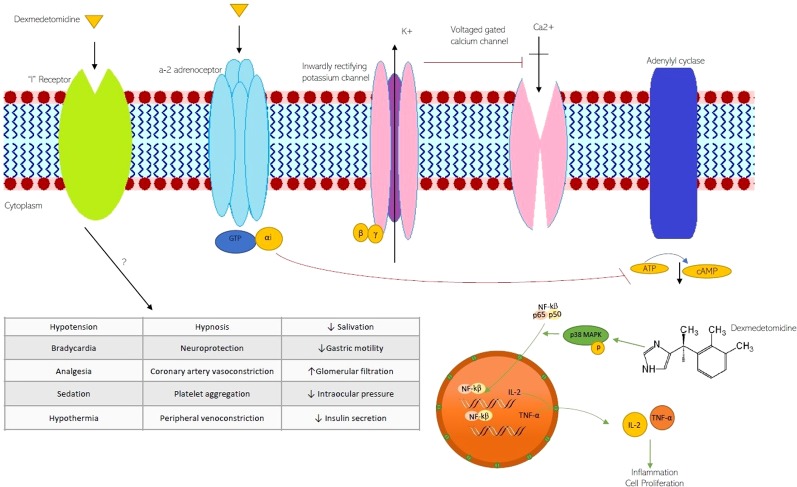
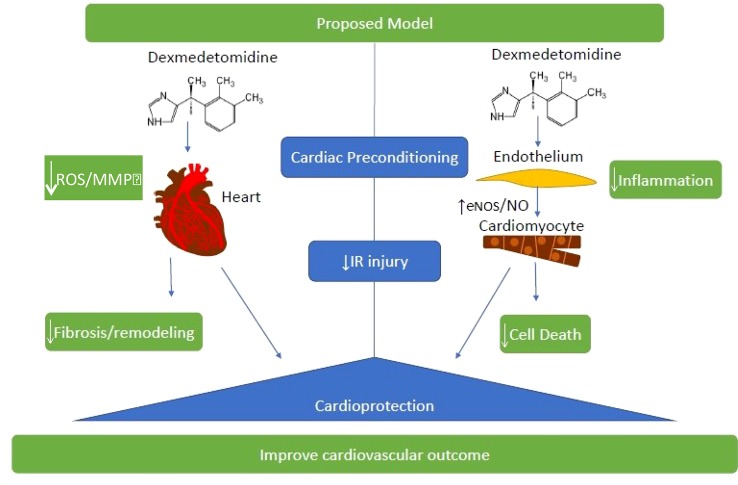
Dexmedetomidine (DEX) is a highly selective α2-adrenergic agonist with sedative and analgesic properties, with minimal respiratory effects. It is used as a sedative in the intensive care unit and the operating room. The opioid-sparing effect and the absence of respiratory effects make dexmedetomidine an attractive adjuvant drug for anesthesia in obese patients who are at an increased risk for postoperative respiratory complications. The pharmacodynamic effects on the cardiovascular system are known; however the mechanisms that induce cardioprotection are still under study. Regarding the pharmacokinetics properties, this drug is extensively metabolized in the liver by the uridine diphosphate glucuronosyltransferases. It has a relatively high hepatic extraction ratio, and therefore, its metabolism is dependent on liver blood flow. This review shows, from a basic clinical approach, the evidence supporting the use of dexmedetomidine in different settings, from its use in animal models of ischemia-reperfusion, and cardioprotective signaling pathways. In addition, pharmacokinetics and pharmacodynamics studies in obese subjects and the management of patients subjected to mechanical ventilation are described. Moreover, the clinical efficacy of delirium incidence in patients with indication of non-invasive ventilation is shown. Finally, the available evidence from DEX is described by a group of Chilean pharmacologists and clinicians who have worked for more than 10 years on DEX.
右美托咪定(DEX)是一种具有镇静和镇痛特性的高选择性α2肾上腺素能激动剂,对呼吸影响极小。它在重症监护病房和手术室用作镇静剂。右美托咪定的阿片类药物节省效应以及无呼吸抑制作用,使其成为肥胖患者麻醉的有吸引力的辅助药物,这些患者术后发生呼吸并发症的风险增加。其对心血管系统的药效学作用是已知的;然而,诱导心脏保护的机制仍在研究中。关于药代动力学特性,该药物在肝脏中由尿苷二磷酸葡萄糖醛酸转移酶广泛代谢。它具有相对较高的肝提取率,因此,其代谢依赖于肝血流量。本综述从基础临床角度展示了支持右美托咪定在不同场景中使用的证据,包括其在缺血再灌注动物模型中的应用以及心脏保护信号通路。此外,还描述了肥胖受试者的药代动力学和药效学研究以及接受机械通气患者的管理。此外,还展示了右美托咪定在无创通气适应症患者中谵妄发生率的临床疗效。最后,一组在右美托咪定方面工作了10多年的智利药理学家和临床医生描述了关于右美托咪定的现有证据。