Bizzaro Nicola
Laboratorio di Patologia Clinica, Ospedale San Antonio, Tolmezzo, Azienda Sanitaria Universitaria Integrata di Udine, Italy.
Mediterr J Rheumatol. 2019 Jun 29;30(2):86-89. doi: 10.31138/mjr.30.2.86. eCollection 2019 Jun.
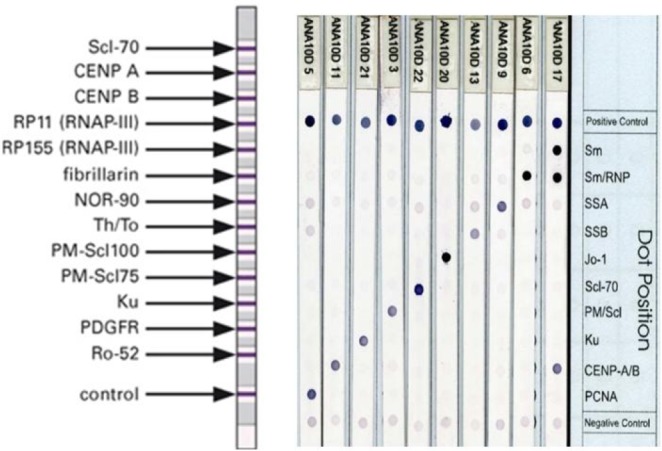
A paradigmatic feature of autoimmune rheumatic diseases (ARD) is the presence of multiple autoantibodies. The use of antibody profiles in the study of ARD therefore should be the best strategy for both diagnostic and classification purposes. To this end, systems using micronized components (protein chips or arrays), consisting of solid phase-linked autoantigens capable of simultaneously detecting many autoantibodies at the same time, are particularly suitable for testing autoantibody profiles. In the near future, extended disease-specific autoantibody profiles consisting of dozens, if not hundreds, of autoantibodies will be able to define each patient's autoantibody fingerprint and identify subclasses of patients with different prognostic characteristics and different therapeutic responses.
自身免疫性风湿性疾病(ARD)的一个典型特征是存在多种自身抗体。因此,在ARD研究中使用抗体谱应该是用于诊断和分类目的的最佳策略。为此,使用微粉化成分(蛋白质芯片或阵列)的系统,由能够同时检测多种自身抗体的固相连接自身抗原组成,特别适合检测自身抗体谱。在不久的将来,由数十种(甚至数百种)自身抗体组成的扩展的疾病特异性自身抗体谱将能够定义每个患者的自身抗体指纹,并识别具有不同预后特征和不同治疗反应的患者亚类。