Centre for Education, Faculty of Life Sciences and Medicine, King's College London, London, UK.
School of Life Sciences, University of Westminster, London, UK.
Mol Cell Biochem. 2020 May;468(1-2):121-128. doi: 10.1007/s11010-020-03716-8. Epub 2020 Mar 17.
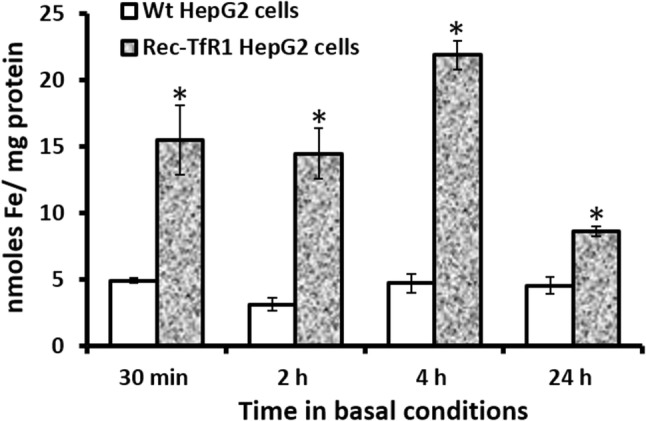
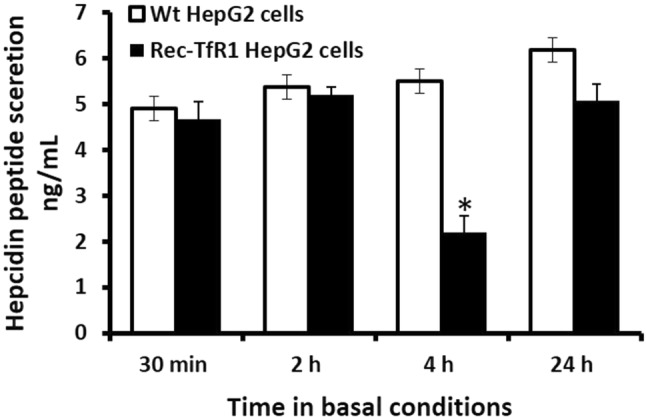
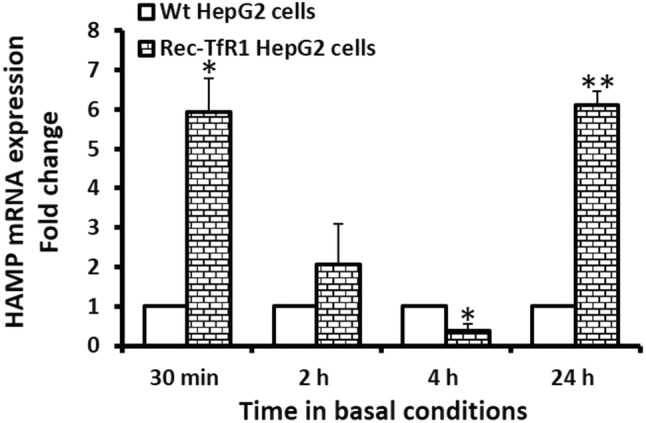
Hepcidin is the master regulator of systemic iron homeostasis and its dysregulation is observed in several chronic liver diseases. Unlike the extracellular iron-sensing mechanisms, the intracellular iron-sensing mechanisms in the hepatocytes that lead to hepcidin induction and secretion are incompletely understood. Here, we aimed to understand the direct role of intracellular iron-loading on hepcidin mRNA and peptide secretion using our previously characterised recombinant HepG2 cells that over-express the cell-surface iron-importer protein transferrin receptor-1. Gene expression of hepcidin (HAMP) was determined by real-time PCR. Intracellular iron levels and secreted hepcidin peptide levels were measured by ferrozine assay and immunoassay, respectively. These measurements were compared in the recombinant and wild-type HepG2 cells under basal conditions at 30 min, 2 h, 4 h and 24 h. Data showed that in the recombinant cells, intracellular iron content was higher than wild-type cells at 30 min (3.1-fold, p < 0.01), 2 h (4.6-fold, p < 0.01), 4 h (4.6-fold, p < 0.01) and 24 h (1.9-fold, p < 0.01). Hepcidin (HAMP) mRNA expression was higher than wild-type cells at 30 min (5.9-fold; p = 0.05) and 24 h (6.1-fold; p < 0.03), but at 4 h, the expression was lower than that in wild-type cells (p < 0.05). However, hepcidin secretion levels in the recombinant cells were similar to those in wild-type cells at all time-points, except at 4 h, when the level was lower than wild-type cells (p < 0.01). High intracellular iron in recombinant HepG2 cells did not proportionally increase hepcidin peptide secretion. This suggests a limited role of elevated intracellular iron in hepcidin secretion.
亚铁调素是系统性铁稳态的主要调节剂,其在几种慢性肝病中存在失调。与细胞外铁感应机制不同,导致铁调素诱导和分泌的肝细胞内铁感应机制尚不完全清楚。在这里,我们旨在使用先前鉴定的过表达细胞表面铁摄取蛋白转铁蛋白受体 1 的重组 HepG2 细胞,了解细胞内铁负荷对铁调素 mRNA 和肽分泌的直接作用。通过实时 PCR 确定铁调素 (HAMP) 的基因表达。通过 Ferrozine 测定法和免疫测定法分别测量细胞内铁水平和分泌的铁调素肽水平。在基础条件下,在 30 分钟、2 小时、4 小时和 24 小时比较重组和野生型 HepG2 细胞中的这些测量值。数据表明,在重组细胞中,细胞内铁含量在 30 分钟时(3.1 倍,p<0.01)、2 小时(4.6 倍,p<0.01)、4 小时(4.6 倍,p<0.01)和 24 小时(1.9 倍,p<0.01)高于野生型细胞。铁调素(HAMP)mRNA 表达在 30 分钟时(5.9 倍;p=0.05)和 24 小时时(6.1 倍;p<0.03)高于野生型细胞,但在 4 小时时,表达低于野生型细胞(p<0.05)。然而,重组细胞中的铁调素分泌水平在所有时间点均与野生型细胞相似,除了在 4 小时时,其水平低于野生型细胞(p<0.01)。重组 HepG2 细胞中的高细胞内铁并没有成比例地增加铁调素肽的分泌。这表明升高的细胞内铁在铁调素分泌中的作用有限。