Department of Pharmacology and Toxicology, Medical College of Georgia, Augusta University, Augusta, 30912, Georgia; Small Animal Behavior Core, Medical College of Georgia, Augusta University, Augusta, 30912, Georgia.
Department of Pharmacology and Toxicology, Medical College of Georgia, Augusta University, Augusta, 30912, Georgia; Small Animal Behavior Core, Medical College of Georgia, Augusta University, Augusta, 30912, Georgia.
Neuropharmacology. 2020 Jun 15;170:108053. doi: 10.1016/j.neuropharm.2020.108053. Epub 2020 Mar 15.
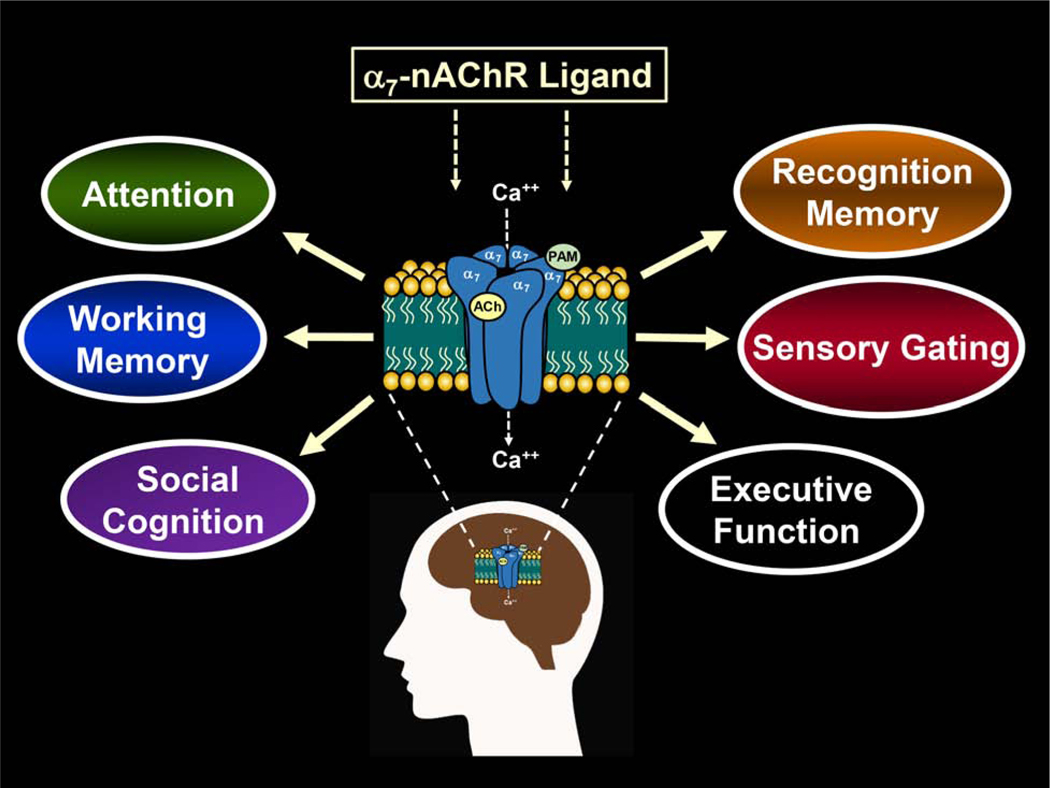
Schizophrenia is a devastating mental illness and its effective treatment is among the most challenging issues in psychiatry. The symptoms of schizophrenia are heterogeneous ranging from positive symptoms (e.g., delusions, hallucinations) to negative symptoms (e.g., anhedonia, social withdrawal) to cognitive dysfunction. Antipsychotics are effective at ameliorating positive symptoms in some patients; however, they are not reliably effective at improving the negative symptoms or cognitive impairments. The inability to address the cognitive impairments is a particular concern since they have the greatest long-term impact on functional outcomes. While decades of research have been devoted to the development of pro-cognitive agents for schizophrenia, to date, no drug has been approved for clinical use. Converging behavioral, neurobiological, and genetic evidence led to the identification of the α7-nicotinic acetylcholine receptor (α7-nAChR) as a therapeutic target several years ago and there is now extensive preclinical evidence that α7-nAChR ligands have pro-cognitive effects and other properties that should be beneficial to schizophrenia patients. However, like the other pro-cognitive strategies, no α7-nAChR ligand has been approved for clinical use in schizophrenia thus far. In this review, several topics are discussed that may impact the success of α7-nAChR ligands as pro-cognitive agents for schizophrenia including the translational value of the animal models used, clinical trial design limitations, confounding effects of polypharmacy, dose-effect relationships, and chronic versus intermittent dosing considerations. Determining the most optimal pharmacologic strategy at α7-nAChRs: agonist, positive allosteric modulator, or potentially even receptor antagonist is also discussed. article is part of the special issue on 'Contemporary Advances in Nicotine Neuropharmacology'.
精神分裂症是一种严重的精神疾病,其有效治疗是精神病学中最具挑战性的问题之一。精神分裂症的症状具有异质性,包括阳性症状(如妄想、幻觉)、阴性症状(如快感缺失、社交退缩)和认知功能障碍。抗精神病药在一些患者中有效改善阳性症状;然而,它们在改善阴性症状或认知障碍方面并不可靠。无法解决认知障碍是一个特别令人关注的问题,因为它们对功能结果的长期影响最大。尽管几十年来一直在致力于开发精神分裂症的认知增强药物,但迄今为止,没有一种药物被批准用于临床使用。行为、神经生物学和遗传证据的融合促使几年前确定了α7-烟碱型乙酰胆碱受体(α7-nAChR)作为一个治疗靶点,现在有大量的临床前证据表明,α7-nAChR 配体具有认知增强作用和其他对精神分裂症患者有益的特性。然而,与其他认知增强策略一样,到目前为止,还没有一种 α7-nAChR 配体被批准用于精神分裂症的临床使用。在这篇综述中,讨论了几个可能影响 α7-nAChR 配体作为精神分裂症认知增强剂的成功的因素,包括所使用的动物模型的转化价值、临床试验设计的局限性、多药治疗的混杂效应、剂量-效应关系以及慢性与间歇性给药的考虑因素。确定 α7-nAChR 上的最佳药物策略:激动剂、正变构调节剂,甚至可能是受体拮抗剂,也是讨论的内容之一。本文是“当代尼古丁神经药理学进展”特刊的一部分。