van Mourik M S, Velu J F, Lanting V R, Limpens J, Bouma B J, Piek J J, Baan J, Henriques J P S, Vis M M
Department of Cardiology, Amsterdam UMC, University of Amsterdam, Amsterdam Cardiovascular Sciences, Amsterdam, The Netherlands.
Medical Library, Amsterdam UMC, University of Amsterdam, Amsterdam, The Netherlands.
Neth Heart J. 2020 May;28(5):280-292. doi: 10.1007/s12471-020-01379-0.
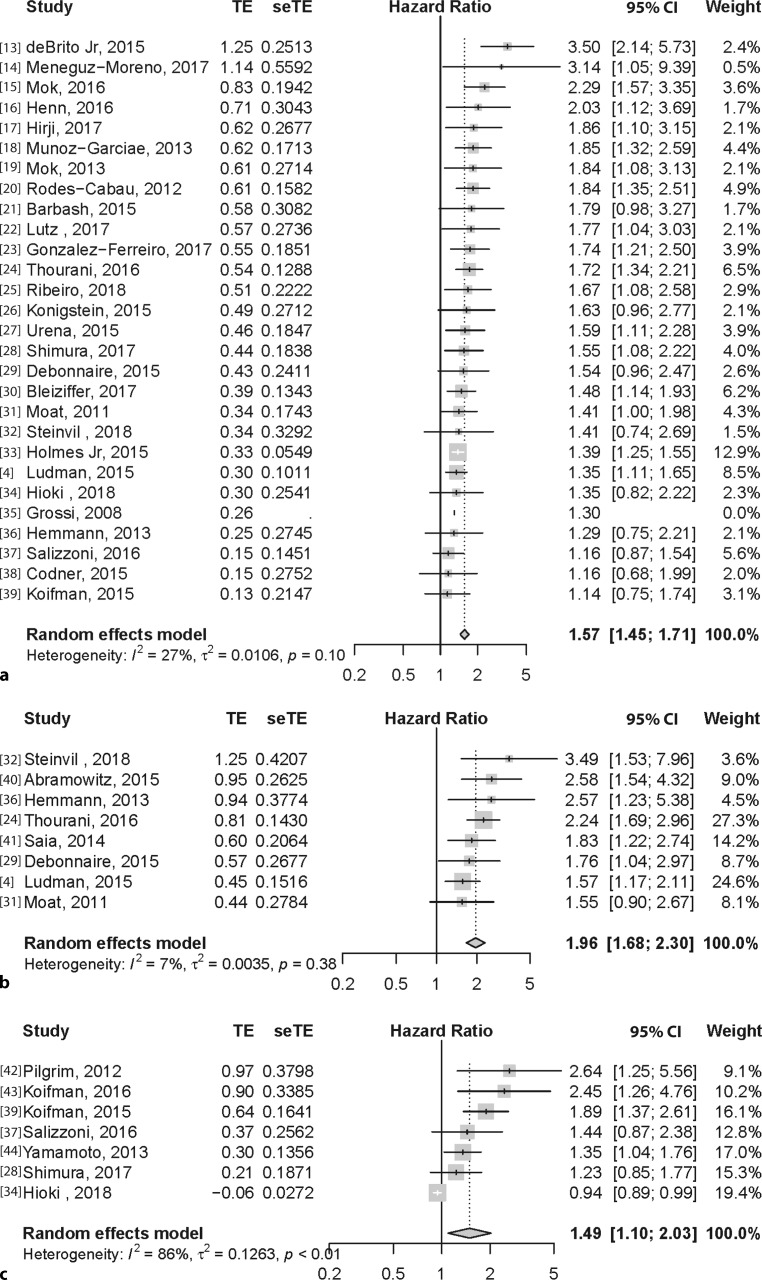
Guidelines suggest using frailty characteristics in the work-up for a transcatheter aortic valve implantation (TAVI). There are many frailty-screening tools with different components. The prognostic value of the individual parameters in frailty is as yet unclear. The objective of this systematic review and meta-analysis was to find and pool predictors for 1‑year mortality after TAVI. We followed a two-step approach. First, we searched for randomised controlled trials on TAVI to identify frailty parameters used in these studies. Second, we searched for publications on these frailty parameters. Articles were included for pooled analysis if the studied frailty parameters were dichotomised with clear cut-off values based on common standards or clinical practice and reported adjusted hazard ratios (HR) of 1‑year mortality after TAVI. We calculated pooled effect estimates of 49 studies based on dichotomised frailty scores (HR: 2.16, 95% CI: 1.57-3.00), chronic lung disease (HR: 1.57, 95% CI: 1.45-1.70), estimated glomerular filtration rate <30 ml/min (HR: 1.95, 95% CI: 1.68-2.29), body mass index <20 kg/m (HR: 1.49, 95% CI: 1.09-2.03), hypoalbuminaemia (HR: 1.77, 95% CI: 1.38-2.25), anaemia (HR: 2.08, 95% CI: 0.93-4.66), low gait speed (HR: 13.33, 95% CI: 1.75-101.49) and Katz activities of daily living (ADL) score of 1 or more deficits (HR: 5.16, 95% CI: 0.77-34.47). Chronic lung disease, chronic kidney disease, underweight, hypoalbuminaemia, a low frailty score, anaemia, low gait speed and an ADL deficiency were associated with worse 1‑year outcomes after TAVI.
指南建议在经导管主动脉瓣植入术(TAVI)的检查过程中使用衰弱特征。有许多具有不同组成部分的衰弱筛查工具。衰弱中各个参数的预后价值尚不清楚。本系统评价和荟萃分析的目的是寻找并汇总TAVI术后1年死亡率的预测因素。我们采用了两步法。首先,我们搜索了关于TAVI的随机对照试验,以确定这些研究中使用的衰弱参数。其次,我们搜索了关于这些衰弱参数的出版物。如果所研究的衰弱参数根据通用标准或临床实践进行二分法划分,并具有明确的临界值,且报告了TAVI术后1年死亡率的调整风险比(HR),则纳入这些文章进行汇总分析。我们基于二分法衰弱评分(HR:2.16,95%CI:1.57 - 3.00)、慢性肺病(HR:1.57,95%CI:1.45 - 1.70)、估计肾小球滤过率<30 ml/min(HR:1.95,95%CI:1.68 - 2.29)、体重指数<20 kg/m(HR:1.49,95%CI:1.09 - 2.03)、低白蛋白血症(HR:1.77,95%CI:1.38 - 2.25)、贫血(HR:2.08,95%CI:0.93 - 4.66)、低步速(HR:13.33,95%CI:1.75 - 101.49)和Katz日常生活活动(ADL)评分有1项或更多缺陷(HR:5.16,95%CI:0.77 - 34.47)计算了49项研究的汇总效应估计值。慢性肺病、慢性肾病、体重过轻、低白蛋白血症、低衰弱评分、贫血、低步速和ADL缺陷与TAVI术后较差的1年结局相关。