Aaltonen Niina, Singha Prosanta K, Jakupović Hermina, Wirth Thomas, Samaranayake Haritha, Pasonen-Seppänen Sanna, Rilla Kirsi, Varjosalo Markku, Edgington-Mitchell Laura E, Kasperkiewicz Paulina, Drag Marcin, Kälvälä Sara, Moisio Eemeli, Savinainen Juha R, Laitinen Jarmo T
1Institute of Biomedicine, University of Eastern Finland (UEF), POB 1627, FI-70211 Kuopio, Finland.
Aurealis Pharma, Kuopio, Finland.
Biol Proced Online. 2020 Mar 15;22:6. doi: 10.1186/s12575-020-00118-4. eCollection 2020.
Serine hydrolases (SHs) are a functionally diverse family of enzymes playing pivotal roles in health and disease and have emerged as important therapeutic targets in many clinical conditions. Activity-based protein profiling (ABPP) using fluorophosphonate (FP) probes has been a powerful chemoproteomic approach in studies unveiling roles of SHs in various biological systems. ABPP utilizes cell/tissue proteomes and features the FP-warhead, linked to a fluorescent reporter for in-gel fluorescence imaging or a biotin tag for streptavidin enrichment and LC-MS/MS-based target identification. Existing ABPP approaches characterize global SH activity based on mobility in gel or MS-based target identification and cannot reveal the identity of the cell-type responsible for an individual SH activity originating from complex proteomes.
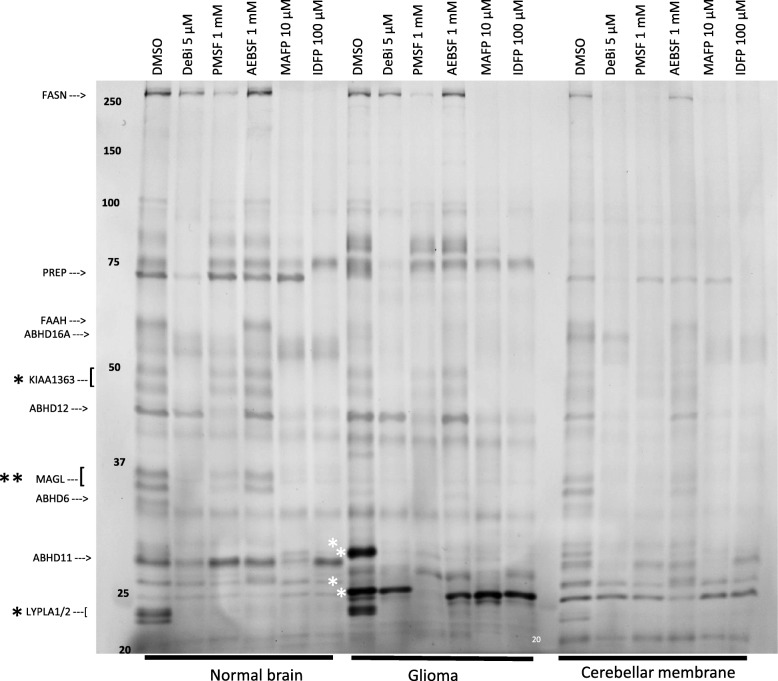
Here, by using an activity probe with broad reactivity towards the SH family, we advance the ABPP methodology to glioma brain cryosections, enabling for the first time high-resolution confocal fluorescence imaging of global SH activity in the tumor microenvironment. Tumor-associated cell types were identified by extensive immunohistochemistry on activity probe-labeled sections. Tissue-ABPP indicated heightened SH activity in glioma vs. normal brain and unveiled activity hotspots originating from tumor-associated neutrophils (TANs), rather than tumor-associated macrophages (TAMs). Thorough optimization and validation was provided by parallel gel-based ABPP combined with LC-MS/MS-based target verification.
Our study advances the ABPP methodology to tissue sections, enabling high-resolution confocal fluorescence imaging of global SH activity in anatomically preserved complex native cellular environment. To achieve global portrait of SH activity throughout the section, a probe with broad reactivity towards the SH family members was employed. As ABPP requires no a priori knowledge of the identity of the target, we envisage no imaginable reason why the presently described approach would not work for sections regardless of species and tissue source.
丝氨酸水解酶(SHs)是一类功能多样的酶家族,在健康和疾病中发挥着关键作用,并已成为许多临床病症中的重要治疗靶点。使用氟膦酸盐(FP)探针的基于活性的蛋白质谱分析(ABPP)是一种强大的化学蛋白质组学方法,可用于揭示SHs在各种生物系统中的作用。ABPP利用细胞/组织蛋白质组,并以FP弹头为特征,该弹头与用于凝胶内荧光成像的荧光报告基团或用于链霉亲和素富集和基于LC-MS/MS的靶标鉴定的生物素标签相连。现有的ABPP方法基于凝胶迁移率或基于MS的靶标鉴定来表征整体SH活性,无法揭示源自复杂蛋白质组的单个SH活性的细胞类型。
在这里,通过使用对SH家族具有广泛反应性的活性探针,我们将ABPP方法推进到胶质瘤脑冰冻切片,首次实现了肿瘤微环境中整体SH活性的高分辨率共聚焦荧光成像。通过对活性探针标记的切片进行广泛的免疫组织化学鉴定肿瘤相关细胞类型。组织ABPP表明胶质瘤中的SH活性高于正常脑,并揭示了源自肿瘤相关中性粒细胞(TANs)而非肿瘤相关巨噬细胞(TAMs)的活性热点。通过基于凝胶的平行ABPP结合基于LC-MS/MS的靶标验证提供了全面的优化和验证。
我们的研究将ABPP方法推进到组织切片,能够在解剖学保存的复杂天然细胞环境中对整体SH活性进行高分辨率共聚焦荧光成像。为了获得整个切片中SH活性的全局图像,采用了对SH家族成员具有广泛反应性的探针。由于ABPP不需要对靶标的身份有先验知识,我们设想不出任何理由说明目前所描述的方法不适用于任何物种和组织来源的切片。