Assadi Majid, Rezaei Samira, Jafari Esmail, Rekabpour Seyed Javad, Ravanbod Mohammad Reza, Zohrabi Farshad, Amini AbdulLatif, Keshmiri Saeid, Dadgar Habibollah, Ahmadzadehfar Hojjat
Department of Molecular Imaging and Radionuclide Therapy (MIRT), The Persian Gulf Nuclear Medicine Research Center, Bushehr University of Medical Sciences, Bushehr, Iran.
Department of Oncology, Bushehr Medical University Hospital, Bushehr University of Medical Sciences, Bushehr, Iran.
World J Nucl Med. 2020 Feb 27;19(1):15-20. doi: 10.4103/wjnm.WJNM_20_19. eCollection 2020 Jan-Mar.
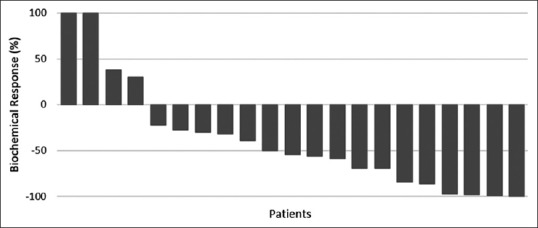
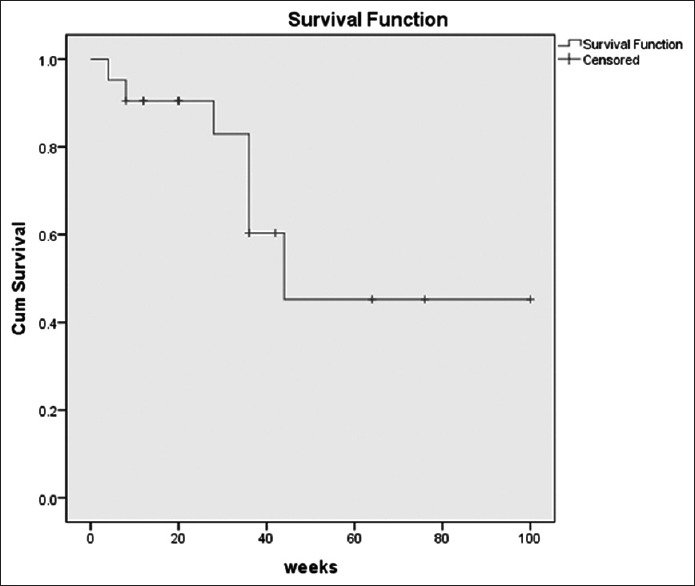
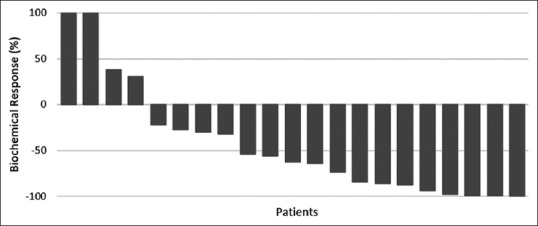
In recent years, lutetium-177 (Lu)-labeled prostate-specific membrane antigen (PSMA)-617 has become a promising new therapeutic agent in patients with metastatic castration-resistant prostate cancer (mCRPC). In this study, we report on an early experience of Lu-PSMA therapy with an evaluation of its efficacy and safety in mCRPC patients. Twenty-one mCRPC patients with a mean age of 70.3 ± 9.6 (54-88)-year-old were treated with one to four therapy cycles (median two cycles) and administered activity of 3.7-29.6 GBq (mean of 15.4 GBq). A prostate-specific antigen (PSA) decline ≥ 50% was considered to be a biochemical response (BCR). To evaluate the clinical response, the Eastern Cooperative Oncology Group (ECOG) status was used. Within 2 weeks before and 1 and 2 months after each therapy cycle, hematology, renal function, liver status, alkaline phosphatase, and PSA were checked. The Common Terminology Criteria for Adverse Events was used for grading adverse events induced by Lu-PSMA. Furthermore, overall survival (OS) was calculated and analyzed. During the treatment, a BCR was seen in 62% of patients; 19% of patients showed progression and 19% of patients showed stable disease. ECOG status was improved after treatment, and OS was 62.7 weeks. After the treatment, two patients showed Grade II toxicity of white blood cells, Grade I thrombocytopenia was observed in two patients, one patient showed Grade II toxicity in serum creatinine and transient Grade I toxicity in creatinine was seen in two patients. In total, our initial experience demonstrates that Lu-PSMA therapy has the potential to positively affect the development and maturation of radioligand practices in selected mCRPC patients, even in resource limited, developing country environments. However, some challenges, such as practitioner training, poor initial acceptance by colleagues and financial concerns, particularly in developing nations, still exist.
近年来,镥 - 177(Lu)标记的前列腺特异性膜抗原(PSMA)-617已成为转移性去势抵抗性前列腺癌(mCRPC)患者一种有前景的新型治疗药物。在本研究中,我们报告了Lu-PSMA治疗的早期经验,并评估了其在mCRPC患者中的疗效和安全性。21例mCRPC患者,平均年龄70.3±9.6(54 - 88)岁,接受了1至4个治疗周期(中位数为2个周期)的治疗,给予的活度为3.7 - 29.6 GBq(平均15.4 GBq)。前列腺特异性抗原(PSA)下降≥50%被认为是生化反应(BCR)。为评估临床反应,采用东部肿瘤协作组(ECOG)状态。在每个治疗周期前2周以及治疗后1个月和2个月,检查血液学、肾功能、肝脏状况、碱性磷酸酶和PSA。采用不良事件通用术语标准对Lu-PSMA诱导的不良事件进行分级。此外,计算并分析总生存期(OS)。治疗期间,62%的患者出现BCR;19%的患者病情进展,19%的患者病情稳定。治疗后ECOG状态有所改善,OS为62.7周。治疗后,2例患者出现白细胞Ⅱ级毒性,2例患者观察到Ⅰ级血小板减少,1例患者出现血清肌酐Ⅱ级毒性,2例患者出现肌酐短暂Ⅰ级毒性。总的来说,我们的初步经验表明,即使在资源有限的发展中国家环境中,Lu-PSMA治疗也有可能对选定的mCRPC患者放射性配体实践的发展和成熟产生积极影响。然而,一些挑战仍然存在,如从业者培训、同事最初接受度低以及财务问题,特别是在发展中国家。