Sueangoen Natthaporn, Tantiwetrueangdet Anchalee, Panvichian Ravat
Research Center, Faculty of Medicine, Ramathibodi Hospital, Mahidol University, Bangkok, Thailand.
Department of Internal Medicine, Division of Medical Oncology, Faculty of Medicine, Ramathibodi Hospital, Mahidol University, Rama 6 Road, Ratchathewi, Bangkok, 10400 Thailand.
Cell Biosci. 2020 Mar 16;10:41. doi: 10.1186/s13578-020-00407-1. eCollection 2020.
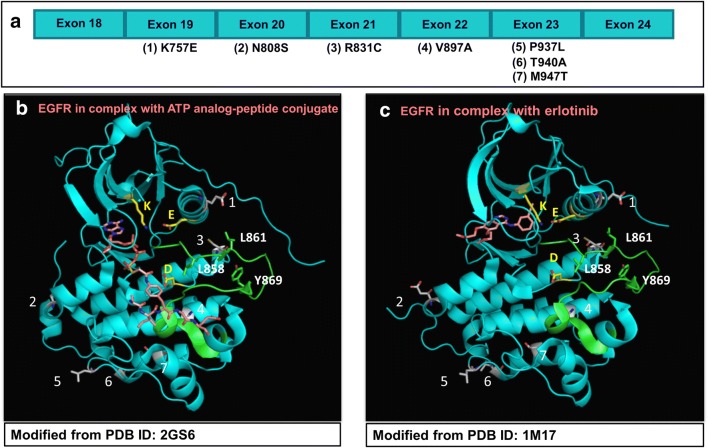
Epidermal growth factor receptor (EGFR) has emerged as an important therapeutic target. Overexpression of EGFR is frequently observed in hepatocellular carcinoma (HCC) and EGFR activation has been proven to be a potential determinant of primary resistance of HCC cells to sorafenib. In our previous study, we found 13 missense mutations in EGFR exon 19-23 from hepatocellular carcinoma (HCC) tissues, but the functions of these mutations have not been determined. This study aims to determine the kinase activity and sensitivity to erlotinib, a 1st-generation EGFR-tyrosine kinase inhibitor (TKI), of seven HCC-derived mutants (K757E, N808S, R831C, V897A, P937L, T940A, and M947T).
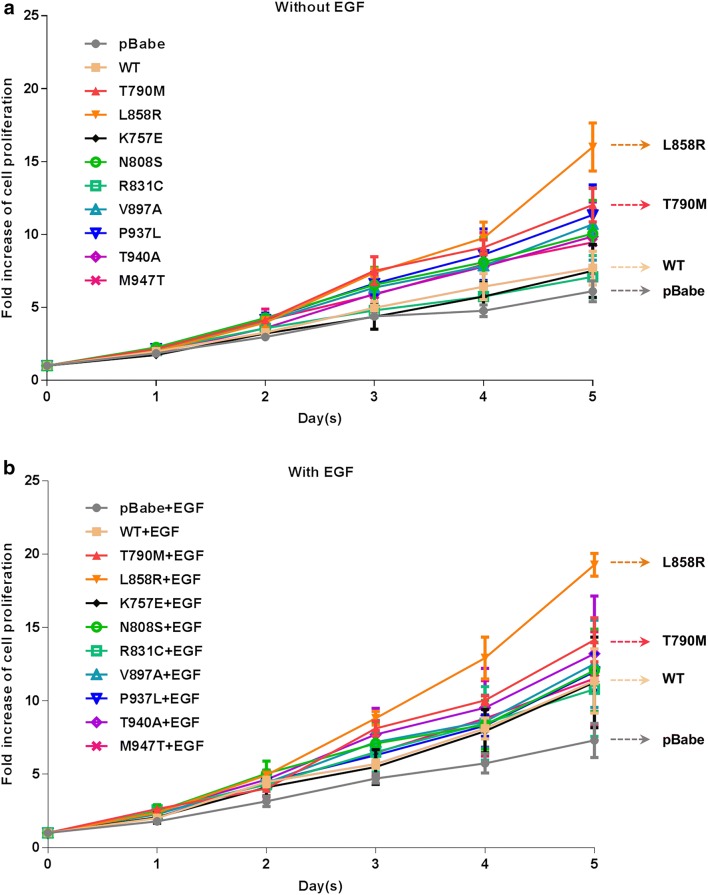
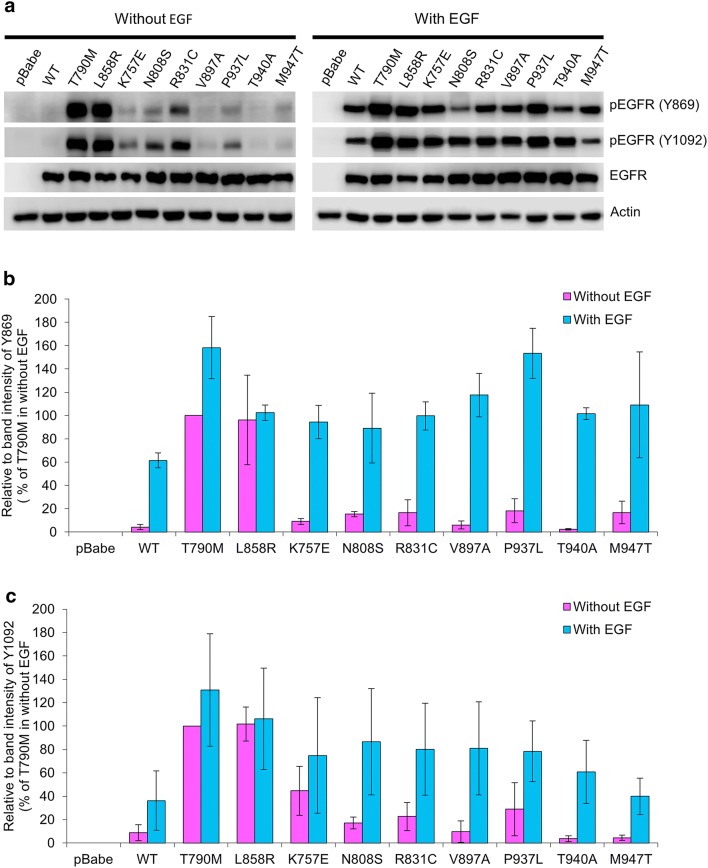
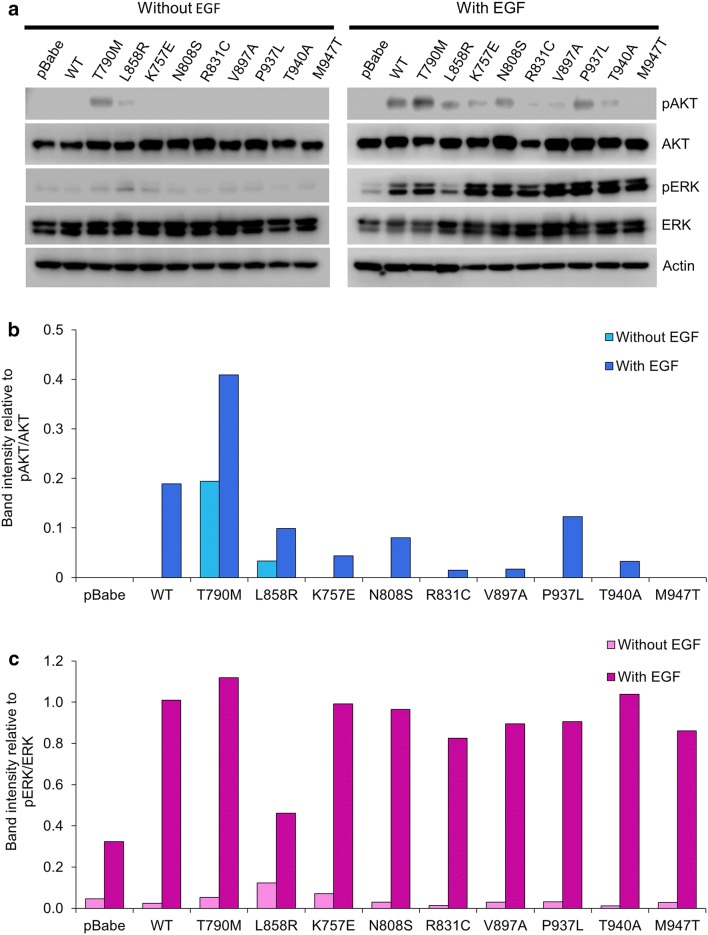
Using transduction of pBabe-puro retroviral vector with or without EGFR, we constructed and determined the function of EGFRs in NIH-3T3 cells stably harboring each of the seven mutants, as well as the erlotinib-sensitive L858R-mutant, the erlotinib-resistant T790M-mutant, and EGFR wild type (WT). Our results indicate that the seven mutants are functioning, EGF-dependent, EGFRs. Cells harboring six of the seven mutants could generate some level of EGFR phosphorylation in the absence of EGF, indicating some constitutive kinase activity, but all of the seven mutants remain primarily EGF-dependent. Our results demonstrate that erlotinib induces differential degree of apoptosis and autophagy among cells harboring different EGFRs: complete apoptosis and autophagy (cleavage of both caspase-3 and PARP, and marked LC3-II increment) in L858R-mutant; partial apoptosis and autophagy (only cleavage of caspase-3, and moderate LC3-II increment) in WT and HCC-derived mutants; and no apoptosis and minimal autophagy (no cleavage of caspase-3 and PARP, and minimal LC3-II increment) in T790M-mutant. The seven HCC-derived mutants are erlotinib-resistant, as treatment with erlotinib up to high concentration could only induce partial inhibition of EGFR phosphorylation, partial or no inhibition of AKT and ERK phosphorylation, and partial apoptosis and autophagy.
The seven HCC-derived EGFR mutants in this study are functioning, EGF-dependent, and erlotinib-resistant. Erlotinib induces differential degree of apoptosis and autophagy among cells harboring different EGFRs. The degree of inhibition of EGFR phosphorylation by erlotinib is the determining factor for the degree of apoptosis and autophagy amongst cells harboring EGFR mutants. This study paves the way for further investigation into the sensitivity of these HCC-derived mutants to the 3rd-generation irreversible EGFR-TKI, osimertinib.
表皮生长因子受体(EGFR)已成为一个重要的治疗靶点。EGFR的过表达在肝细胞癌(HCC)中经常被观察到,并且EGFR激活已被证明是HCC细胞对索拉非尼原发性耐药的一个潜在决定因素。在我们之前的研究中,我们在肝细胞癌(HCC)组织的EGFR外显子19 - 23中发现了13个错义突变,但这些突变的功能尚未确定。本研究旨在确定7个源自HCC的突变体(K757E、N808S、R831C、V897A、P937L、T940A和M947T)的激酶活性以及对第一代EGFR酪氨酸激酶抑制剂(TKI)厄洛替尼的敏感性。
通过转导携带或不携带EGFR的pBabe - puro逆转录病毒载体,我们构建并确定了稳定携带这7个突变体以及厄洛替尼敏感的L858R突变体、厄洛替尼耐药的T790M突变体和EGFR野生型(WT)的NIH - 3T3细胞中EGFR的功能。我们的结果表明,这7个突变体是有功能的、依赖表皮生长因子(EGF)的EGFR。携带7个突变体中6个的细胞在没有EGF的情况下可以产生一定水平的EGFR磷酸化,表明有一些组成性激酶活性,但所有7个突变体仍然主要依赖EGF。我们的结果表明,厄洛替尼在携带不同EGFR的细胞中诱导不同程度的凋亡和自噬:L858R突变体中完全凋亡和自噬(半胱天冬酶 - 3和聚(ADP - 核糖)聚合酶(PARP)均裂解,且LC3 - II显著增加);野生型和源自HCC的突变体中部分凋亡和自噬(仅半胱天冬酶 - 3裂解,且LC3 - II适度增加);T790M突变体中无凋亡且自噬极少(半胱天冬酶 - 3和PARP未裂解,且LC3 - II增加极少)。这7个源自HCC的突变体对厄洛替尼耐药,因为用高浓度厄洛替尼处理只能诱导EGFR磷酸化的部分抑制、AKT和ERK磷酸化的部分或无抑制以及部分凋亡和自噬。
本研究中的7个源自HCC的EGFR突变体是有功能的、依赖EGF的且对厄洛替尼耐药。厄洛替尼在携带不同EGFR的细胞中诱导不同程度的凋亡和自噬。厄洛替尼对EGFR磷酸化的抑制程度是携带EGFR突变体的细胞中凋亡和自噬程度的决定因素。本研究为进一步研究这些源自HCC的突变体对第三代不可逆EGFR - TKI奥希替尼的敏感性铺平了道路。