Saha Rony Kumer
Radio and Spectrum Laboratory, KDDI Research Inc., 2-1-15 Ohara, Fujimino-shi, Saitama 356-8502, Japan.
Sensors (Basel). 2020 Mar 17;20(6):1676. doi: 10.3390/s20061676.
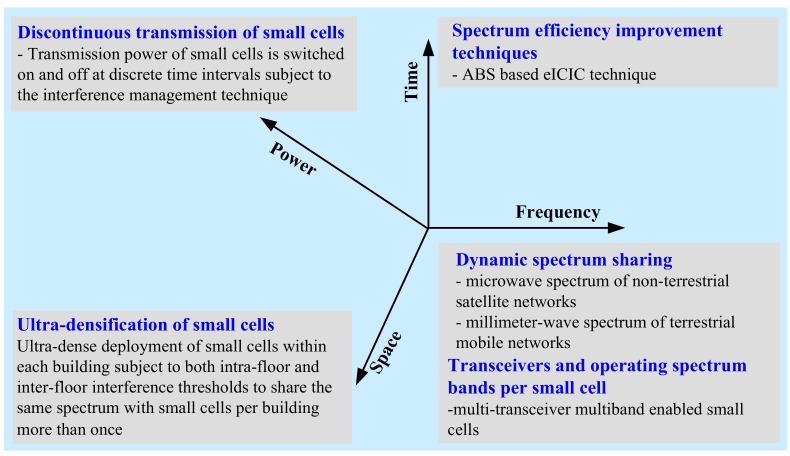
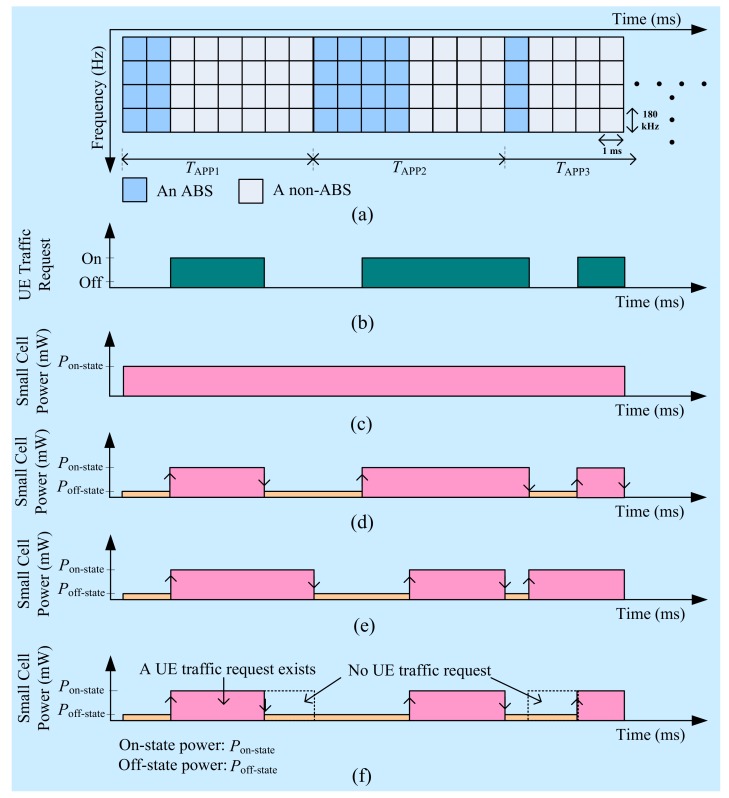
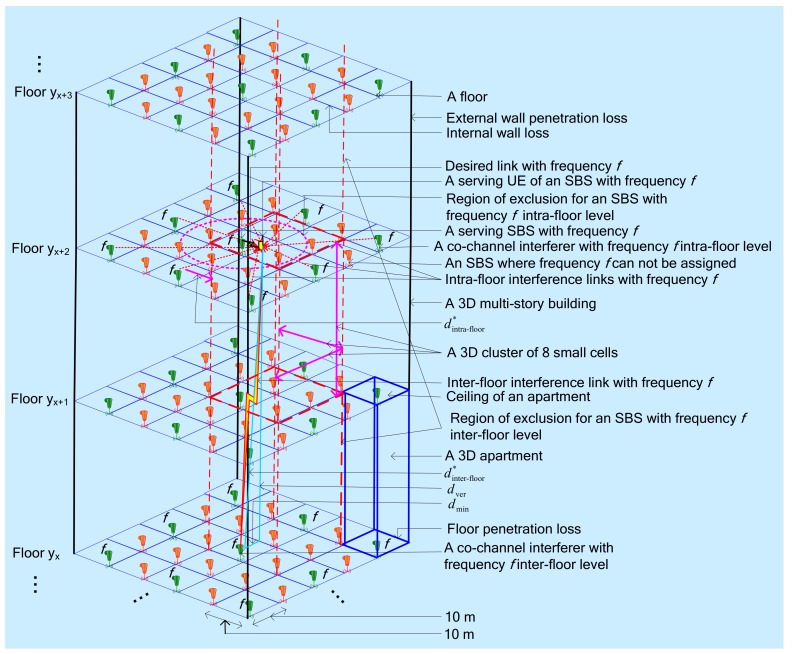
Addressing high capacity at low power as a key design goal envisages achieving high spectral efficiency (SE) and energy efficiency (EE) for the next-generation mobile networks. Because most data are generated in indoor environments, an ultra-dense deployment of small cells (SCs), particularly within multistory buildings in urban areas, is revealed as an effective technique to improve SE and EE by numerous studies. In this paper, we present a framework exploiting the four most interconnected-domain, including, power, time, frequency, and space, in the perspectives of SE and EE. Unlike existing literature, the framework takes advantage of higher degrees of freedom to maximize SE and EE using in-building SCs for 5G and beyond mobile networks. We derive average capacity, SE, and EE metrics, along with defining the condition for optimality of SE and EE and developing an algorithm for the framework. An extensive system-level evaluation is performed to show the impact of each domain on SE and EE. It is shown that employing multiband enabled SC base stations (SBSs) to increase operating spectrum in frequency-domain, reusing spectrum to SBSs more than once per building in spatial-domain, switching on and off each in-building SBS based on traffic availability to reduce SBS power consumption in power-domain, and using eICIC to avoid co-channel interference due to sharing spectrum with SBSs in time-domain can achieve massive SE and EE. Finally, we show that the proposed framework can satisfy SE, EE, as well as user experience data rate requirements for 5G and beyond mobile networks.
将低功耗下的高容量作为关键设计目标,旨在为下一代移动网络实现高频谱效率(SE)和高能效(EE)。由于大多数数据在室内环境中产生,众多研究表明,超密集部署小小区(SCs),尤其是在城市地区的多层建筑内,是提高SE和EE的有效技术。在本文中,我们从SE和EE的角度提出了一个利用四个最相互关联领域(包括功率、时间、频率和空间)的框架。与现有文献不同,该框架利用更高的自由度,通过用于5G及以后移动网络的室内SCs来最大化SE和EE。我们推导了平均容量、SE和EE指标,同时定义了SE和EE最优性的条件,并为该框架开发了一种算法。进行了广泛的系统级评估,以展示每个领域对SE和EE的影响。结果表明,采用支持多频段的SC基站(SBS)在频域增加工作频谱,在空间域中每个建筑物内多次复用频谱给SBS,根据流量可用性打开和关闭每个室内SBS以降低功率域中的SBS功耗,以及在时域中使用增强型小区间干扰协调(eICIC)来避免由于与SBS共享频谱而产生的同信道干扰,可以实现大规模的SE和EE。最后,我们表明所提出的框架可以满足5G及以后移动网络的SE、EE以及用户体验数据速率要求。