Capehorn Matthew, Ghani Yasmin, Hindsberger Charlotte, Johansen Pierre, Jódar Esteban
Rotherham Institute for Obesity (RIO), Clifton Medical Centre, Rotherham, South Yorkshire, UK.
Novo Nordisk A/S, London, UK.
Diabetes Ther. 2020 May;11(5):1061-1075. doi: 10.1007/s13300-020-00796-z. Epub 2020 Mar 19.
Despite treatment with oral antidiabetic drugs (OADs), achieving effective glycaemic control in type 2 diabetes (T2D) remains a challenge. The objective of this post hoc analysis of data from the SUSTAIN 2, 3, 4 and 10 active-controlled trials was to assess the efficacy and safety of the once-weekly glucagon-like peptide 1 receptor agonist (GLP-1RA) semaglutide in patients on background treatment with metformin (MET), with or without a sulphonylurea (SU).
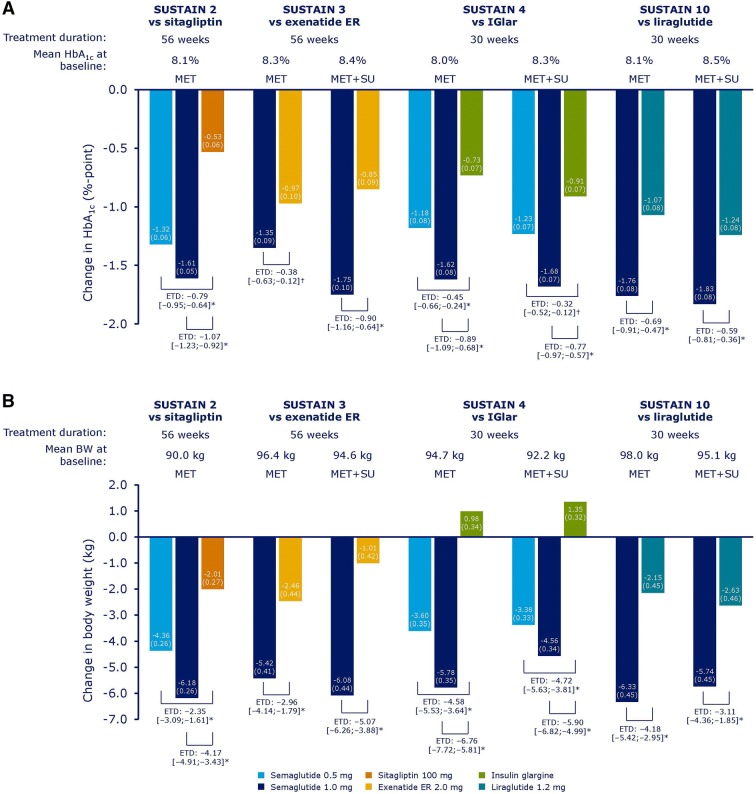
Data from the randomised phase 3 trials SUSTAIN 2, 3, 4 and 10 for subjects who received background MET alone or MET + SU were analysed. Change from baseline in HbA and body weight at the end of treatment visit (week 30 in SUSTAIN 4 and 10, week 56 in SUSTAIN 2 and 3), and rates of hypoglycaemia and adverse events leading to premature treatment discontinuation were assessed.
In total, 3411 subjects were included in the full analysis set (3410 in the safety analysis set). Across the four trials, semaglutide significantly reduced HbA (estimated treatment difference [ETD] - 0.32 to - 0.79%-points for semaglutide 0.5 mg, and - 0.38 to - 1.07%-points for semaglutide 1.0 mg vs comparators; p < 0.01) in subjects receiving both MET and MET + SU. Regardless of background OAD, semaglutide significantly reduced body weight (ETD - 2.35 to - 4.72 kg for semaglutide 0.5 mg, and - 2.96 to - 6.76 kg for semaglutide 1.0 mg vs comparators; p < 0.0001). Across the trials, hypoglycaemic events were more common with background MET + SU than MET alone, in subjects receiving either semaglutide or a comparator. The rate of adverse events (AEs) leading to premature treatment discontinuations in subjects treated with semaglutide were generally consistent regardless of background therapy.
Semaglutide 0.5 mg and 1.0 mg significantly improve glycaemic control (HbA) and body weight in subjects with T2D, with a similar tolerability profile, regardless of whether they receive background MET or MET + SU.
Clinicaltrials.gov: NCT01930188 (SUSTAIN 2), NCT01885208 (SUSTAIN 3), NCT02128932 (SUSTAIN 4) and NCT03191396 (SUSTAIN 10).
尽管使用了口服抗糖尿病药物(OADs),但在2型糖尿病(T2D)中实现有效的血糖控制仍然是一项挑战。这项对SUSTAIN 2、3、4和10项活性对照试验数据进行的事后分析的目的是评估每周一次的胰高血糖素样肽1受体激动剂(GLP-1RA)司美格鲁肽在接受二甲双胍(MET)基础治疗、联合或不联合磺脲类药物(SU)的患者中的疗效和安全性。
分析了随机3期试验SUSTAIN 2、3、4和10中接受单独MET基础治疗或MET+SU治疗的受试者的数据。评估了治疗访视结束时(SUSTAIN 4和10中为第30周,SUSTAIN 2和3中为第56周)糖化血红蛋白(HbA)和体重相对于基线的变化,以及低血糖和导致提前停药的不良事件发生率。
全分析集共纳入3411名受试者(安全性分析集为3410名)。在四项试验中,对于接受MET和MET+SU治疗的受试者,司美格鲁肽显著降低了HbA(司美格鲁肽0.5 mg的估计治疗差异[ETD]为-0.32至-0.79个百分点,司美格鲁肽1.0 mg相对于对照的ETD为-0.38至-1.07个百分点;p<0.01)。无论基础OAD如何,司美格鲁肽均显著降低了体重(司美格鲁肽0.5 mg相对于对照的ETD为-2.35至-4.72 kg,司美格鲁肽1.0 mg相对于对照的ETD为-2.96至-6.76 kg;p<0.0001)。在各项试验中,接受司美格鲁肽或对照治疗的受试者中,背景为MET+SU时低血糖事件比单独使用MET时更常见。无论背景治疗如何,接受司美格鲁肽治疗的受试者中导致提前停药的不良事件(AE)发生率总体一致。
无论接受背景MET还是MET+SU治疗,司美格鲁肽0.5 mg和1.0 mg均能显著改善T2D患者的血糖控制(HbA)和体重,且耐受性相似。
Clinicaltrials.gov:NCT01930188(SUSTAIN 2)、NCT01885208(SUSTAIN 3)、NCT02128932(SUSTAIN 4)和NCT03191396(SUSTAIN 10)。