Morphology and Evolution of Invertebrates, Philipps University, FB17, Karl von Frisch Str. 8, 35032, Marburg, Germany.
DFG Research Training Group, Membrane Plasticity in Tissue Development and Remodeling, GRK 2213, Philipps-Universität Marburg, Marburg, Germany.
Dev Genes Evol. 2020 May;230(3):227-238. doi: 10.1007/s00427-020-00659-4. Epub 2020 Mar 20.
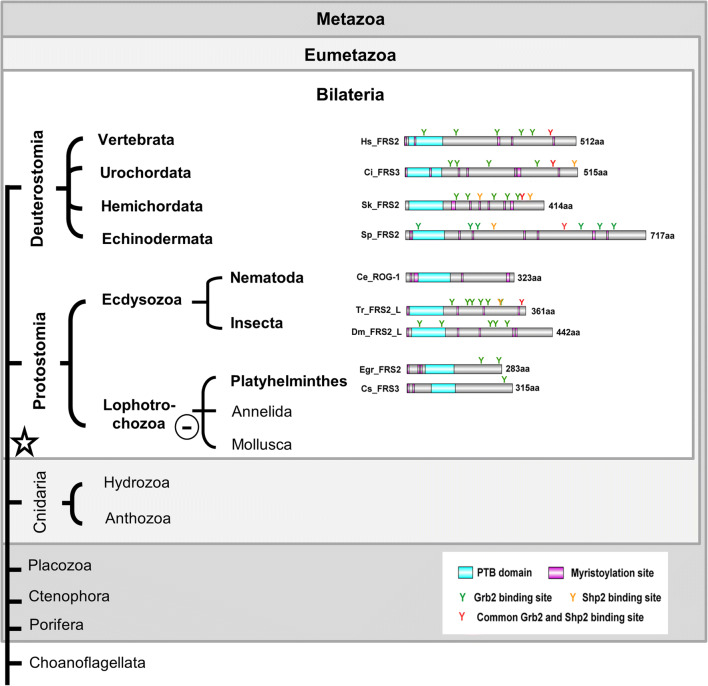
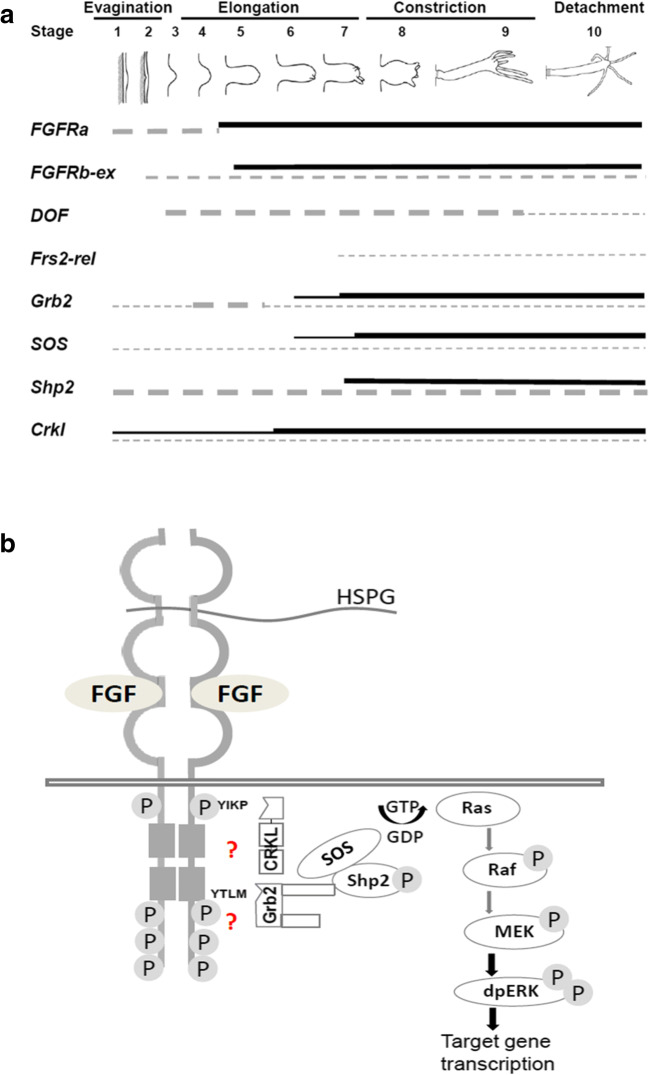
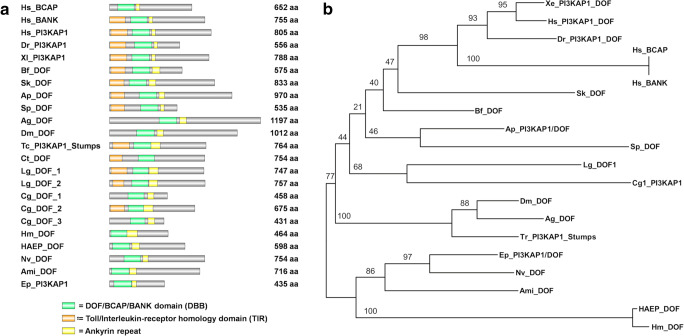
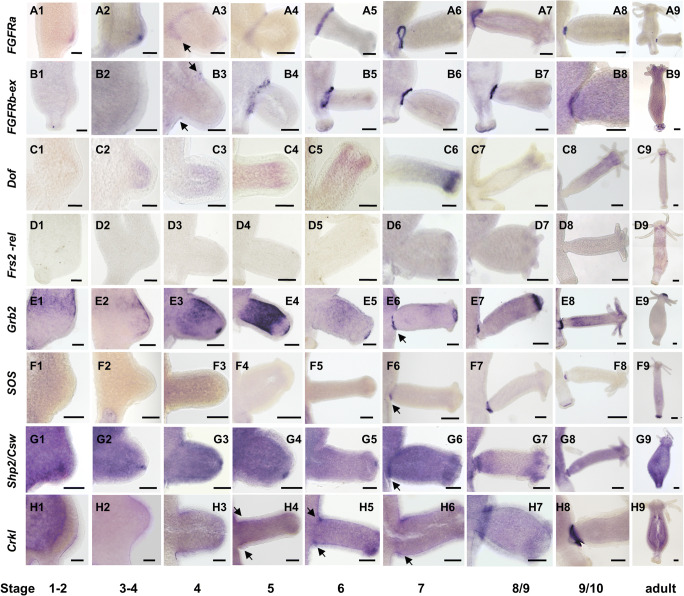
Across the Bilateria, FGF/FGFR signaling is critical for normal development, and in both Drosophila and vertebrates, docking proteins are required to connect activated FGFRs with downstream pathways. While vertebrates use Frs2 to dock FGFR to the RAS/MAPK or PI3K pathways, the unrelated protein, downstream of FGFR (Dof/stumps/heartbroken), fulfills the corresponding function in Drosophila. To better understand the evolution of the signaling pathway downstream of FGFR, the available sequence databases were screened to identify Frs2, Dof, and other key pathway components in phyla that diverged early in animal evolution. While Frs2 homologues were detected only in members of the Bilateria, canonical Dof sequences (containing Dof, ankyrin, and SH2/SH3 domains) were present in cnidarians as well as bilaterians (but not in other animals or holozoans), correlating with the appearance of FGFR. Although these data suggested that Dof coupling might be ancestral, gene expression analysis in the cnidarian Hydra revealed that Dof is not upregulated in the zone of strong FGFRa and FGFRb expression at the bud base, where FGFR signaling controls detachment. In contrast, transcripts encoding other, known elements of FGFR signaling in Bilateria, namely the FGFR adaptors Grb2 and Crkl, which are acting downstream of Dof (and Frs2), as well as the guanyl nucleotide exchange factor Sos, and the tyrosine phosphatase Csw/Shp2, were strongly upregulated at the bud base. Our expression analysis, thus, identified transcriptional upregulation of known elements of FGFR signaling at the Hydra bud base indicating a highly conserved toolkit. Lack of transcriptional Dof upregulation raises the interesting question, whether Hydra FGFR signaling requires either of the docking proteins known from Bilateria.
在所有两侧对称动物中,FGF/FGFR 信号通路对于正常发育至关重要,在果蝇和脊椎动物中,衔接蛋白都被用来将激活的 FGFR 与下游信号通路连接起来。脊椎动物利用 Frs2 将 FGFR 与 RAS/MAPK 或 PI3K 信号通路衔接,而在果蝇中,不相关的蛋白下游衔接蛋白(Dof/stumps/heartbroken)则起到了相同的作用。为了更好地理解 FGFR 下游信号通路的进化,本研究利用现有的序列数据库来鉴定在动物进化早期分支的动物门中存在的 Frs2、Dof 和其他关键信号通路成分。尽管仅在两侧对称动物门的成员中检测到 Frs2 同源物,但在刺胞动物门以及两侧对称动物门(而非其他动物或原生动物)中都存在典型的 Dof 序列(包含 Dof、锚蛋白和 SH2/SH3 结构域),这与 FGFR 的出现相关。尽管这些数据表明 Dof 偶联可能是古老的,但在刺胞动物门水螅中进行的基因表达分析表明,在芽基中 FGFRa 和 FGFRb 表达强烈的区域,Dof 并未上调,而 FGFR 信号通路在此处控制芽的脱离。相比之下,在芽基中强烈上调的水螅 FGFR 信号通路的其他已知成分的转录本,包括 FGFR 衔接子 Grb2 和 Crkl(它们作用于 Dof(和 Frs2)下游)、鸟嘌呤核苷酸交换因子 Sos 以及酪氨酸磷酸酶 Csw/Shp2,在芽基中强烈上调。因此,我们的表达分析在水螅芽基中鉴定了 FGFR 信号通路的已知成分的转录上调,表明存在高度保守的工具包。Dof 转录上调的缺失提出了一个有趣的问题,即水螅 FGFR 信号通路是否需要从两侧对称动物中已知的任何一种衔接蛋白。