Yang Feng-Jung, Hou Ying-Hui, Chang Ray-E
Institute of Health Policy and Management, College of Public Health, National Taiwan University, Taipei, Taiwan.
Department of Internal Medicine, National Taiwan University Hospital Yun Lin Branch, Douliu, Taiwan.
J Med Internet Res. 2020 Apr 14;22(4):e15565. doi: 10.2196/15565.
Stage 5 chronic kidney disease (CKD) presents a high risk for dialysis initiation and for complications such as uremic encephalopathy, uremic symptoms, gastrointestinal bleeding, and infection. One of the most common barriers to health care for patients with stage 5 CKD is poor continuity of care due to unresolved communication gaps.
Our aim was to establish a powerful care model that includes the use of a social networking service (SNS) to improve care quality for patients with CKD and safely delay dialysis initiation.
We used a retrospective cohort of CKD patients aged 20-85 years who received care between 2007 and 2017 to evaluate the efficacy of incorporating an SNS into the health care system. In 2014, author F-JY, a nephrologist at the National Taiwan University Hospital Yunlin Branch, started to use an SNS app to connect with stage 5 CKD patients and their families. In cases of emergency, patients and families could quickly report any condition to F-JY. Using this app, F-JY helped facilitate productive interactions between these patients and the health care system. The intention was to safely delay the initiation of dialysis therapy. We divided patients into four groups: group 1 (G1) included patients at the study hospital during the 2007-2014 period who had contact only with nephrologists other than F-JY; group 2 (G2) included patients who visited F-JY during the 2007-2014 period before he began using the SNS app; group 3 (G3) included patients who visited nephrologists other than F-JY during the 2014-2017 period and had no interactions using the SNS; and group 4 (G4) included patients who visited F-JY during the 2014-2017 period and interacted with him using the SNS app.
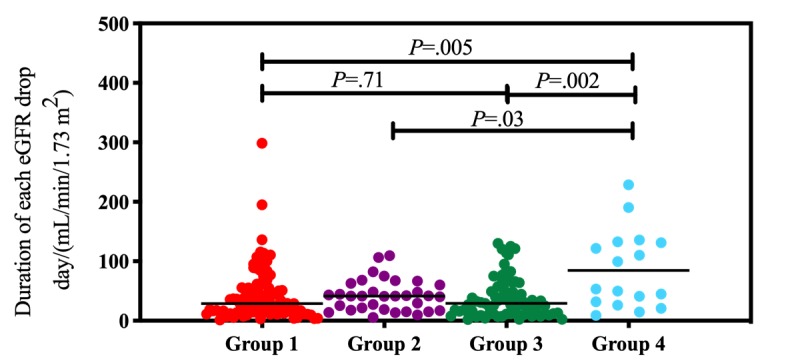
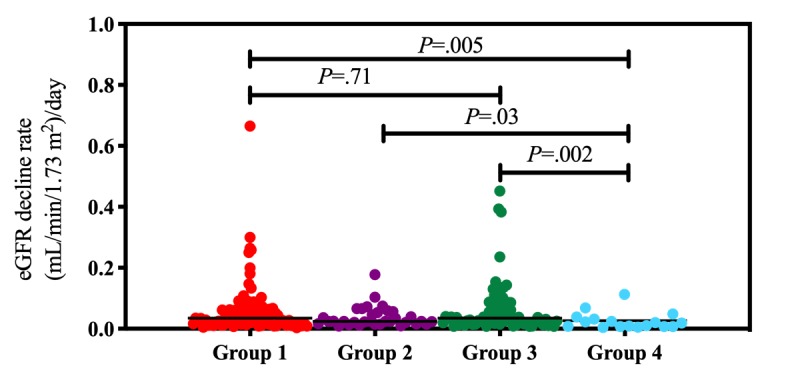
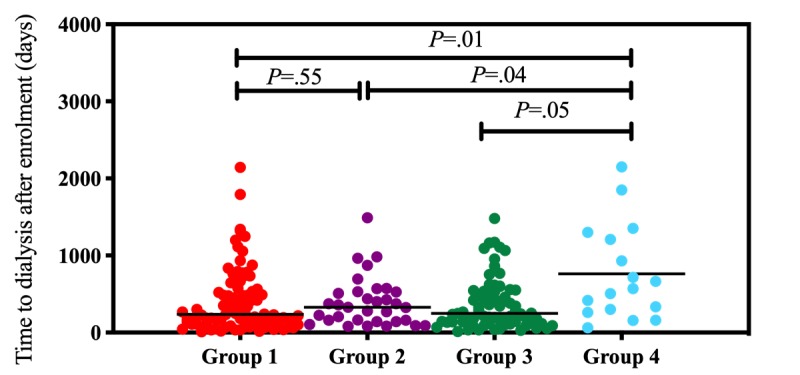
We recruited 209 patients with stage 5 CKD who had been enrolled in the study hospital's CKD program between 2007 and 2017. Each of the four groups initiated dialysis at different times. Before adjusting for baseline estimated glomerular filtration rate (eGFR), the G4 patients had a longer time to dialysis (mean 761.7 days, SD 616.2 days) than the other groups (G1: mean 403.6 days, SD 409.4 days, P=.011 for G4 vs G1; G2: 394.8 days, SD 318.8 days, P=.04; G3: 369.1 days, SD 330.8 days, P=.049). After adjusting for baseline eGFR, G4 had a longer duration for each eGFR drop (mean 84.8 days, SD 65.1 days) than the other groups (G1: mean 43.5 days, SD 45.4 days, P=.005; G2: mean 42.5 days, SD 26.5 days, P=.03; G3: mean 3.8.7 days, SD 33.5 days, P=.002).
The use of an SNS app between patients with stage 5 CKD and their physicians can reduce the communication gap between them and create benefits such as prolonging time-to-dialysis initiation. The role of SNSs and associated care models should be further investigated in a larger population.
5期慢性肾脏病(CKD)患者开始透析及出现诸如尿毒症脑病、尿毒症症状、胃肠道出血和感染等并发症的风险很高。5期CKD患者获得医疗保健的最常见障碍之一是由于沟通差距未得到解决而导致的护理连续性差。
我们的目标是建立一种强大的护理模式,包括使用社交网络服务(SNS)来提高CKD患者的护理质量并安全地推迟透析开始时间。
我们使用了一个回顾性队列,研究对象为2007年至2017年期间接受治疗的20至85岁的CKD患者,以评估将SNS纳入医疗保健系统的疗效。2014年,台湾大学医院云林分院的肾病学家作者F-JY开始使用一款SNS应用程序与5期CKD患者及其家属建立联系。在紧急情况下,患者及其家属可以迅速向F-JY报告任何情况。通过使用这款应用程序,F-JY帮助促进了这些患者与医疗保健系统之间富有成效的互动。目的是安全地推迟透析治疗的开始时间。我们将患者分为四组:第1组(G1)包括2007年至2014年期间在研究医院就诊且仅与F-JY以外的肾病学家接触的患者;第2组(G2)包括2007年至2014年期间在F-JY开始使用SNS应用程序之前就诊于他处的患者;第3组(G3)包括2014年至2017年期间就诊于F-JY以外的肾病学家且未使用SNS进行互动的患者;第4组(G4)包括2014年至2017年期间就诊于F-JY处并使用SNS应用程序与他互动的患者。
我们招募了209例2007年至2017年期间纳入研究医院CKD项目的5期CKD患者。四组患者开始透析的时间各不相同。在调整基线估计肾小球滤过率(eGFR)之前,G4组患者开始透析的时间(平均761.7天,标准差616.2天)比其他组更长(G1组:平均403.6天,标准差409.4天,G4组与G1组相比P = 0.011;G2组:394.8天,标准差318.8天,P = 0.04;G3组:369.1天,标准差330.8天,P = 0.049)。在调整基线eGFR之后,G4组每次eGFR下降的持续时间(平均84.8天,标准差65.1天)比其他组更长(G1组:平均43.5天,标准差45.4天,P = 0.005;G2组:平均42.5天,标准差26.5天,P = 0.03;G3组:平均38.7天,标准差33.5天,P = 0.002)。
5期CKD患者与其医生之间使用SNS应用程序可以减少他们之间的沟通差距,并产生诸如延长透析开始时间等益处。SNS及其相关护理模式的作用应在更大规模的人群中进一步研究。