Epidemiology and Biostatistics Department, Health School, Isfahan University of Medical Sciences, Isfahan, Iran.
Infectious Diseases and Tropical Medicine Research Center, Isfahan University of Medical Sciences, Isfahan, Iran.
Int J Health Policy Manag. 2020 Mar 1;9(3):108-115. doi: 10.15171/ijhpm.2019.91.
In Sudan, where studies on HIV dynamics are few, model projections provide an additional source of information for policy-makers to identify data collection priorities and develop prevention programs. In this study, we aimed to estimate the distribution of new HIV infections by mode of exposure and to identify populations who are disproportionately contributing to the total number of new infections in Sudan.
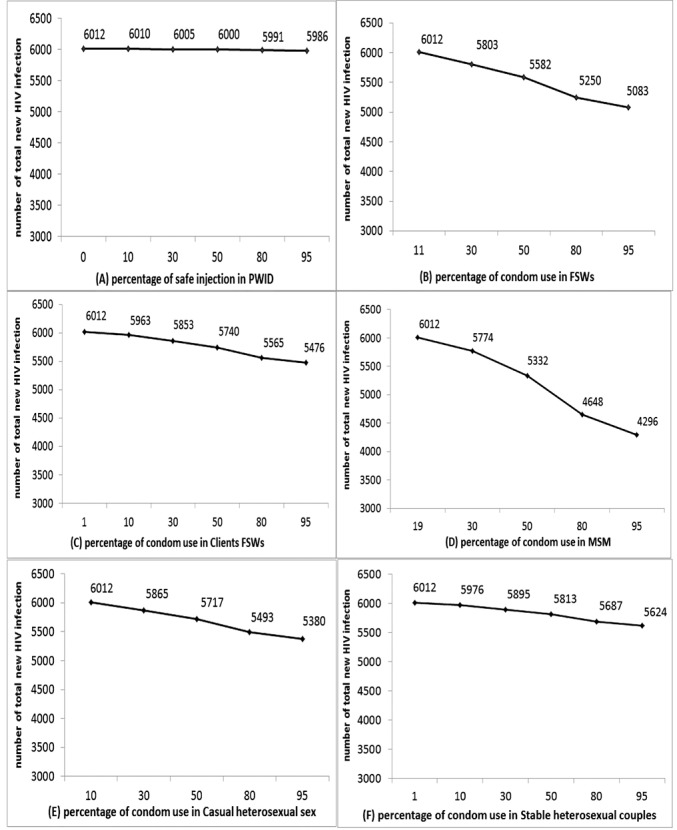
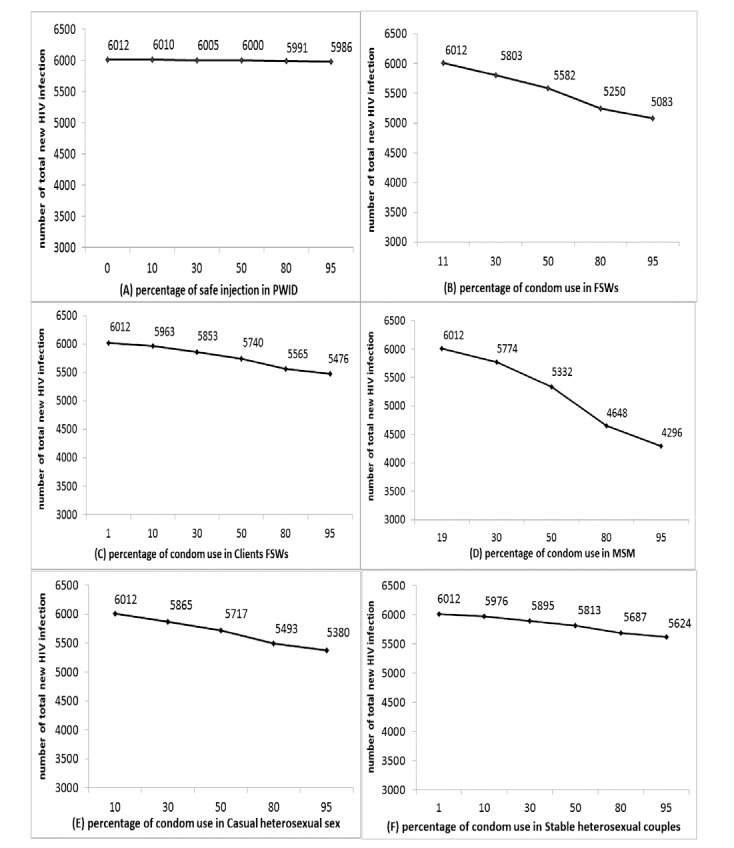
We applied the modes of transmission (MoT) mathematical model in Sudan to estimate the distribution of new HIV infections among the 15-49 age group for 2014, based on the main routes of exposure to HIV. Data for the MoT model were collected through a systematic review of peer-reviewed articles, grey literature, interviews with key participants and focus groups. We used the MoT uncertainty module to represent uncertainty in model projections and created one general model for the whole nation and 5 sub-models for each region (Northern, Central, Eastern, Kurdufan, and Khartoum regions). We also examined how different service coverages could change HIV incidence rates and distributions in Sudan.
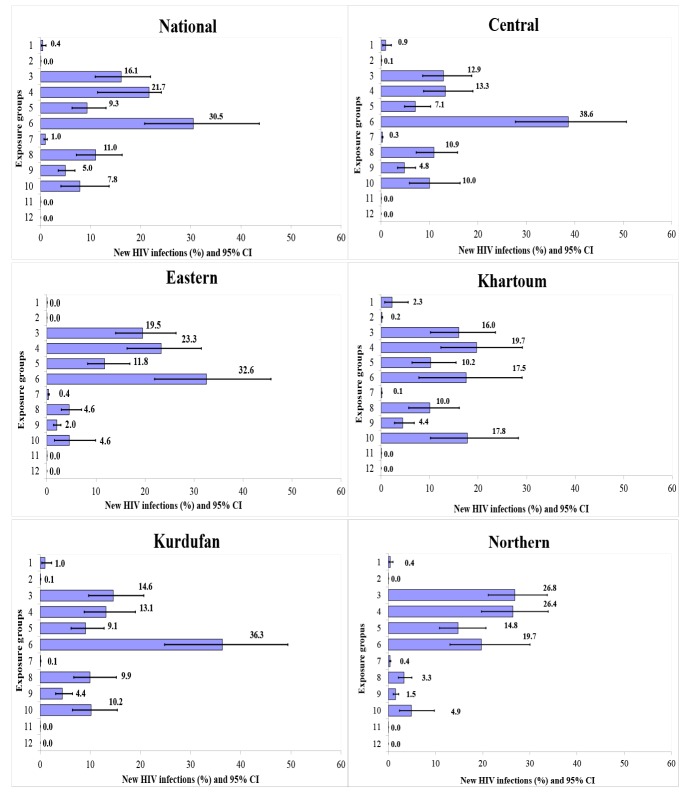
The model estimated that about 6000 new HIV infections occurred in Sudan in 2014 (95% CI: 4651-7432). Men who had sex with men (MSM) (30.52%), female sex workers (FSW) (16.37%), and FSW's clients accounted (19.43%) for most of the new HIV cases. FSW accounted for the highest incidence rate in the Central, Kurdufan, and Khartoum regions; and FSW's clients had the highest incidence rate in the Eastern and Northern regions. The annual incidence rate of HIV in the total adult population was estimated at 330 per 1 000 000 populations. The incidence rate was at its highest in the Eastern region (980 annual infections per 1 000 000 populations).
Although the national HIV incidence rate estimate was relatively low compared to that observed in some sub-Saharan African countries with generalized epidemics, a more severe epidemic existed within certain regions and key populations. HIV burden was mostly concentrated among MSM, FSW, and FSW's clients both nationally and regionally. Thus, the authorities should pay more attention to key populations and Eastern and Northern regions when developing prevention programs. The findings of this study can improve HIV prevention programs in Sudan.
在苏丹,HIV 动态研究较少,模型预测为决策者提供了额外的信息来源,以确定数据收集重点并制定预防计划。本研究旨在估计新的 HIV 感染的分布模式,并确定哪些人群不成比例地对苏丹的新感染总数作出贡献。
我们应用模式传播(MoT)数学模型,根据 HIV 的主要暴露途径,估计 2014 年 15-49 岁年龄组中 HIV 新感染的分布情况。MoT 模型的数据通过对同行评议文章、灰色文献、与关键参与者的访谈和焦点小组的系统审查收集。我们使用 MoT 不确定性模块来表示模型预测中的不确定性,并为整个国家创建了一个通用模型,以及为每个地区(北部、中部、东部、库尔迪凡和喀土穆地区)创建了 5 个子模型。我们还研究了不同的服务覆盖范围如何改变苏丹的 HIV 发病率和分布情况。
模型估计,2014 年苏丹约有 6000 例新的 HIV 感染(95%置信区间:4651-7432)。男男性行为者(MSM)(30.52%)、女性性工作者(FSW)(16.37%)和 FSW 的客户占大多数新的 HIV 病例。FSW 在中部、库尔迪凡和喀土穆地区的发病率最高;FSW 的客户在东部和北部地区的发病率最高。总成年人口的 HIV 年发病率估计为每 100 万人中有 330 例。在东部地区,发病率最高(每 100 万人中有 980 例年度感染)。
尽管与一些存在普遍流行的撒哈拉以南非洲国家相比,全国 HIV 发病率估计相对较低,但在某些地区和重点人群中存在更为严重的疫情。HIV 负担主要集中在全国和地区范围内的 MSM、FSW 和 FSW 的客户中。因此,当局在制定预防计划时应更加关注重点人群和东部和北部地区。本研究的结果可以改善苏丹的 HIV 预防计划。