Ren Si-Yu, Wang Zhen-Zhen, Zhang Yi, Chen Nai-Hong
Hunan University of Chinese Medicine & Hunan Engineering Technology Center of Standardization and Function of Chinese Herbal Decoction Pieces, Changsha, 410208, China.
State Key Laboratory of Bioactive Substances and Functions of Natural Medicines, Institute of Materia Medica & Neuroscience Center, Chinese Academy of Medical Sciences and Peking Union Medical College, Beijing, 100050, China.
Acta Pharmacol Sin. 2020 Oct;41(10):1263-1271. doi: 10.1038/s41401-020-0385-7. Epub 2020 Mar 18.
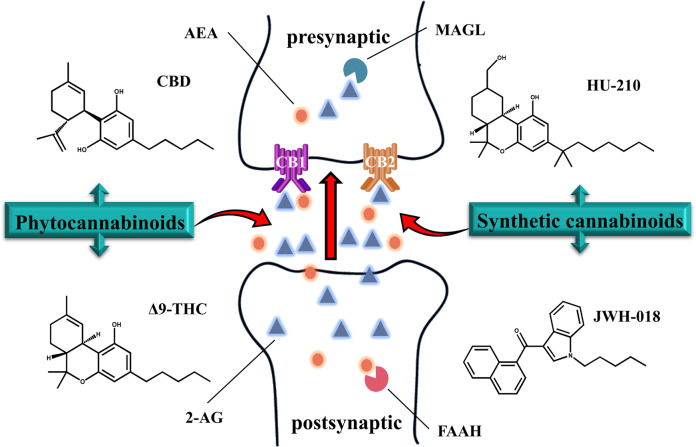
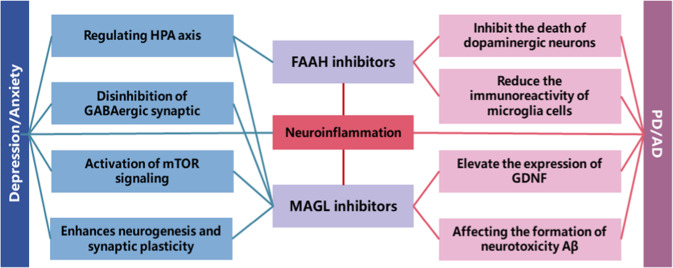
The endocannabinoid system (ECS) has received extensive attention for its neuroprotective effect on the brain. This system comprises endocannabinoids, endocannabinoid receptors, and the corresponding ligands and proteins. The molecular players involved in their regulation and metabolism are potential therapeutic targets for neuropsychiatric diseases including anxiety, depression and neurodegenerative diseases such as Alzheimer's disease (AD) and Parkinson's disease (PD). The inhibitors of two endocannabinoid hydrolases, i.e., fatty acid amide hydrolase (FAAH) and monoacylglycerol lipase (MAGL), have the capacity to increase the level of endocannabinoids indirectly, causing fewer side effects than those associated with direct supplementation of cannabinoids. Their antidepressant and anxiolytic mechanisms are considered to modulate the hypothalamic-pituitary-adrenal axis and regulate synaptic and neural plasticity. In terms of AD/PD, treatment with FAAH/MAGL inhibitors leads to reduction in amyloid β-protein deposition and inhibition of the death of dopamine neurons, which are commonly accepted to underlie the pathogenesis of AD and PD, respectively. Inflammation as the cause of depression/anxiety and PD/AD is also the target of FAAH/MAGL inhibitors. In this review, we summarize the application and involvement of FAAH/MAGL inhibitors in related neurological diseases. Focus on the latest research progress using FAAH/MAGL inhibitors is expected to facilitate the development of novel approaches with therapeutic potential.
内源性大麻素系统(ECS)因其对大脑的神经保护作用而受到广泛关注。该系统由内源性大麻素、内源性大麻素受体以及相应的配体和蛋白质组成。参与其调节和代谢的分子成分是包括焦虑症、抑郁症等神经精神疾病以及阿尔茨海默病(AD)和帕金森病(PD)等神经退行性疾病的潜在治疗靶点。两种内源性大麻素水解酶,即脂肪酸酰胺水解酶(FAAH)和单酰甘油脂肪酶(MAGL)的抑制剂,具有间接提高内源性大麻素水平的能力,与直接补充大麻素相比,副作用更少。它们的抗抑郁和抗焦虑机制被认为是调节下丘脑 - 垂体 - 肾上腺轴并调节突触和神经可塑性。就AD/PD而言,用FAAH/MAGL抑制剂治疗可减少淀粉样β蛋白沉积并抑制多巴胺能神经元死亡,这分别是AD和PD发病机制的公认基础。作为抑郁症/焦虑症以及PD/AD病因的炎症也是FAAH/MAGL抑制剂的作用靶点。在本综述中,我们总结了FAAH/MAGL抑制剂在相关神经疾病中的应用和作用。关注使用FAAH/MAGL抑制剂的最新研究进展有望促进具有治疗潜力的新方法的开发。