Gembillo Guido, Cernaro Valeria, Siligato Rossella, Curreri Francesco, Catalano Antonino, Santoro Domenico
Unit of Nephrology and Dialysis, Department of Clinical and Experimental Medicine, University of Messina, Via Consolare Valeria, 98125 Messina, Italy.
MIFT, University of Messina, Messina, Italy.
Metabolites. 2020 Mar 19;10(3):115. doi: 10.3390/metabo10030115.
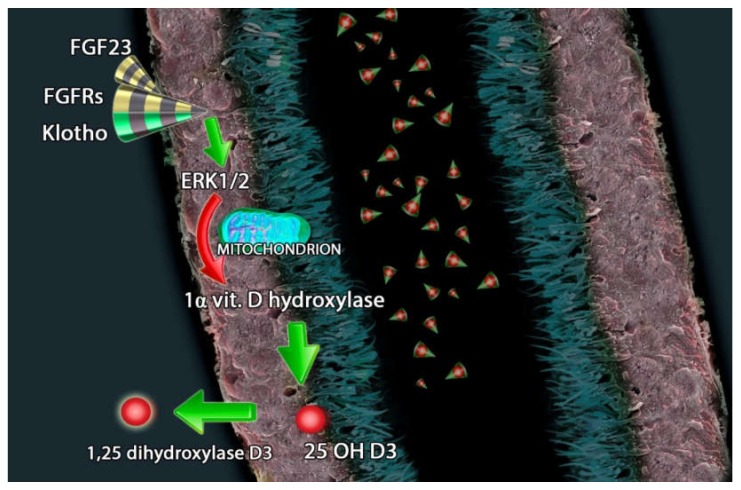
Vitamin D is tightly linked with renal tubular homeostasis: the mitochondria of proximal convoluted tubule cells are the production site of 1α,25-dihydroxyvitamin D3. Patients with renal impairment or tubular injury often suffer from chronic inflammation. This alteration comes from oxidative stress, acidosis, decreased clearance of inflammatory cytokines and stimulation of inflammatory factors. The challenge is to find the right formula for each patient to correctly modulate the landscape of treatment and preserve the essential functions of the organism without perturbating its homeostasis. The complexity of the counter-regulation mechanisms and the different axis involved in the Vitamin D equilibrium pose a major issue on Vitamin D as a potential effective anti-inflammatory drug. The therapeutic use of this compound should be able to inhibit the development of inflammation without interfering with normal homeostasis. Megalin-Cubilin-Amnionless and the FGF23-Klotho axis represent two Vitamin D-linked mechanisms that could modulate and ameliorate the damage response at the renal tubular level, balancing Vitamin D therapy with an effect potent enough to contrast the inflammatory cascades, but which avoids potential severe side effects.
维生素D与肾小管稳态密切相关:近端小管细胞的线粒体是1α,25-二羟基维生素D3的产生部位。肾功能损害或肾小管损伤的患者常患有慢性炎症。这种改变源于氧化应激、酸中毒、炎性细胞因子清除减少以及炎性因子的刺激。挑战在于为每位患者找到正确的方案,以正确调节治疗方案并维持机体的基本功能,同时不扰乱其稳态。维生素D平衡中涉及的反调节机制和不同轴的复杂性,对维生素D作为一种潜在有效的抗炎药物构成了重大问题。该化合物的治疗用途应能够抑制炎症发展,同时不干扰正常稳态。巨膜蛋白-立方蛋白-无氨基蛋白轴和FGF23-klotho轴代表两种与维生素D相关的机制,它们可以调节和改善肾小管水平的损伤反应,在维生素D治疗的效力足以对抗炎症级联反应但又避免潜在严重副作用之间取得平衡。