Department of Public Health Sciences, Miller School of Medicine, University of Miami, Miami, FL, United States of America.
Miami-Dade County Mosquito Control Division, Miami, FL, United States of America.
PLoS One. 2020 Mar 24;15(3):e0230748. doi: 10.1371/journal.pone.0230748. eCollection 2020.
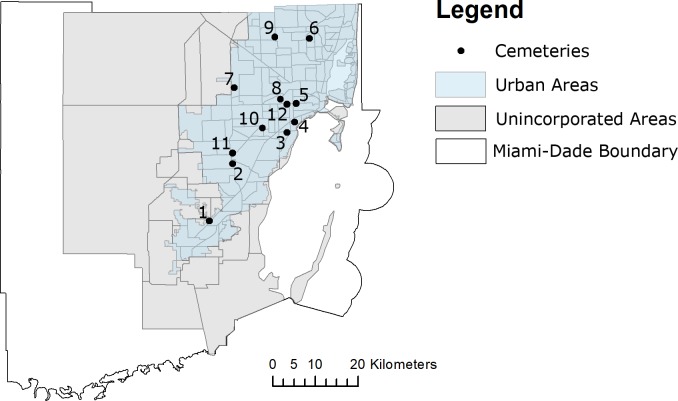
Definable habitats at the neighborhood level provide a wide range of favorable habitats with optimal conditions and environmental resources for mosquito survival. Problematic habitats for controlling mosquitoes in urban environments such as tire shops, bromeliad patches, and construction sites must be taken into consideration in the development of effective mosquito management and control in urban areas. Cemeteries are often located in highly urbanized areas serving as a haven for populations of vector mosquito species due to the availability of natural resources present in most cemeteries. Even though Miami-Dade County, Florida was the most affected area in the United States during the Zika virus outbreak in 2016 and is currently under a mosquito-borne illness alert after 14 confirmed locally transmitted dengue cases, the role of cemeteries in the proliferation of vector mosquitoes is unknown. Therefore, our objective was to use a cross-sectional experimental design to survey twelve cemeteries across Miami-Dade County to assess if vector mosquitoes in Miami can be found in these areas. Our results are indicating that vector mosquitoes are able to successfully exploit the resources available in the cemeteries. Culex quinquefasciatus was the most abundant species but it was neither as frequent nor present in its immature form as Aedes aegypti and Aedes albopictus. This study revealed that vector mosquitoes, such as Ae. aegypti, Ae. albopictus, and Cx. quinquefasciatus are successfully exploiting the resources available in these areas being able to thrive and reach high numbers. Mosquito control strategies should consider both long-term strategies, based on changing human behavior to reduce the availability of aquatic habitats for vector mosquitoes; as well as short-term strategies such as drilling holes or adding larvicide to the flower vases. Simple practices would greatly help improve the effectiveness of mosquito management and control in these problematic urban habitats.
可定义的邻里生境为蚊子的生存提供了广泛的有利生境和最佳的条件及环境资源。在城市环境中,轮胎店、凤梨科植物斑块和建筑工地等有问题的蚊子栖息地必须考虑在内,以制定有效的城市蚊子管理和控制措施。由于大多数墓地都存在自然资源,因此墓地通常位于高度城市化的地区,是病媒蚊子种群的避难所。尽管佛罗里达州迈阿密-戴德县是 2016 年寨卡病毒爆发期间美国受影响最严重的地区,并且在 14 例本地传播的登革热确诊病例后目前处于蚊媒疾病警报之下,但墓地在病媒蚊子的传播中所起的作用尚不清楚。因此,我们的目的是使用横断面实验设计调查迈阿密-戴德县的 12 个墓地,以评估迈阿密的病媒蚊子是否可以在这些地区找到。我们的研究结果表明,病媒蚊子能够成功利用墓地中的资源。库蚊是最丰富的物种,但它既不如埃及伊蚊和白纹伊蚊那样频繁,也不如它们的幼体形式存在。这项研究表明,病媒蚊子,如埃及伊蚊、白纹伊蚊和库蚊,正在成功地利用这些地区的资源,能够茁壮成长并达到较高的数量。蚊子控制策略应考虑长期策略,即改变人类行为以减少病媒蚊子的水生栖息地的可用性;以及短期策略,如在花瓶上钻孔或添加幼虫杀药剂。简单的做法将极大地有助于提高这些有问题的城市栖息地的蚊子管理和控制的有效性。