School of Health and Exercise Sciences, University of British Columbia, Okanagan Campus, Kelowna, BC V1V 1V7, Canada.
Nutrients. 2020 Mar 23;12(3):854. doi: 10.3390/nu12030854.
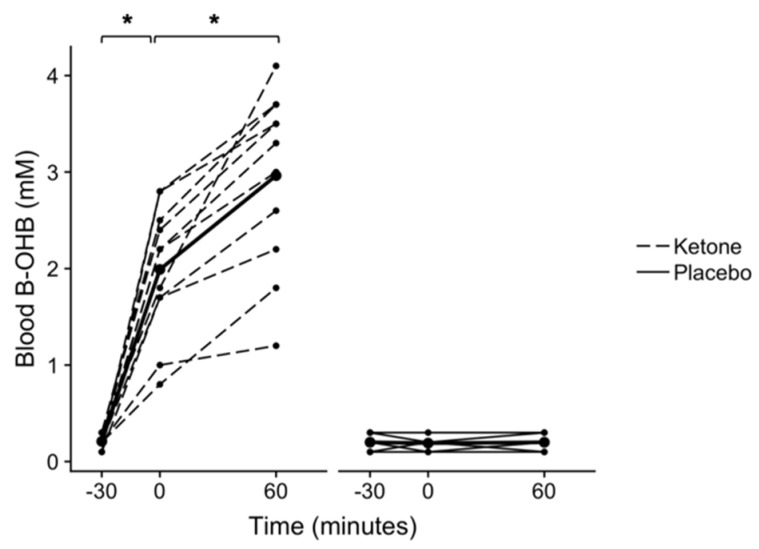
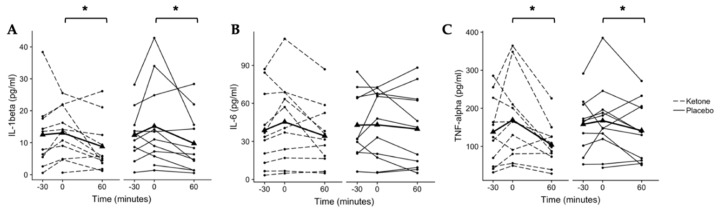
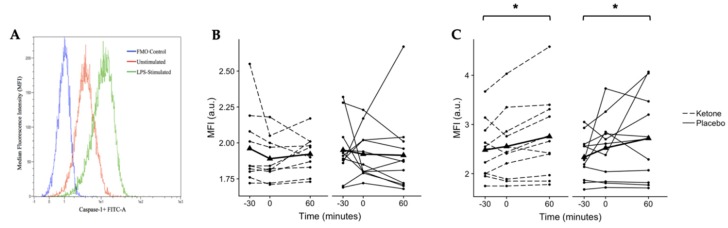
Activation of the NOD-like receptor pyrin-domain containing 3 (NLRP3) inflammasome is associated with chronic low-grade inflammation in metabolic diseases such as obesity. Mechanistic studies have shown that β-hydroxybutyrate (OHB) attenuates activation of NLRP3, but human data are limited. In a randomized, double-blind, placebo-controlled crossover trial ( = 11) we tested the hypothesis that acutely raising β-OHB by ingestion of exogenous ketones would attenuate NLRP3 activation in humans with obesity. Blood was sampled before and 30 min post-ingestion of a ketone monoester drink ((R)-3-hydroxybutyl (R)-3-hydroxybutyrate, 482 mg/kg body mass) or placebo. A 75 g oral glucose load was then ingested, and a third blood sample was obtained 60 min following glucose ingestion. NLRP3 activation was quantified by assessing monocyte caspase-1 activation and interleukin (IL)-1β secretion in ex vivo lipopolysaccharide (LPS)-stimulated whole-blood cultures. LPS-stimulated caspase-1 activation increased following glucose ingestion (main effect of time; = 0.032), with no differences between conditions. IL-1β secretion did not differ between conditions but was lower 60 min post-glucose ingestion compared to the fasting baseline (main effect of time, = 0.014). Plasma IL-1β was detectable in ~80% of samples and showed a decrease from fasting baseline to 60 min in the ketone condition only (condition × time interaction, = 0.01). In individuals with obesity, an excursion into hyperglycemia following ingestion of a glucose load augments LPS-induced activation of caspase-1 in monocytes with no apparent impact of raising circulating β-OHB concentration via ingestion of exogenous ketones. Exogenous ketone supplementation may impact plasma IL-1β, but these findings require confirmation in studies with larger sample sizes.
NLRP3 炎性小体的激活与肥胖等代谢疾病中的慢性低度炎症有关。机制研究表明,β-羟丁酸(OHB)可减弱 NLRP3 的激活,但人体数据有限。在一项随机、双盲、安慰剂对照交叉试验(n = 11)中,我们检验了这样一个假设,即通过摄入外源性酮体急性增加β-OHB 会减弱肥胖人群中 NLRP3 的激活。在摄入酮单酯饮料((R)-3-羟基丁酸(R)-3-羟基丁酸,482mg/kg 体重)或安慰剂前和摄入后 30 分钟采集血液。然后摄入 75g 口服葡萄糖负荷,在摄入葡萄糖后 60 分钟采集第三份血液样本。通过评估单核细胞 caspase-1 激活和白细胞介素(IL)-1β在体外脂多糖(LPS)刺激的全血培养物中的分泌来量化 NLRP3 的激活。LPS 刺激的 caspase-1 激活在摄入葡萄糖后增加(时间主效应,p=0.032),但两种条件之间没有差异。IL-1β 分泌在两种条件之间没有差异,但与空腹基线相比,摄入葡萄糖后 60 分钟时降低(时间主效应,p=0.014)。在大约 80%的样本中可检测到血浆 IL-1β,并且仅在酮组中从空腹基线到 60 分钟时下降(条件×时间相互作用,p=0.01)。在肥胖个体中,摄入葡萄糖负荷后血糖升高会增强 LPS 诱导的单核细胞中 caspase-1 的激活,而通过摄入外源性酮体升高循环β-OHB 浓度似乎没有明显影响。外源性酮体补充可能会影响血浆 IL-1β,但这些发现需要在更大样本量的研究中得到证实。