Solana José Carlos, Ramírez Laura, Cook Emma Cl, Hernández-García Elena, Sacristán Silvia, Martín M Elena, Manuel González Víctor, Reguera Rosa María, Balaña-Fouce Rafael, Fresno Manuel, Requena José María, Iborra Salvador, Soto Manuel
Centro de Biología Molecular Severo Ochoa (CSIC-UAM), Departamento de Biología Molecular, Nicolás Cabrera 1, Universidad Autónoma de Madrid, 28049 Madrid, Spain.
WHO Collaborating Centre for Leishmaniasis, National Centre for Microbiology, Instituto de Salud Carlos III, 28220 Madrid, Spain.
Vaccines (Basel). 2020 Mar 23;8(1):141. doi: 10.3390/vaccines8010141.
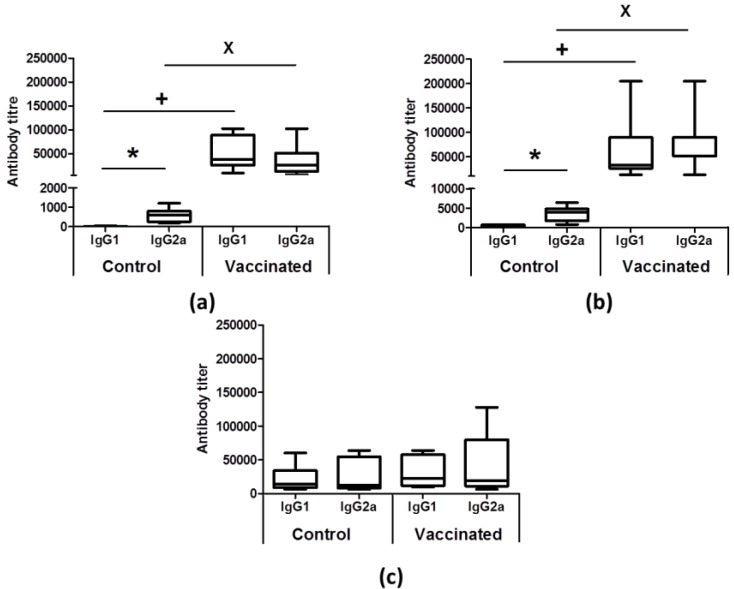
parasites cause a severe form of visceral leishmaniasis in human and viscerocutaneous leishmaniasis in dogs. Recently, we reported that immunization with an attenuated cell line, lacking the gene, protects against the development of murine cutaneous leishmaniasis. In this work, we analyzed the vaccine potential of this cell line towards the long-term protection against murine visceral leishmaniasis. This model shows an organ-dependent evolution of the disease. The infection can resolve in the liver but chronically affect spleen and bone marrow. Twelve weeks after subcutaneous administration of attenuated , Bagg Albino (BALB/c) mice were challenged with infective parasites expressing the luciferase-encoding gene. Combining in vivo bioimaging techniques with limiting dilution experiments, we report that, in the initial phase of the disease, vaccinated animals presented lower parasite loads than unvaccinated animals. A reduction of the severity of liver damage was also detected. Protection was associated with the induction of rapid parasite-specific IFN-γ production by CD4 and CD8 T cells. However, the vaccine was unable to control the chronic phase of the disease, since we did not find differences in the parasite burdens nor in the immune response at that time point.
寄生虫可导致人类严重的内脏利什曼病和犬类的皮肤黏膜利什曼病。最近,我们报道了用缺失 基因的减毒细胞系进行免疫接种可预防小鼠皮肤利什曼病的发生。在这项研究中,我们分析了该细胞系对小鼠内脏利什曼病长期保护的疫苗潜力。该模型显示疾病具有器官依赖性演变。感染在肝脏中可得到缓解,但会长期影响脾脏和骨髓。在皮下注射减毒 十二周后,用表达荧光素酶编码基因的感染性 寄生虫对Bagg白化(BALB/c)小鼠进行攻击。将体内生物成像技术与有限稀释实验相结合,我们发现,在疾病的初始阶段,接种疫苗的动物体内的寄生虫负荷低于未接种疫苗的动物。还检测到肝损伤严重程度有所降低。保护作用与CD4和CD8 T细胞快速产生寄生虫特异性IFN-γ有关。然而,该疫苗无法控制疾病的慢性阶段,因为在那个时间点我们没有发现寄生虫负荷和免疫反应方面的差异。