Xu Fen, Xu Yun, Xiong Jian-Hui, Zhang Jing-Hui, Wu Jian, Luo Jie, Xiong Jian-Ping
The First Affiliated Hospital of Nanchang University, Nanchang, Jiangxi, People's Republic of China.
Jiangxi Medical College, Shangrao, Jiangxi, People's Republic of China.
Cancer Manag Res. 2020 Mar 10;12:1789-1798. doi: 10.2147/CMAR.S225229. eCollection 2020.
AOC1 is a copper-containing amine oxidase that is responsible for catalyzing the deamination of polyamines, which produces reactive oxygen species. Previous studies have demonstrated that polyamines are involved in the regulation of proliferation, migration, and apoptosis of cells. However, very little is known about the functions and regulatory mechanisms of AOC1 in tumors.
Based on GEPIA data, we found that AOC1 was significantly upregulated in human gastric cancer tissues. We knocked down AOC1 in human AGS and MKN45 cells using siRNA transfection, then utilized qRT-PCR assay and Western blot to verify the effectiveness of AOC1 knockdown in gastric cancer cells.
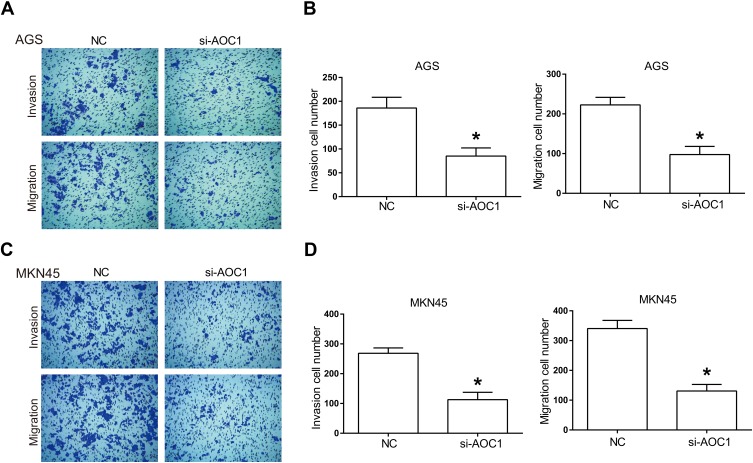
Function analysis demonstrated that knockdown of AOC1 inhibited the proliferation, invasion, and migration of human gastric cancer cells. Flow cytometry detection suggested that AOC1 knockdown induced apoptosis in human gastric cancer cells. Mechanism investigation suggested that AOC1 knockdown increased the ratio of Bax/Bcl2 and induced activation of the caspase cascade. Furthermore, the AKT signaling pathway was inactivated when AOC1 was silenced, including downregulated phosphorylation level of AKT and expression of downstream effectors, Cyclin D1, and p70S6K. Finally, we found that knockdown of AOC1 inhibited the epithelial-mesenchymal transition (EMT) in human gastric cancer by increasing the expression of epithelial markers E-cadherin, as well as decreasing mesenchymal marker N-cadherin, SNAIL and Slug.
Our study suggests that AOC1 functions as an oncogene in human gastric cancer by activating the AKT signaling pathway and EMT process and maybe a target of 6-mercaptopurine, which provides new insight in the clinical use of AOC1 in gastric cancer therapy.
AOC1是一种含铜胺氧化酶,负责催化多胺的脱氨反应,该反应会产生活性氧。先前的研究表明,多胺参与细胞增殖、迁移和凋亡的调控。然而,关于AOC1在肿瘤中的功能和调控机制知之甚少。
基于GEPIA数据,我们发现AOC1在人胃癌组织中显著上调。我们使用siRNA转染在人AGS和MKN45细胞中敲低AOC1,然后利用qRT-PCR检测和蛋白质印迹法验证AOC1在胃癌细胞中敲低的有效性。
功能分析表明,敲低AOC1可抑制人胃癌细胞的增殖、侵袭和迁移。流式细胞术检测表明,敲低AOC1可诱导人胃癌细胞凋亡。机制研究表明,敲低AOC1可增加Bax/Bcl2的比值并诱导半胱天冬酶级联反应的激活。此外,当AOC1沉默时,AKT信号通路失活,包括AKT磷酸化水平以及下游效应分子细胞周期蛋白D1和p70S6K的表达下调。最后,我们发现敲低AOC1可通过增加上皮标志物E-钙黏蛋白的表达以及降低间充质标志物N-钙黏蛋白、SNAIL和Slug的表达来抑制人胃癌中的上皮-间质转化(EMT)。
我们的研究表明,AOC1通过激活AKT信号通路和EMT过程在人胃癌中发挥癌基因的作用,并且可能是6-巯基嘌呤的靶点,这为AOC1在胃癌治疗中的临床应用提供了新的见解。