Duan Guangyou, Wang Kai, Peng Taotao, Wu Zhuoxi, Li Hong
Department of Anesthesiology, Second Affiliated Hospital, Army Medical University, Chongqing 400037, People's Republic of China.
Nat Sci Sleep. 2020 Mar 12;12:209-219. doi: 10.2147/NSS.S239706. eCollection 2020.
The study aimed to investigate the effects of intraoperative dexmedetomidine on postoperative sleep disturbance for different surgical patients and compare such effects between different dose of dexmedetomidine.
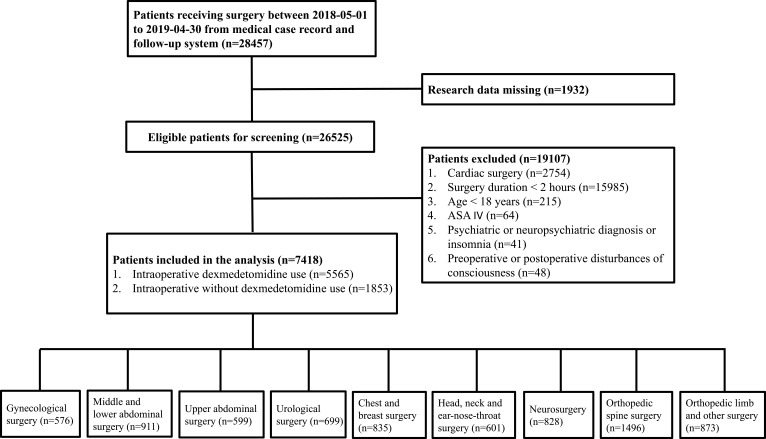
A total of 7418 patients undergoing nine types of non-cardiac major surgeries were retrospectively studied. Patients were separated into DEX (dexmedetomidine) or Non-DEX (Non-dexmedetomidine) groups based on the use of dexmedetomidine during surgery. The patients who reported they could not fall asleep during the night or woke up repeatedly during the most of the night at the day of the surgery and whose NRS were >6 were defined as cases with severe sleep disturbance. Propensity score matched analysis based on all preoperative baseline data was performed along with logistic regression analysis including different surgery types and dosage of dexmedetomidine use.
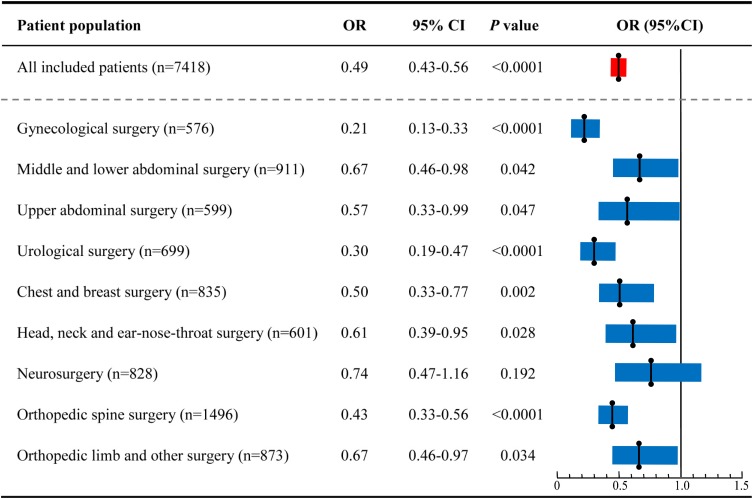
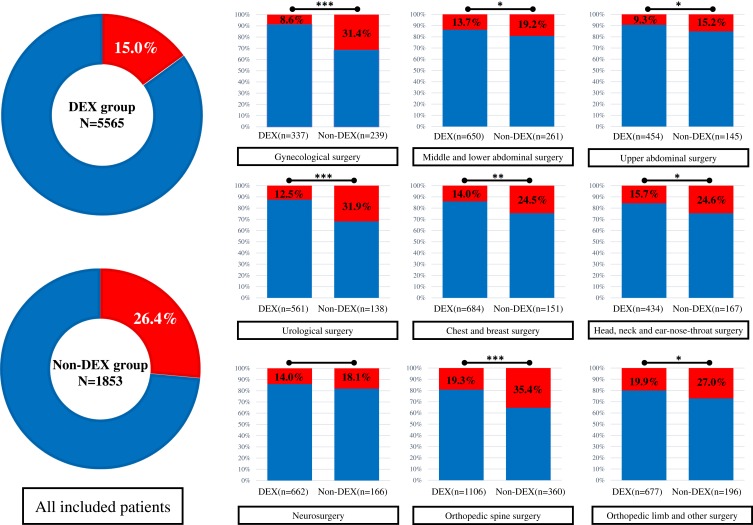
In both of the unmatched cohort (OR, 0.49 [95% CI: 0.43-0.56]) and matched cohort (0.49 [95% CI: 0.42-0.58]), the DEX group had a significantly lower incidence of severe sleep disturbance than the Non-DEX group. In the subgroup analysis, for gynecological and urological surgery population, the ORs for DEX-group reached 0.21 (95% CI, 0.13-0.33; 0.0001) and 0.30 (95% CI,0.19-0.47; 0.0001), respectively. In addition, low-dose dexmedetomidine (0.2-0.4 μg·kg·h) showed the greatest effect with an odds ratio of 0.38 (95% CI: 0.31-0.44; 0.0001), and the incidence of severe sleep disturbance in the low-dose group was significantly lower (11.5% vs. 17.7% vs. 16.5%, 0.0001) than that in the medium- (0.4-0.6 μg·kg·h) and high-dose (0.6-0.8 μg·kg·h) groups.
Intraoperative dexmedetomidine use can significantly decrease the incidence of severe sleep disturbance on the day of surgery for patients undergoing non-cardiac major surgery, and the effects were most significant in patients receiving gynecological and urological surgery. Furthermore, low-dose dexmedetomidine (0.2-0.4 μg·kg·h) is most effective for prevention of postoperative sleep disturbance.
本研究旨在探讨术中使用右美托咪定对不同手术患者术后睡眠障碍的影响,并比较不同剂量右美托咪定的效果。
回顾性研究了7418例接受九种非心脏大手术的患者。根据手术期间是否使用右美托咪定,将患者分为DEX(右美托咪定)组或非DEX(非右美托咪定)组。那些报告在手术当天夜间无法入睡或大部分夜间反复醒来且数字评分量表(NRS)>6的患者被定义为严重睡眠障碍病例。基于所有术前基线数据进行倾向评分匹配分析,并进行包括不同手术类型和右美托咪定使用剂量的逻辑回归分析。
在未匹配队列(比值比[OR],0.49[95%可信区间(CI):0.43 - 0.56])和匹配队列(0.49[95%CI:0.42 - 0.58])中,DEX组严重睡眠障碍的发生率均显著低于非DEX组。在亚组分析中,对于妇科和泌尿外科手术人群,DEX组的OR分别达到0.21(95%CI,0.13 - 0.33;P<0.0001)和0.30(95%CI,0.19 - 0.47;P<0.0001)。此外,低剂量右美托咪定(0.2 - 0.4μg·kg·h)显示出最大效果,比值比为0.38(95%CI:0.31 - 0.44;P<0.0001),低剂量组严重睡眠障碍的发生率显著低于中剂量(0.4 - 0.6μg·kg·h)和高剂量(0.6 - 0.8μg·kg·h)组(11.5%对17.7%对16.5%,P<0.0001)。
术中使用右美托咪定可显著降低非心脏大手术患者手术当天严重睡眠障碍的发生率,对接受妇科和泌尿外科手术的患者效果最为显著。此外,低剂量右美托咪定(0.2 - 0.4μg·kg·h)预防术后睡眠障碍最有效。