Buin E, Pavin E J, Silveira M S V M
1Internal Medicine Postgraduate Program, Faculty of Medical Sciences, State University of Campinas, Campinas, São Paulo, Brazil.
2Endocrinology Division, Department of Internal Medicine, Faculty of Medical Sciences, State University of Campinas, Campinas, São Paulo, Brazil.
Diabetol Metab Syndr. 2020 Mar 24;12:23. doi: 10.1186/s13098-020-00531-5. eCollection 2020.
Type 1 diabetes (T1D) affects psychologically not only the persons with diabetes themselves but affects their family members. Few studies were conducted to investigate mental health in T1D partners. This study aims: (1) to investigate the frequency of depressive and anxiety symptoms in T1D partners and, (2) to investigate the associations among partners' depressive and anxiety symptoms and their sociodemographic and behavioral characteristics, and (3) to investigate the associations among partners' depressive and anxiety symptoms and clinical, laboratory and demographic characteristics of their T1D spouses in a Brazilian population.
In a transversal study 72 T1D partners were interviewed. Partners were invited to take part in the study during their T1D spouses' routine consultations. Those who consented to take part in the study signed the consent form. This study followed the principles of the Declaration of Helsinki and was approved by the University Ethics in Research Committee. Inclusion criteria were T1D partners age ≥ 18 and T1D diagnosis > 6 months. Exclusion criteria were cognitive impairment, history of major psychiatric disorders, and severe chronic and terminal diseases. Depressive symptoms were evaluated by the depression subscale of the Hospital Anxiety and Depression scale (HADD) and anxiety symptoms were evaluated by the anxiety subscale of the same instrument (HADA). T1D partners were divided into subgroups according to score ≥ 8 and < 8 in both subscales. Demographic and clinical data were obtained from interview. Descriptive analyses were undertaken using means and percentages, as appropriate. Differences between groups were assessed by the Mann-Whitney test for numerical variables, by the Chi Square test or by Fisher's exact test for categorical variables, as appropriate. All analyses were undertaken using SAS version 9.2 for Windows. Statistical significance was set at 0.05.
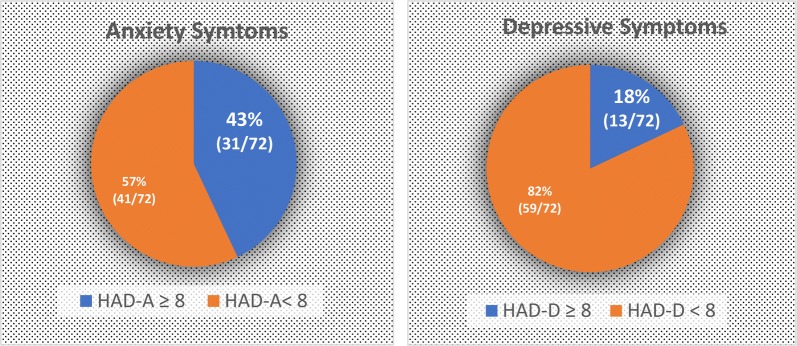
Of all 72 T1D partners, 72.2% were male, mean age was 42.7 ± 14.1 years old, years of school attendance were 11.8 ± 3.9 years, and 48.5% had income reaching until 3 Brazilian minimal wages. Forty-three percent reported high anxiety symptoms (HADA ≥ 8) and 18.1% reported high depressive symptoms (HADD ≥ 8). Comparing T1D partners group with HADA ≥ 8 and < 8, the first one was associated with CGM use (41.94% vs 19.51%; p = 0.03). Similarly, comparing T1D partners group with HADD ≥ 8 and < 8, the first one was associated with (1) longer duration of T1D of their spouses (28.6 ± 7.1 vs 22.4 ± 12.2; p = 0.02); (2) less years of school attendance of T1D partners (9.3 ± 3.2 vs 12.3 ± 3.8; p = 0.02), and (3) higher number of hypoglycemic episodes requiring other person's intervention (6.3 ± 8.9 vs 2.4 ± 4.7; p = 0.009). Seventy-six percent of partners who helped personally in their spouses' hypoglycemia recovery had HADD ≥ 8 vs 44.7% with HADD < 8 (p = 0.03). Likewise, 84.6% vs 54.2% of partners in which their spouses have T1D chronic complications had HADD ≥ 8 and < 8, respectively (p = 0.04).
This study showed a high frequency of relevant anxiety and depressive symptoms in this T1D partner population. Several issues related to T1D of their spouses were associated with these symptoms. These results emphasize the need to incorporate the psychological and psychiatric aspects into T1D partners' education and care.
1型糖尿病(T1D)不仅会对糖尿病患者本人造成心理影响,还会影响其家庭成员。很少有研究调查T1D患者配偶的心理健康状况。本研究旨在:(1)调查T1D患者配偶中抑郁和焦虑症状的发生频率;(2)调查配偶的抑郁和焦虑症状与其社会人口学及行为特征之间的关联;(3)在巴西人群中调查配偶的抑郁和焦虑症状与其T1D配偶的临床、实验室及人口统计学特征之间的关联。
在一项横断面研究中,对72名T1D患者的配偶进行了访谈。在其T1D配偶进行常规会诊期间,邀请这些配偶参与研究。同意参与研究的人签署了知情同意书。本研究遵循赫尔辛基宣言的原则,并获得了大学研究伦理委员会的批准。纳入标准为年龄≥18岁的T1D患者配偶且T1D诊断时间>6个月。排除标准为认知障碍、有严重精神疾病史以及患有严重慢性和终末期疾病。通过医院焦虑抑郁量表(HADD)的抑郁分量表评估抑郁症状,通过同一量表(HADA)的焦虑分量表评估焦虑症状。根据两个分量表得分≥8分和<8分,将T1D患者配偶分为亚组。通过访谈获取人口统计学和临床数据。酌情使用均值和百分比进行描述性分析。对于数值变量,采用曼-惠特尼检验评估组间差异;对于分类变量,酌情采用卡方检验或费舍尔精确检验。所有分析均使用Windows版SAS 9.2进行。设定统计学显著性水平为0.05。
在所有72名T1D患者配偶中,72.2%为男性,平均年龄为42.7±14.1岁,受教育年限为11.8±3.9年,48.5%的人收入达到3份巴西最低工资标准。43%的人报告有高焦虑症状(HADA≥8),18.1%的人报告有高抑郁症状(HADD≥8)。将HADA≥8分和<8分的T1D患者配偶组进行比较,前者与使用动态血糖监测(CGM)相关(41.94%对19.51%;p=0.03)。同样,将HADD≥8分和<8分的T1D患者配偶组进行比较,前者与以下因素相关:(1)其配偶T1D病程更长(28.6±7.1对22.4±12.2;p=0.02);(2)T1D患者配偶受教育年限更少(9.3±3.2对12.3±3.8;p=0.02);(3)需要他人干预的低血糖发作次数更多(6.3±8.9对2.4±4.7;p=0.009)。在配偶低血糖恢复过程中亲自提供帮助的配偶中,76%的人HADD≥8,而HADD<8的为44.7%(p=0.03)。同样,配偶患有T1D慢性并发症的配偶中,分别有84.6%和54.2%的人HADD≥8和<8(p=0.04)。
本研究表明,在这一T1D患者配偶群体中,相关焦虑和抑郁症状的发生率较高。与其配偶T1D相关的若干问题与这些症状有关。这些结果强调了将心理和精神方面纳入T1D患者配偶教育和护理的必要性。
