El-Daly Usama M, Saber Magdy M, Abdellateif Mona S, Nassar Hanan R, Namour Alfred E, Ismail Yahia M, Zekri Abdel-Rhaman N
Department of Medical Oncology, Damietta Oncology Center, Damietta,, Egypt.
Department of Medical Oncology and Malignant Hematology, National Cancer Institute, Cairo University, Cairo, Egypt.
Asian Pac J Cancer Prev. 2020 Mar 1;21(3):599-609. doi: 10.31557/APJCP.2020.21.3.599.
Adipokines play an important role in the regulation of inflammation and tumor progression.
Assessment of the possible role of adiponectin, leptin and visfatin in HCV associated hepatocellular carcinoma (HCC).
patients were classified into 85 patients with HCV associated HCC, 100 patients with chronic hepatitis C viral (HCV) infection compared to 50 normal control (NC) subjects. All subjects included in the study were assessed for HCV infection by seropositive HCV antibodies, as well as HCV RNA by RT-PCR. Serum levels of adiponectin, leptin and visfatin were assessed using enzyme linked immunosorbent assay (ELISA). The data were correlated to the relevant clinic-pathological features of the patients, and the overall survival (OS) rate.
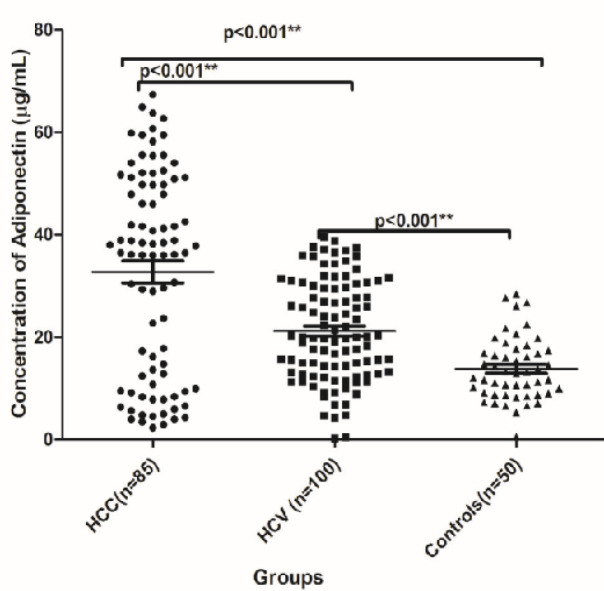
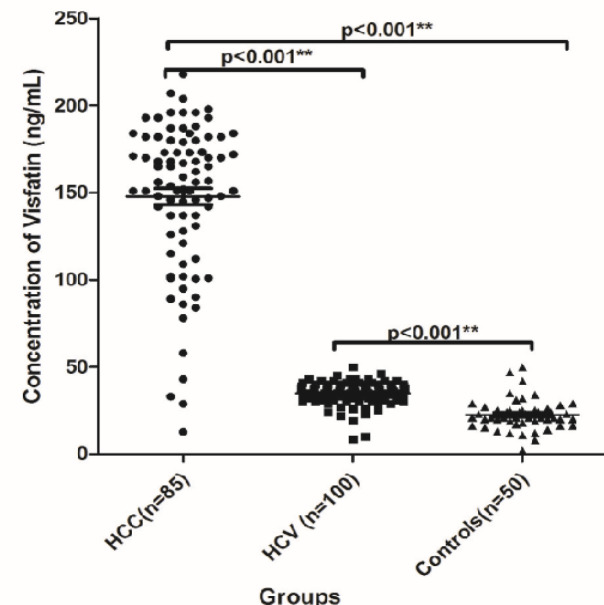
There was a significant difference in the serum levels of adiponectin and visfatin among HCC, HCV and NC groups (P<0.001). The serum levels of leptin and alpha fetoprotein (AFP) were significantly higher in HCC group (P<0.001). There was a significant association between the serum level of adiponectin and advanced Child class liver cirrhosis (P=0.03), as well as with poor performance status (ECOG, P=0.02). Serum leptin associated significantly with the number of lesions in the liver (P=0.006), visfatin associated with increased mortality rate (P<0.001). Adiponectin, leptin and visfatin associated significantly with liver cirrhosis in HCV patients (P<0.01). Leptin achieved the highest sensitivity (98.8%). visfatin achieved the highest specificity (100%) and PPV (100%) for detection of HCC. The combination of serum leptin and visfatin for the diagnosis of HCV associated HCC showed sensitivity, specificity, PPV, NPV and accuracy (100%, 96.6%, 93.4%, 100% and 97.4%; respectively).
Adiponectin, leptin and visfatin have an important role(s) in the pathogenesis of HCV associated HCC.
.
脂肪因子在炎症调节和肿瘤进展中起重要作用。
评估脂联素、瘦素和内脂素在丙型肝炎病毒(HCV)相关肝细胞癌(HCC)中的可能作用。
将患者分为85例HCV相关HCC患者、100例慢性丙型肝炎病毒(HCV)感染者,与50例正常对照(NC)受试者进行比较。纳入研究的所有受试者均通过血清HCV抗体阳性评估HCV感染情况,并通过逆转录聚合酶链反应(RT-PCR)检测HCV RNA。采用酶联免疫吸附测定(ELISA)评估血清脂联素、瘦素和内脂素水平。将数据与患者的相关临床病理特征及总生存率(OS)进行关联分析。
HCC组、HCV组和NC组之间脂联素和内脂素的血清水平存在显著差异(P<0.001)。HCC组的血清瘦素和甲胎蛋白(AFP)水平显著更高(P<0.001)。脂联素血清水平与晚期Child分级肝硬化显著相关(P=0.03),也与较差的体能状态(东部肿瘤协作组,P=0.02)相关。血清瘦素与肝脏病变数量显著相关(P=0.006),内脂素与死亡率增加相关(P<0.001)。脂联素、瘦素和内脂素与HCV患者的肝硬化显著相关(P<0.01)。瘦素的敏感性最高(98.8%)。内脂素在检测HCC方面具有最高的特异性(100%)和阳性预测值(PPV,100%)。血清瘦素和内脂素联合诊断HCV相关HCC的敏感性、特异性、PPV、阴性预测值(NPV)和准确性分别为100%、96.6%、93.4%、100%和97.4%。
脂联素、瘦素和内脂素在HCV相关HCC的发病机制中起重要作用。