Division of Cardiovascular Medicine Department of Medicine Beth Israel Deaconess Medical Center Harvard Medical School Boston MA.
Department of Medicine Beth Israel Deaconess Medical Center Harvard Medical School Boston MA.
J Am Heart Assoc. 2020 Apr 7;9(7):e014919. doi: 10.1161/JAHA.119.014919. Epub 2020 Mar 26.
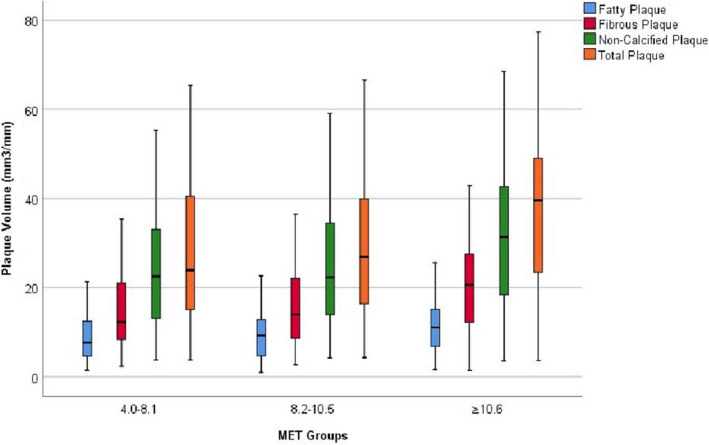
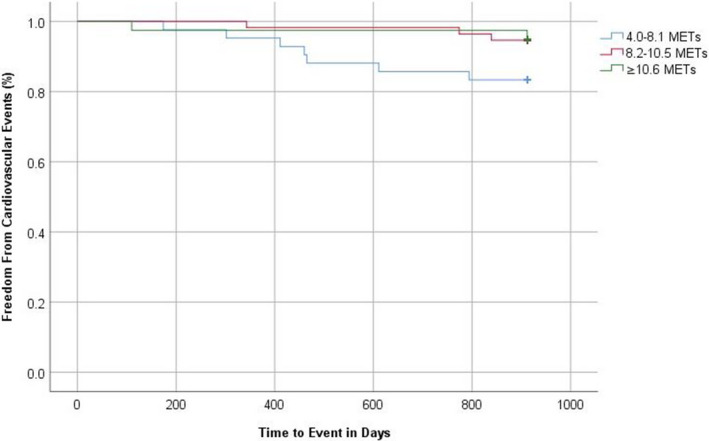
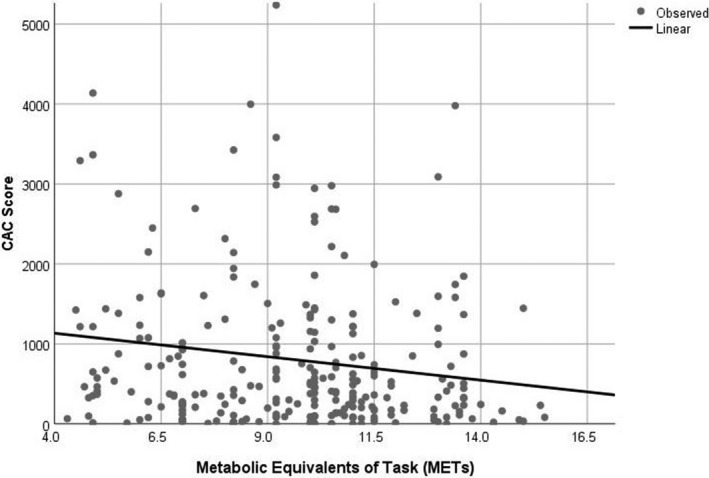
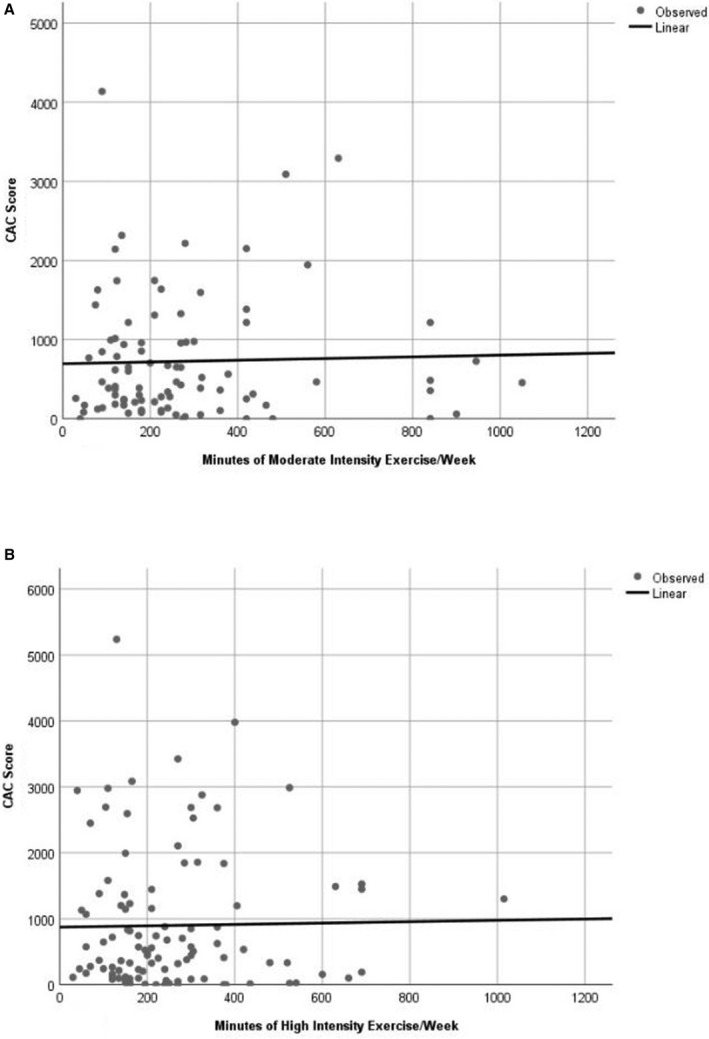
Background Aerobic exercise capacity is inversely associated with cardiovascular and all-cause mortality in men and women without coronary artery disease (CAD); however, a higher amount of vigorous exercise is associated with a J-shaped relationship in CAD patients. Therefore, the optimal type and amount of exercise for CAD patients is unclear. Coronary artery calcification (CAC) is associated with increased cardiovascular disease (CVD) events and mortality. Fatty plaque is more likely to rupture and cause coronary events than other types. We examined the association between exercise capacity, fatty plaque, CAC score and CVD events in CAD patients. Methods and Results A total of 270 subjects with stable CAD were divided into tertiles based on metabolic equivalents of task (METs) calculated from exercise treadmill testing. Self-reported exercise was obtained. Coronary computed tomographic angiography measured coronary plaque volume and CAC score. After adjustment, fatty plaque volume was not different among the 3 MET groups. For each 1 MET increase, CAC was 66.2 units lower (=0.017). Those with CAC >400 and ≥8.2 METs had fewer CVD events over 30 months compared to <8.2 METs (=0.037). Of moderate intensity exercisers (median, 240 min/wk; 78% walking only), 62.4% achieved ≥8.2 METs and lower CAC scores (=0.07). Intensity and duration of exercise had no adverse impact on coronary plaque or CVD events. Conclusions Achieving ≥8.2 METs with moderate exercise intensity and volume as walking resulted in lower CAC scores and fewer CVD events. Therefore, vigorous exercise intensity and volume may not be needed for CAD patients to derive benefit. Registration URL: https://www.clinicaltrials.gov; Unique Identifier: NCT01624727.
在没有冠状动脉疾病 (CAD) 的男性和女性中,有氧运动能力与心血管和全因死亡率呈反比;然而,在 CAD 患者中,剧烈运动的量与 J 形关系相关。因此,CAD 患者的最佳运动类型和量尚不清楚。冠状动脉钙化 (CAC) 与增加的心血管疾病 (CVD) 事件和死亡率相关。与其他类型相比,脂肪斑块更有可能破裂并导致冠状动脉事件。我们检查了 CAD 患者的运动能力、脂肪斑块、CAC 评分和 CVD 事件之间的关系。
共有 270 名稳定型 CAD 患者根据运动平板测试计算的代谢当量 (MET) 分为三分位数。获得自我报告的运动情况。冠状动脉计算机断层血管造影测量冠状动脉斑块体积和 CAC 评分。调整后,3 个 MET 组之间的脂肪斑块体积无差异。每增加 1 MET,CAC 降低 66.2 个单位(=0.017)。与<8.2 METs 相比,CAC>400 和≥8.2 METs 的患者在 30 个月时的 CVD 事件更少(=0.037)。在中等强度的运动者(中位数 240 分钟/周;78%仅步行)中,62.4%达到≥8.2 METs 和较低的 CAC 评分(=0.07)。运动的强度和持续时间对冠状动脉斑块或 CVD 事件没有不利影响。
以步行的中等运动强度和量达到≥8.2 METs 可降低 CAC 评分和 CVD 事件。因此,剧烈运动的强度和量可能不是 CAD 患者获益所必需的。