Abdou Rania H, Elbadawy Mohamed, Khalil Waleed F, Usui Tatsuya, Sasaki Kazuaki, Shimoda Minoru
Laboratory of Veterinary Pharmacology, Cooperative Department of Veterinary Medicine, Tokyo University of Agriculture and Technology, Fuchu, Tokyo 183-8509, Japan.
Forensic Medicine and Toxicology Department, Faculty of Veterinary Medicine, Suez Canal University, Ismailia, 41522, Egypt.
J Vet Med Sci. 2020 May 15;82(5):598-606. doi: 10.1292/jvms.19-0452. Epub 2020 Mar 25.
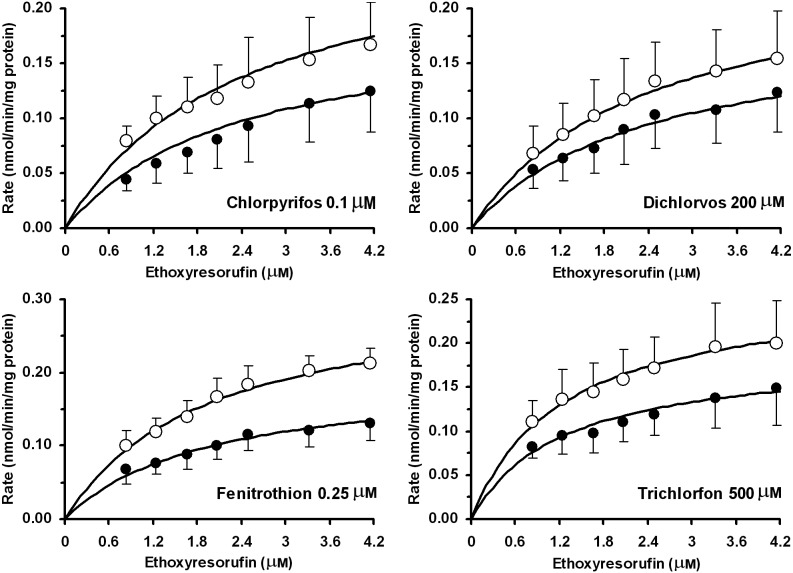
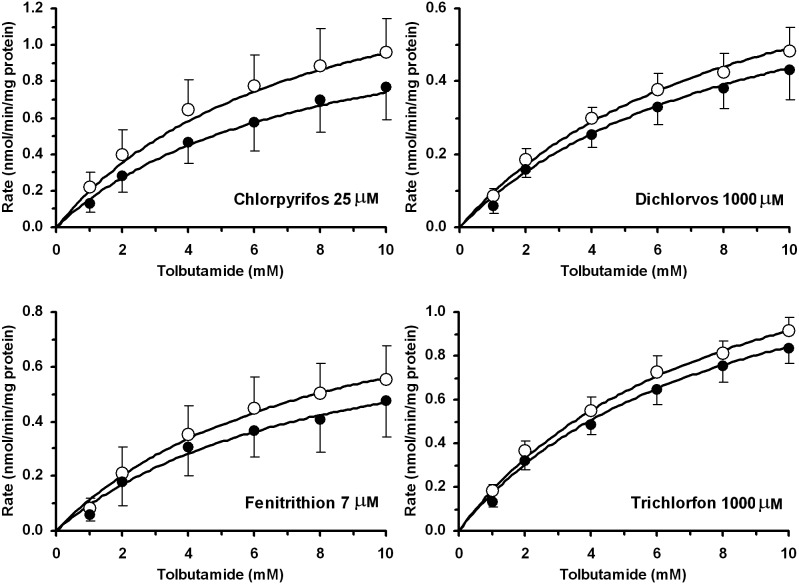
Four commonly used organophosphates (fenitrothion, dichlorvos, chlorpyrifos, and trichlorfon) were orally administered to male Sprague-Dawley rats for five days in order to explore their effects on the activities of liver cytochrome P450 (CYP). In addition, Michaelis-Menten kinetics of the metabolic reactions catalyzed by liver CYPs were analyzed following the addition of these compounds to the assay system to examine their potential inhibitory effects on liver CYPs activities. These reactions included ethoxyresorufin O-deethylation, midazolam 4-hydroxylation, tolbutamide hydroxylation, and bufuralol 1'-hydroxylation for CYP1A, 3A, 2C, and 2D activities, respectively. Total CYP content was also examined after oral administration of each organophosphate. Results revealed that oral giving of fenitrothion inhibited significantly CYP1A and 3A activities while elevated activity of CYP2C. Fenitrothion is a potent inhibitor for CYP1A and 2C with Ki values of 0.42 and 36.1 µM, respectively but had a weak inhibitory effect on CYP2D and 3A with Ki values of 290 and 226 µM, respectively. Chlorpyrifos is a potent inhibitor of CYP1A with Ki 0.24 µM and moderately inhibited CYP2C or 3A with Ki values of 84.8 and 77.7 µM, respectively. On the other hand, dichlorvos and trichlorfon caused extremely low or negligible inhibition of different CYP activities. From these results, it is concluded that both fenitrothion and chlorpyrifos may increase the toxicity of chemicals in environmental living organisms through their potent inhibitory effects on these CYP activities, but dichlorvos and trichlorfon may not.
为了探究四种常用有机磷酸酯(杀螟硫磷、敌敌畏、毒死蜱和敌百虫)对雄性斯普拉格-道利大鼠肝脏细胞色素P450(CYP)活性的影响,对其进行了为期五天的口服给药。此外,在测定系统中添加这些化合物后,分析了肝脏CYP催化的代谢反应的米氏动力学,以检查它们对肝脏CYP活性的潜在抑制作用。这些反应分别包括用于CYP1A、3A、2C和2D活性的乙氧基亚香豆素O-脱乙基化、咪达唑仑4-羟基化、甲苯磺丁脲羟基化和布非洛尔1'-羟基化。在口服每种有机磷酸酯后,还检测了总CYP含量。结果显示,口服杀螟硫磷显著抑制CYP1A和3A活性,同时提高CYP2C活性。杀螟硫磷是CYP1A和2C的强效抑制剂,Ki值分别为0.42和36.1 μM,但对CYP2D和3A的抑制作用较弱,Ki值分别为290和226 μM。毒死蜱是CYP1A的强效抑制剂,Ki为0.24 μM,对CYP2C或3A有中度抑制作用,Ki值分别为84.8和77.7 μM。另一方面,敌敌畏和敌百虫对不同CYP活性的抑制作用极低或可忽略不计。从这些结果可以得出结论,杀螟硫磷和毒死蜱可能通过对这些CYP活性的强效抑制作用增加环境生物体内化学物质的毒性,但敌敌畏和敌百虫可能不会。