Institute of Histology and Embryology, Faculty of Medicine, Comenius University, Sasinkova 4, 811 08 Bratislava, Slovakia.
Institute of Medical Biology, Genetics and Clinical Genetics, Faculty of Medicine, Comenius University, Sasinkova 4, 811 08 Bratislava, Slovakia.
Int J Mol Sci. 2020 Mar 24;21(6):2239. doi: 10.3390/ijms21062239.
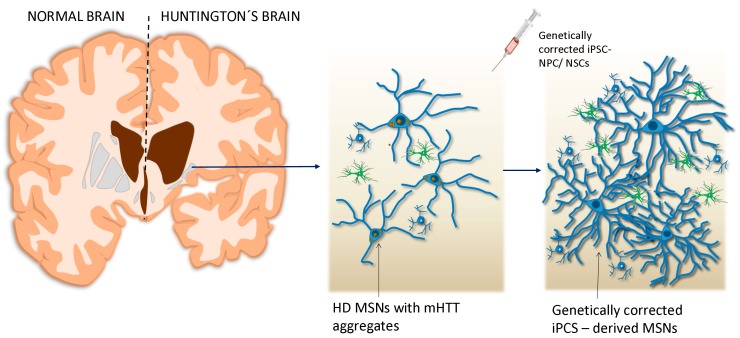
Huntington's disease (HD) is an inherited, autosomal dominant, degenerative disease characterized by involuntary movements, cognitive decline, and behavioral impairment ending in death. HD is caused by an expansion in the number of CAG repeats in the huntingtin gene on chromosome 4. To date, no effective therapy for preventing the onset or progression of the disease has been found, and many symptoms do not respond to pharmacologic treatment. However, recent results of pre-clinical trials suggest a beneficial effect of stem-cell-based therapy. Induced pluripotent stem cells (iPSCs) represent an unlimited cell source and are the most suitable among the various types of autologous stem cells due to their patient specificity and ability to differentiate into a variety of cell types both in vitro and in vivo. Furthermore, the cultivation of iPSC-derived neural cells offers the possibility of studying the etiopathology of neurodegenerative diseases, such as HD. Moreover, differentiated neural cells can organize into three-dimensional (3D) organoids, mimicking the complex architecture of the brain. In this article, we present a comprehensive review of recent HD models, the methods for differentiating HD-iPSCs into the desired neural cell types, and the progress in gene editing techniques leading toward stem-cell-based therapy.
亨廷顿病(HD)是一种遗传性、常染色体显性、退行性疾病,其特征为不自主运动、认知能力下降和行为障碍,最终导致死亡。HD 是由 4 号染色体上亨廷顿基因中的 CAG 重复次数增加引起的。迄今为止,尚未发现预防疾病发作或进展的有效疗法,许多症状对药物治疗没有反应。然而,最近的临床前试验结果表明,基于干细胞的治疗具有有益的效果。诱导多能干细胞(iPSCs)是一种无限的细胞来源,由于其患者特异性和在体外和体内分化为多种细胞类型的能力,是各种类型的自体干细胞中最适合的。此外,iPSC 衍生的神经细胞的培养为研究神经退行性疾病(如 HD)的病因病理学提供了可能性。此外,分化的神经细胞可以组织成三维(3D)类器官,模拟大脑的复杂结构。在本文中,我们全面回顾了最近的 HD 模型、将 HD-iPSCs 分化为所需神经细胞类型的方法,以及基因编辑技术在基于干细胞的治疗方面的进展。