Ramalingam Naveen, San Tong Chee, Kai Teo Jin, Mak Matthew Yew Mun, Gong Hai-Qing
1BioMEMS Laboratory, N3.1, B3Ma, School of Mechanical and Aerospace Engineering, Nanyang Technological University, 50 Nanyang Avenue, Singapore, 639798 Singapore.
2School of Life Sciences and Chemical Technology, Ngee Ann Polytechnic, Block 83, #06-00, 535 Clementi Road, Singapore, 599489 Singapore.
Microfluid Nanofluidics. 2009;7(3):325. doi: 10.1007/s10404-008-0378-1. Epub 2009 Jan 9.
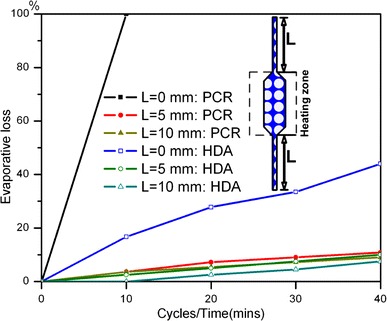
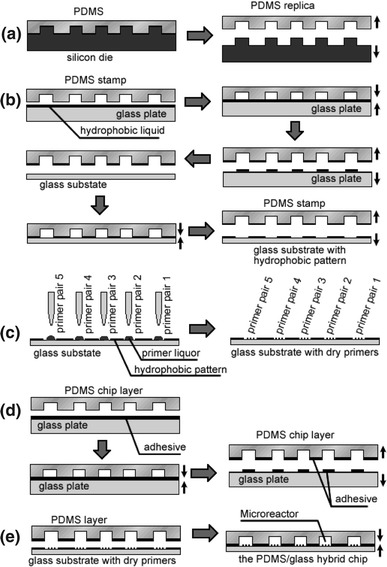
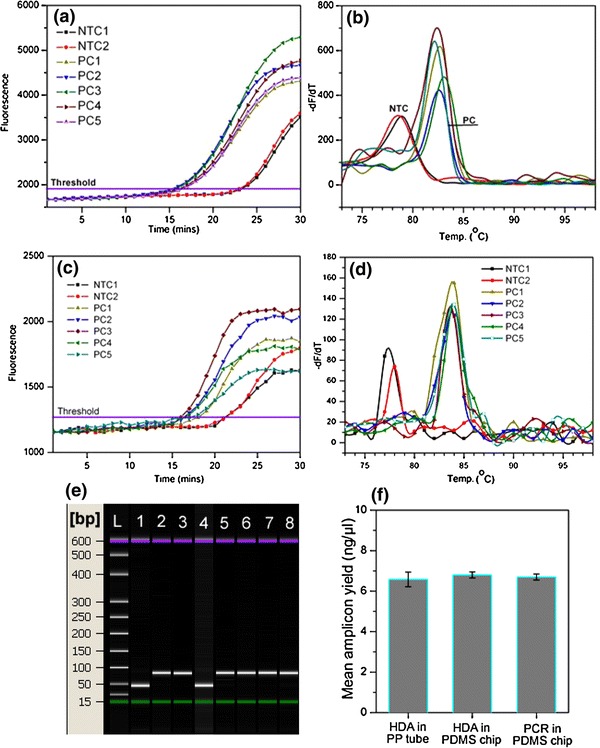
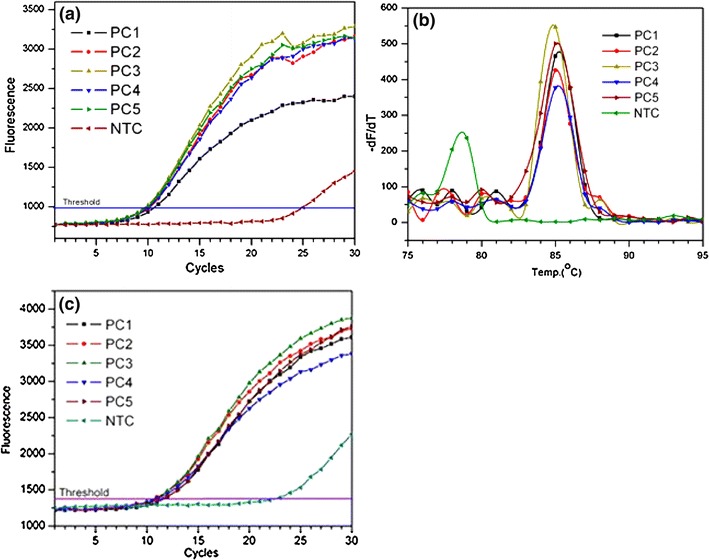
High-throughput microchip devices used for nucleic-acid amplification require sealed reactors. This is to prevent evaporative loss of the amplification mixture and cross-contamination, which may occur among fluidically connected reactors. In most high-throughput nucleic-acid amplification devices, reactor sealing is achieved by microvalves. Additionally, these devices require micropumps to distribute amplification mixture into an array of reactors, thereby increasing the device cost, and adding complexity to the chip fabrication and operation processes. To overcome these limitations, we report microfluidic devices harboring open (unsealed) reactors in conjunction with a single-step capillary based flow scheme for sequential distribution of amplification mixture into an array of reactors. Concern about evaporative loss in unsealed reactors have been addressed by optimized reactor design, smooth internal reactor surfaces, and incorporation of a localized heating scheme for the reactors, in which isothermal, real-time helicase-dependent amplification (HDA) was performed.
用于核酸扩增的高通量微芯片设备需要密封的反应腔。这是为了防止扩增混合物的蒸发损失以及交叉污染,交叉污染可能发生在流体连接的反应腔之间。在大多数高通量核酸扩增设备中,反应腔密封是通过微阀实现的。此外,这些设备需要微泵将扩增混合物分配到一系列反应腔中,从而增加了设备成本,并使芯片制造和操作过程更加复杂。为了克服这些限制,我们报道了一种微流控设备,该设备具有开放(未密封)的反应腔,并结合了基于毛细管的单步流动方案,用于将扩增混合物顺序分配到一系列反应腔中。通过优化反应腔设计、使反应腔内表面光滑以及为反应腔引入局部加热方案,解决了对未密封反应腔中蒸发损失的担忧,在该局部加热方案中进行了等温、实时解旋酶依赖性扩增(HDA)。