Department of Medical Nursing, School of Nursing, College of Medicine and Health Sciences, University of Gondar, Gondar, Ethiopia.
Unit of Community Health Nursing, School of Nursing, College of Medicine and Health Sciences, University of Gondar, Gondar, Ethiopia.
BMC Infect Dis. 2020 Mar 26;20(1):245. doi: 10.1186/s12879-020-04959-y.
In resource limited settings, Tuberculosis (TB) is a major cause of morbidity and mortality among patients on antiretroviral treatment. Ethiopia is one of the 30 high TB burden countries. TB causes burden in healthcare system and challenge the effectiveness of HIV care. This study was to assess incidence and predictors of Tuberculosis among adults on antiretroviral therapy at Debre Markos Referral Hospital, Northwest Ethiopia, 2019.
Institution based retrospective follow up study was conducted among adults on ART newly enrolled from 2014 to 2018 at Debre Markos Referral Hospital. Simple random sampling technique was used to select patients chart. Data was entered to EPI- INFO version 7.2.2.6 and analyzed using Stata 14.0. Tuberculosis incidence rate was computed and described using frequency tables. Both bivariable and multivariable Cox proportional hazard models was fitted to identify predictors of TB.
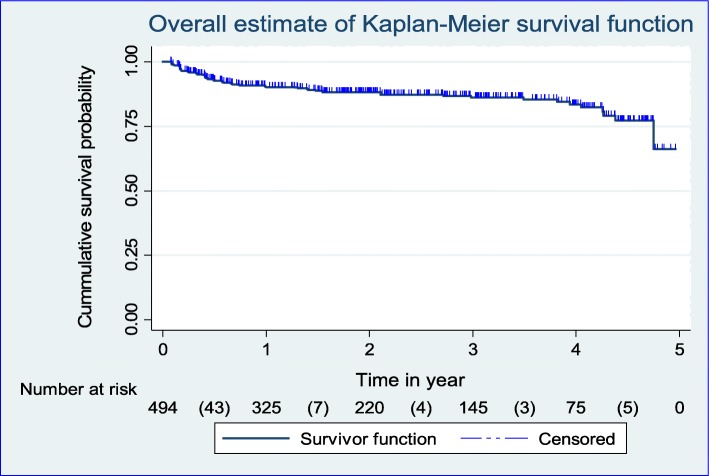
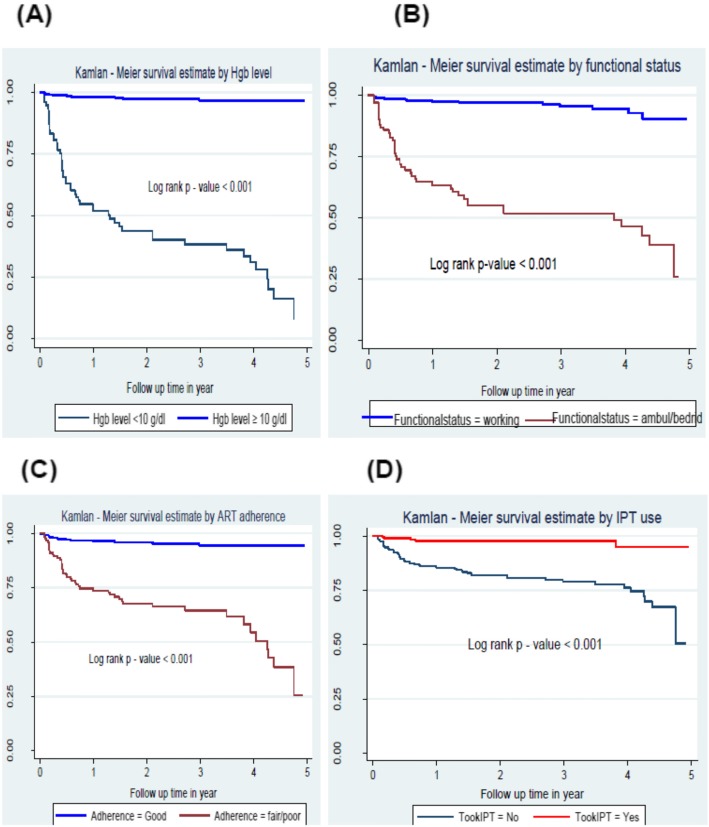
Out of the 536 patients chart reviewed, 494 patient records were included in the analysis. A total of 62 patients developed new TB cases during the follow up period of 1000.22 Person Years (PY); which gives an overall incidence rate of 6.19 cases per 100 PY (95% CI: 4.83-7.95). The highest rate was seen within the first year of follow up. After adjustment base line Hemoglobin < 10 g/dl (AHR = 5.25; 95% CI: 2.52-10.95), ambulatory/bedridden patients at enrolment (AHR = 2.31; 95% CI: 1.13-4.73), having fair or poor ART adherence (AHR = 3.22; 95% CI: 1.64-6.31) were associated with increased risk of tuberculosis whereas taking Isoniazid Preventive Therapy (IPT) (AHR = 0.33; 95% CI: 0.12-0.85) were protective factors of TB occurrence.
TB incidence was high among adults on ART especially in the first year of enrollment to ART. Low hemoglobin level, ambulatory or bedridden functional status, non-adherence to ART and IPT usage status were found to be independent predictors. Hence, continuous follow up for ART adherence and provision of IPT has a great importance to reduce the risk of TB.
在资源有限的情况下,结核病(TB)是接受抗逆转录病毒治疗的患者发病和死亡的主要原因。埃塞俄比亚是 30 个结核病高负担国家之一。结核病给医疗系统带来负担,并影响了艾滋病毒护理的效果。本研究旨在评估 2019 年在埃塞俄比亚德布雷马科斯转诊医院接受抗逆转录病毒治疗的成年人中结核病的发生率和预测因素。
这是一项在德布雷马科斯转诊医院新入组的 2014 年至 2018 年接受抗逆转录病毒治疗的成年人中开展的基于机构的回顾性随访研究。采用简单随机抽样技术选择患者病历。数据录入 EPI-INFO 版本 7.2.2.6,并使用 Stata 14.0 进行分析。计算结核病发病率并使用频率表进行描述。采用单变量和多变量 Cox 比例风险模型来确定结核病的预测因素。
在审查的 536 份病历中,有 494 份病历被纳入分析。在 1000.22 人年的随访期间,共有 62 名患者发生新的结核病病例,总发病率为 6.19 例/100 人年(95%CI:4.83-7.95)。在随访的第一年观察到最高发病率。在调整基线血红蛋白<10g/dl(AHR=5.25;95%CI:2.52-10.95)、入组时活动或卧床状态(AHR=2.31;95%CI:1.13-4.73)、ART 依从性差(AHR=3.22;95%CI:1.64-6.31)后,结核病的发生风险增加,而服用异烟肼预防治疗(IPT)(AHR=0.33;95%CI:0.12-0.85)是结核病发生的保护因素。
接受抗逆转录病毒治疗的成年人结核病发病率较高,尤其是在开始接受抗逆转录病毒治疗的第一年。低血红蛋白水平、活动或卧床状态、ART 依从性差和 IPT 使用情况是独立的预测因素。因此,持续监测 ART 依从性并提供 IPT 非常重要,可以降低结核病的风险。