Lommen Kim, Odeh Selena, Theije Chiel C de, Smits Kim M
Department of Pathology, GROW-School for Oncology and Developmental Biology, Maastricht University Medical Center, 6229HX Maastricht, The Netherlands.
Central Biobank Maastricht UMC, 6229 ER Maastricht, The Netherlands.
Cancers (Basel). 2020 Mar 25;12(4):776. doi: 10.3390/cancers12040776.
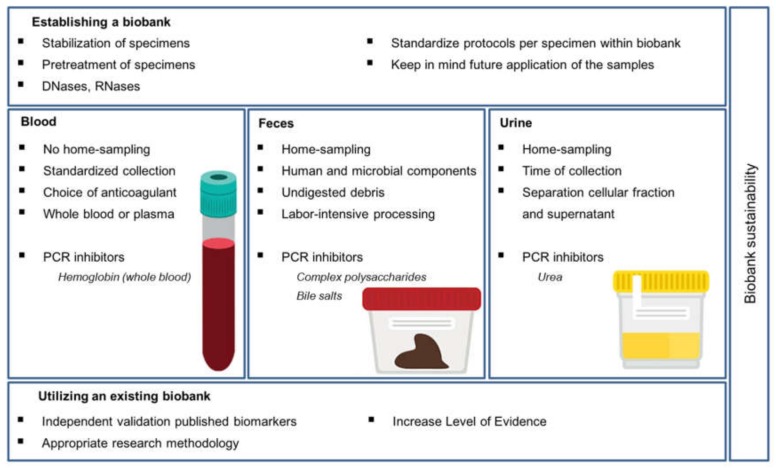
Although population-wide screening programs for several cancer types have been implemented in multiple countries, screening procedures are invasive, time-consuming and often perceived as a burden for patients. Molecular biomarkers measurable in non-invasively collected samples (liquid biopsies) could facilitate screening, as they could have incremental value on early diagnosis of cancer, but could also predict prognosis or monitor treatment response. Although the shift towards biomarkers from liquid biopsies for early cancer detection was initiated some time ago, there are many challenges that hamper the development of such biomarkers. One of these challenges is large-scale validation that requires large prospectively collected biobanks with liquid biopsies. Establishing those biobanks involves several considerations, such as standardization of sample collection, processing and storage within and between biobanks. In this perspective, we will elaborate on several issues that need to be contemplated in biobanking, both in general and for certain specimen types specifically, to be able to facilitate biomarker validation for early detection of cancer.
尽管多个国家已实施了针对多种癌症类型的全人群筛查项目,但筛查程序具有侵入性、耗时且常被患者视为负担。可在非侵入性采集的样本(液体活检)中检测到的分子生物标志物有助于筛查,因为它们对癌症早期诊断可能具有增量价值,还能预测预后或监测治疗反应。尽管从液体活检转向用于早期癌症检测的生物标志物的转变在一段时间前就已开始,但仍有许多挑战阻碍着此类生物标志物的开发。其中一个挑战是大规模验证,这需要大规模前瞻性收集的液体活检生物样本库。建立这些生物样本库涉及多个考量因素,例如生物样本库内部以及不同生物样本库之间样本采集、处理和存储的标准化。从这个角度出发,我们将详细阐述生物样本库中需要考虑的几个问题,包括一般情况以及特定标本类型的情况,以便能够促进用于癌症早期检测的生物标志物的验证。