University of Pennsylvania, Department of Earth and Environmental Science, Philadelphia, PA, 19104-6316, USA.
State Museum of Pennsylvania, Section of Paleontology and Geology, 300 North Street, Harrisburg, PA, 17120-0024, USA.
Sci Rep. 2020 Mar 26;10(1):5105. doi: 10.1038/s41598-020-61480-7.
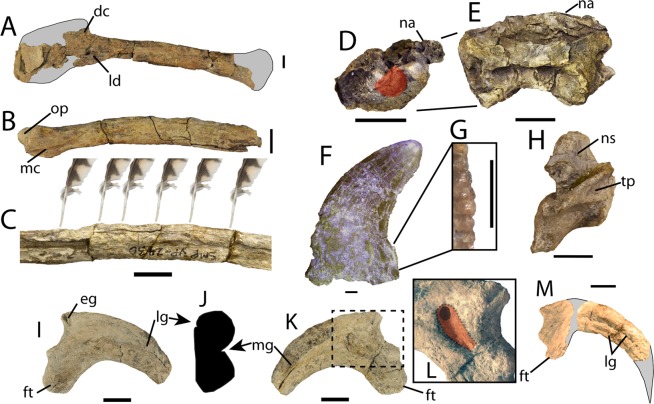
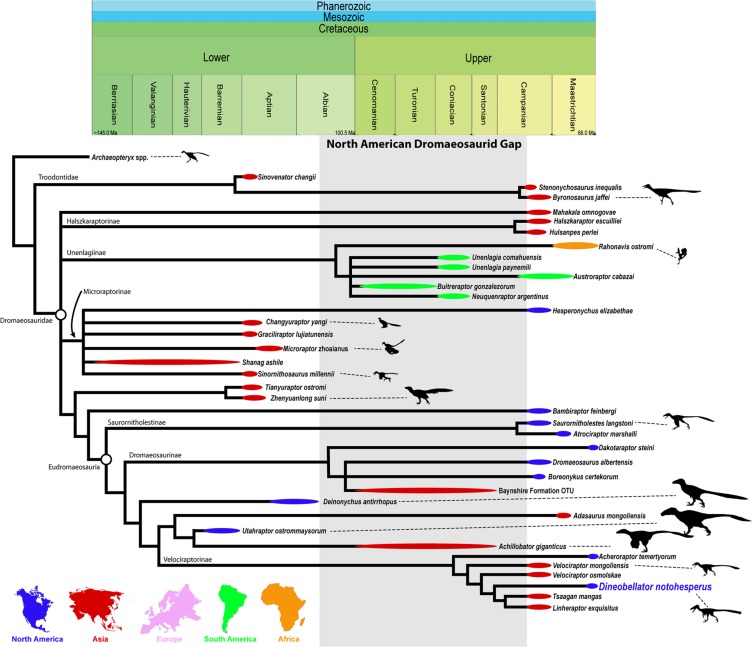
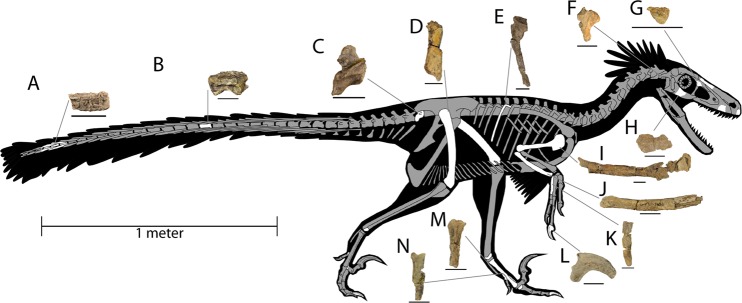
Dromaeosaurids (Theropoda: Dromaeosauridae), a group of dynamic, swift predators, have a sparse fossil record, particularly at the time of their extinction near the Cretaceous-Paleogene boundary. Here we report on a new dromaeosaurid, Dineobellator notohesperus, gen. and sp. nov., consisting of a partial skeleton from the Upper Cretaceous (Maastrichtian) of New Mexico, the first diagnostic dromaeosaurid to be recovered from the latest Cretaceous of the southern United States (southern Laramidia). The holotype includes elements of the skull, axial, and appendicular skeleton. The specimen reveals a host of morphologies that shed light on new behavioral attributes for these feathered dinosaurs. Unique features on its forelimbs suggest greater strength capabilities in flexion than the normal dromaeosaurid condition, in conjunction with a relatively tighter grip strength in the manual claws. Aspects of the caudal vertebrae suggest greater movement near the tail base, aiding in agility and predation. Phylogenetic analysis places Dineobellator within Velociraptorinae. Its phylogenetic position, along with that of other Maastrichtian taxa (Acheroraptor and Dakotaraptor), suggests dromaeosaurids were still diversifying at the end of the Cretaceous. Furthermore, its recovery as a second North American Maastrichtian velociraptorine suggests vicariance of North American velociraptorines after a dispersal event during the Campanian-Maastrichtian from Asia. Features of Dineobellator also imply that dromaeosaurids were active predators that occupied discrete ecological niches while living in the shadow of Tyrannosaurus rex, until the end of the dinosaurs' reign.
奔龙类(兽脚亚目:奔龙科)是一群活跃、迅猛的掠食者,其化石记录相对较少,尤其是在白垩纪-古近纪之交灭绝时期。本文报道了一种新的奔龙类恐龙,Dineobellator notohesperus,属种名新,由来自新墨西哥州晚白垩世(马斯特里赫特阶)的部分骨骼组成,这是美国南部(拉拉米迪亚南部)最晚白垩世首次发现的可诊断的奔龙类恐龙。正型标本包含头骨、轴骨和附肢骨骼的部分。该标本揭示了一系列形态特征,为这些有羽毛的恐龙提供了新的行为属性。前肢的独特特征表明其弯曲时的强度能力比正常奔龙类更强,同时手动爪的握力相对更紧。尾椎骨的某些方面表明在尾部基部附近有更大的运动范围,有助于提高敏捷性和捕食能力。系统发育分析将 Dineobellator 置于迅猛龙科内。它的系统发育位置,以及其他马斯特里赫特阶的分类单元(Acheroraptor 和 Dakotaraptor),表明奔龙类在白垩纪末期仍在不断分化。此外,它作为第二个北美马斯特里赫特阶的迅猛龙类的发现表明,在亚洲的坎潘阶-马斯特里赫特阶期间发生了扩散事件后,北美的迅猛龙类发生了隔离。Dineobellator 的特征还表明,奔龙类是活跃的掠食者,它们在霸王龙的阴影下生活,占据着不同的生态位,直到恐龙统治的结束。