Human Oncology and Pathogenesis Program, Memorial Sloan Kettering Cancer Center, New York, NY 10065.
Laboratory of Protein and Nucleic Acid Chemistry, The Rockefeller University, New York, NY 10065.
Proc Natl Acad Sci U S A. 2020 Apr 14;117(15):8584-8592. doi: 10.1073/pnas.1922159117. Epub 2020 Mar 27.
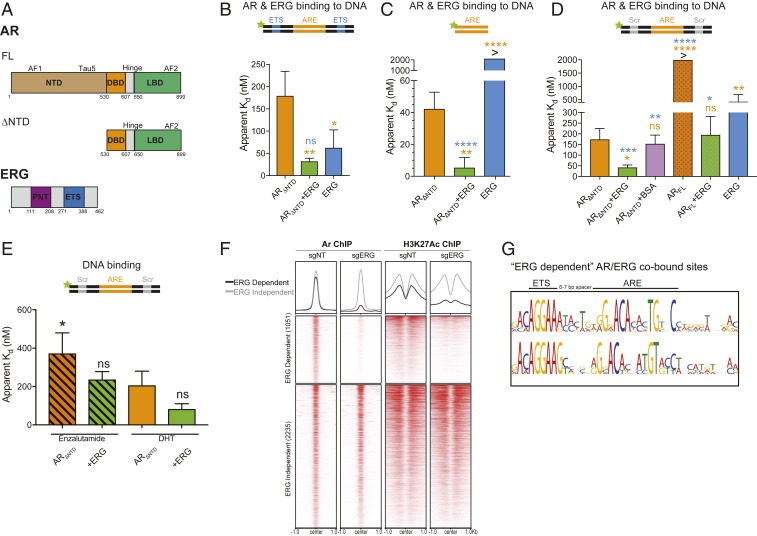
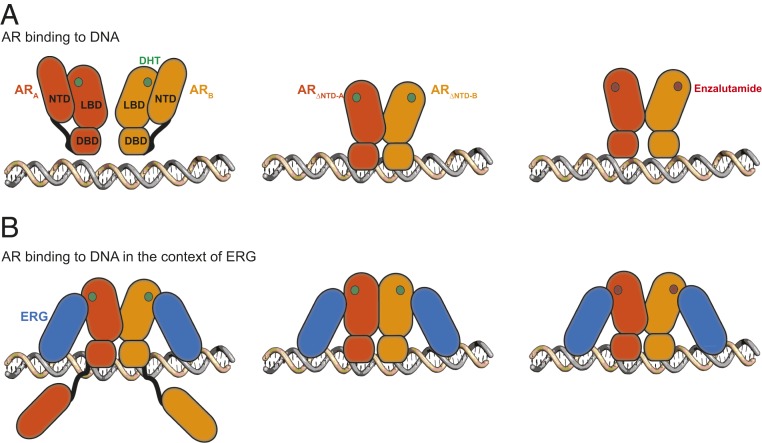
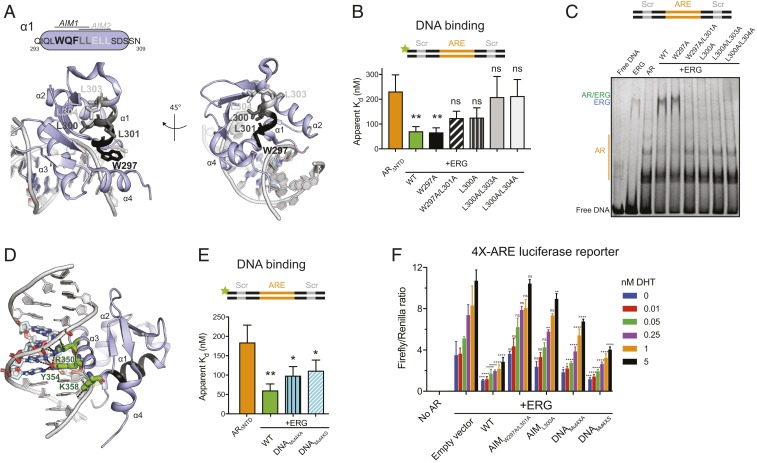
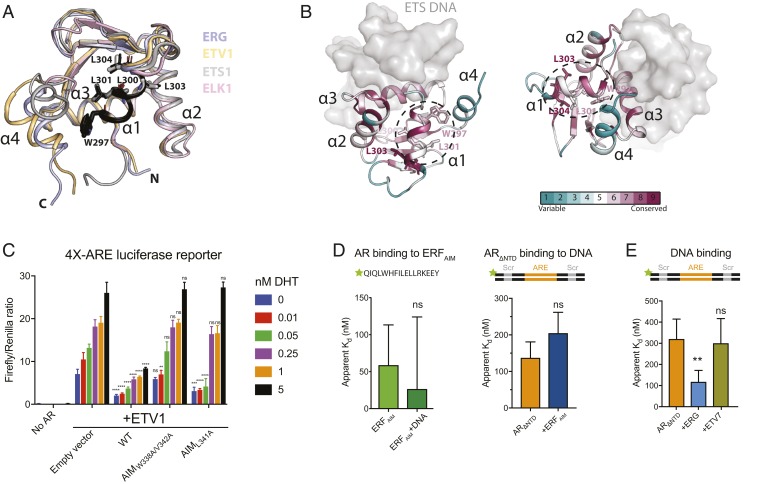
The androgen receptor (AR) is a type I nuclear hormone receptor and the primary drug target in prostate cancer due to its role as a lineage survival factor in prostate luminal epithelium. In prostate cancer, the AR cistrome is reprogrammed relative to normal prostate epithelium and particularly in cancers driven by oncogenic ETS fusion genes. The molecular basis for this change has remained elusive. Using purified proteins, we report a minimal cell-free system that demonstrates interdomain cooperativity between the ligand (LBD) and DNA binding domains (DBD) of AR, and its autoinhibition by the N terminus of AR. Furthermore, we identify ERG as a cofactor that activates AR's ability to bind DNA in both high and lower affinity contexts through direct interaction within a newly identified AR-interacting motif (AIM) in the ETS domain, independent of ERG's own DNA binding ability. Finally, we present evidence that this interaction is conserved among ETS factors whose expression is altered in prostate cancer. Our work highlights, at a biochemical level, how tumor-initiating ETS translocations result in reprogramming of the AR cistrome.
雄激素受体 (AR) 是一种 I 型核激素受体,也是前列腺癌的主要药物靶点,因为它在前列腺腔上皮中作为谱系存活因子发挥作用。在前列腺癌中,AR 顺式作用元件相对于正常前列腺上皮发生重编程,特别是在由致癌 ETS 融合基因驱动的癌症中。这种变化的分子基础仍然难以捉摸。使用纯化的蛋白质,我们报告了一个最小的无细胞系统,该系统证明了 AR 的配体 (LBD) 和 DNA 结合域 (DBD) 之间的结构域间协同作用,以及其自身 N 端对 AR 的自动抑制作用。此外,我们确定 ERG 是一种辅助因子,它通过在新鉴定的 AR 相互作用基序 (AIM) 内的直接相互作用,在高亲和度和低亲和度的情况下激活 AR 结合 DNA 的能力,而不依赖 ERG 自身的 DNA 结合能力。最后,我们提出的证据表明,这种相互作用在前列腺癌中表达改变的 ETS 因子中是保守的。我们的工作从生化水平上强调了起始肿瘤的 ETS 易位如何导致 AR 顺式作用元件的重编程。