Baker Kevin, Maurel Alice, Ward Charlotte, Getachew Dawit, Habte Tedila, McWhorter Cindy, LaBarre Paul, Karlström Jonas, Petzold Max, Källander Karin
Malaria Consortium, London, United Kingdom.
Karolinska Institute, Stockholm, Sweden.
JMIR Res Protoc. 2020 Mar 30;9(3):e14405. doi: 10.2196/14405.
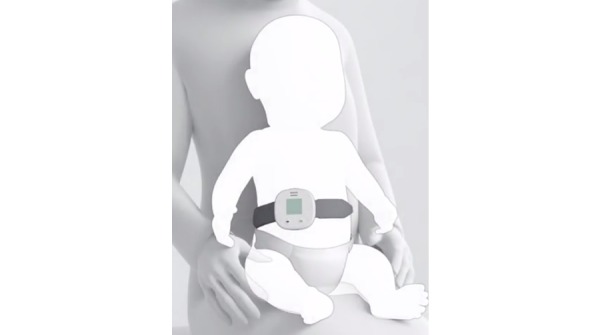
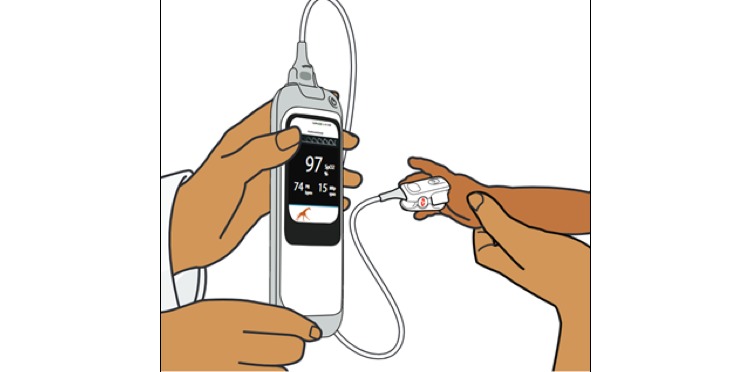
Manually counting a child's respiratory rate (RR) for 60 seconds using an acute respiratory infection timer is the World Health Organization (WHO) recommended method for detecting fast breathing as a sign of pneumonia. However, counting the RR is challenging and misclassification of an observed rate is common, often leading to inappropriate treatment. To address this gap, the acute respiratory infection diagnostic aid (ARIDA) project was initiated in response to a call for better pneumonia diagnostic aids and aimed to identify and assess automated RR counters for classifying fast breathing pneumonia when used by front-line health workers in resource-limited community settings and health facilities. The Children's Automated Respiration Monitor (ChARM), an automated RR diagnostic aid using accelerometer technology developed by Koninklijke Philips NV, and the Rad-G, a multimodal RR diagnostic and pulse oximeter developed by Masimo, were the two devices tested in these studies conducted in the Southern Nations, Nationalities, and Peoples' Region in Ethiopia and in the Karnali region in Nepal.
In these studies, we aimed to understand the usability of two new automated RR diagnostic aids for community health workers (CHWs; health extension workers [Ethiopia] and female community health volunteers [Nepal]) and their acceptability to CHWs in Ethiopia and Nepal, first-level health facility workers (FLHFWs) in Ethiopia only, and caregivers in both Ethiopia and Nepal.
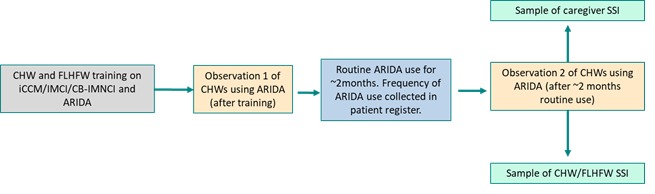
This was a prospective, cross-sectional study with a mixed methods design. CHWs and FLHFWs were trained to use both devices and provided with refresher training on all WHO requirements to assess fast breathing. Immediately after training, CHWs were observed using ARIDA on two children. Routine pneumonia case management consultations for children aged 5 years and younger and the device used for these consultations between the first and second consultations were recorded by CHWs in their patient log books. CHWs were observed a second time after 2 months. Semistructured interviews were also conducted with CHWs, FLHFWs, and caregivers. The proportion of consultations with children aged 5 years and younger where CHWs using an ARIDA and adhered to all WHO requirements to assess fast breathing and device manufacturer instructions for use after 2 months will be calculated. Qualitative data from semistructured interviews will be analyzed using a thematic framework approach.
The ARIDA project was funded in November 2015, and data collection was conducted between April and December 2018. Data analysis is currently under way and the first results are expected to be submitted for publication in 2020.
This is the first time the usability and acceptability of automated RR counters in low-resource settings have been evaluated. Outcomes will be relevant for policy makers and are important for future research of this new class of diagnostic aids for the management of children with suspected pneumonia.
INTERNATIONAL REGISTERED REPORT IDENTIFIER (IRRID): DERR1-10.2196/14405.
使用急性呼吸道感染计时器手动计数儿童呼吸频率(RR)60秒是世界卫生组织(WHO)推荐的检测呼吸急促这一肺炎体征的方法。然而,计数RR具有挑战性,观察到的呼吸频率误分类很常见,常常导致不恰当的治疗。为填补这一空白,急性呼吸道感染诊断辅助工具(ARIDA)项目应更好的肺炎诊断辅助工具的需求而启动,旨在识别和评估自动RR计数器,以便在资源有限的社区环境和卫生设施中由一线卫生工作者使用时对呼吸急促型肺炎进行分类。儿童自动呼吸监测仪(ChARM)是由皇家飞利浦公司开发的一种使用加速度计技术的自动RR诊断辅助工具,而Rad - G是由Masimo公司开发的一种多模式RR诊断仪和脉搏血氧仪,这两种设备在埃塞俄比亚南方各族州和尼泊尔卡纳利地区进行的这些研究中进行了测试。
在这些研究中,我们旨在了解两种新型自动RR诊断辅助工具对社区卫生工作者(CHWs;埃塞俄比亚的健康推广工作者和尼泊尔的女性社区卫生志愿者)以及它们在埃塞俄比亚和尼泊尔的CHWs、仅在埃塞俄比亚的一级卫生设施工作者(FLHFWs)和埃塞俄比亚及尼泊尔的护理人员中的可接受性。
这是一项采用混合方法设计的前瞻性横断面研究。对CHWs和FLHFWs进行培训以使用这两种设备,并提供关于评估呼吸急促的所有WHO要求的复习培训。培训后立即观察CHWs使用ARIDA对两名儿童进行操作。CHWs在其患者日志中记录5岁及以下儿童的常规肺炎病例管理咨询以及首次和第二次咨询之间用于这些咨询的设备。2个月后再次观察CHWs。还对CHWs、FLHFWs和护理人员进行了半结构化访谈。将计算使用ARIDA且在2个月后遵守所有WHO评估呼吸急促要求和设备制造商使用说明的5岁及以下儿童咨询的比例。将使用主题框架方法分析半结构化访谈的定性数据。
ARIDA项目于2015年11月获得资助,数据收集于2018年4月至12月进行。目前正在进行数据分析,预计首批结果将于2020年提交发表。
这是首次在资源匮乏环境中评估自动RR计数器的可用性和可接受性。结果将对政策制定者具有参考价值,对于这类用于疑似肺炎儿童管理的新型诊断辅助工具的未来研究也很重要。
国际注册报告标识符(IRRID):DERR1 - 10.2196/14405。