Premrov Bajuk Blanka, Zrimšek Petra, Pipan Maja Zakošek, Tilocca Bruno, Soggiu Alessio, Bonizzi Luigi, Roncada Paola
Institute of Preclinical Sciences, Veterinary Faculty, University of Ljubljana, Gerbičeva 60, 1000 Ljubljana, Slovenia.
Clinic for Reproduction and Large Animals, Veterinary Faculty, University of Ljubljana, Gerbičeva 60, 1000 Ljubljana, Slovenia.
Animals (Basel). 2020 Mar 26;10(4):553. doi: 10.3390/ani10040553.
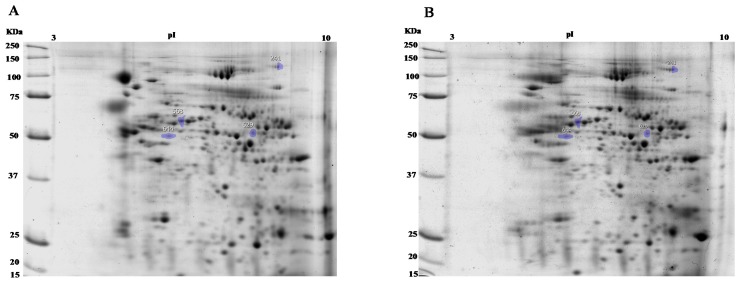
In this study comparative proteomics was used to define changes in the expression of the spermatozoa proteins during liquid storage. Semen from eight boars was analyzed on the day of collection and after liquid preservation at 15-17 °C for three days. Sperm parameters (concentration, motility, morphology, vitality) and percentage of non-capacitated and acrosomal-reacted spermatozoa were determined. Sperm proteins were extracted and separated by two-dimensional sodium dodecyl sulphate-polyacrylamide gel electrophoresis (SDS-PAGE) and proteomic profiles were computationally compared to highlight differentially expressed protein spots that were, in turn, identified by mass spectrometry. The intensities of four spots were significantly different between fresh and liquid stored sperm. Namely: ATP citrate lyase, chaperonin containing T-complex polypeptide 1 (TCP1) subunit ε and probable phospholipid-transporting ATP-ase were over-expressed in liquid stored sperm, whereas cytosolic non-specific dipeptidase was over-expressed in fresh sperm. These differentially expressed proteins could be used as plausible biomarkers for the evaluation of boar semen quality and spermatozoa survival after liquid storage and could help to address problems associated with sperm preservation.
在本研究中,采用比较蛋白质组学来确定液态保存期间精子蛋白质表达的变化。采集了八头公猪的精液,在采集当天以及在15 - 17°C下液态保存三天后进行分析。测定了精子参数(浓度、活力、形态、活力)以及未获能和顶体反应精子的百分比。提取精子蛋白质并通过二维十二烷基硫酸钠 - 聚丙烯酰胺凝胶电泳(SDS - PAGE)进行分离,对蛋白质组图谱进行计算比较,以突出差异表达的蛋白质斑点,进而通过质谱鉴定这些斑点。新鲜精子和液态保存精子之间有四个斑点的强度存在显著差异。具体而言:柠檬酸ATP裂解酶、含T - 复合物多肽1(TCP1)亚基ε的伴侣蛋白和可能的磷脂转运ATP酶在液态保存精子中过度表达,而胞质非特异性二肽酶在新鲜精子中过度表达。这些差异表达的蛋白质可作为合理的生物标志物,用于评估公猪精液质量以及液态保存后精子的存活率,并有助于解决与精子保存相关的问题。