Alam Jahangir, Khaliel Maher, Fawky Abdelfattah, El-Awamry Ahmed, Kaiser Thomas
Institute of Digital Signal Processing, Faculty of Engineering, University of Duisburg-Essen, 47057 Duisburg, Germany.
Benha Faculty of Engineering, Benha University, 13511 Benha, Egypt.
Sensors (Basel). 2020 Mar 26;20(7):1843. doi: 10.3390/s20071843.
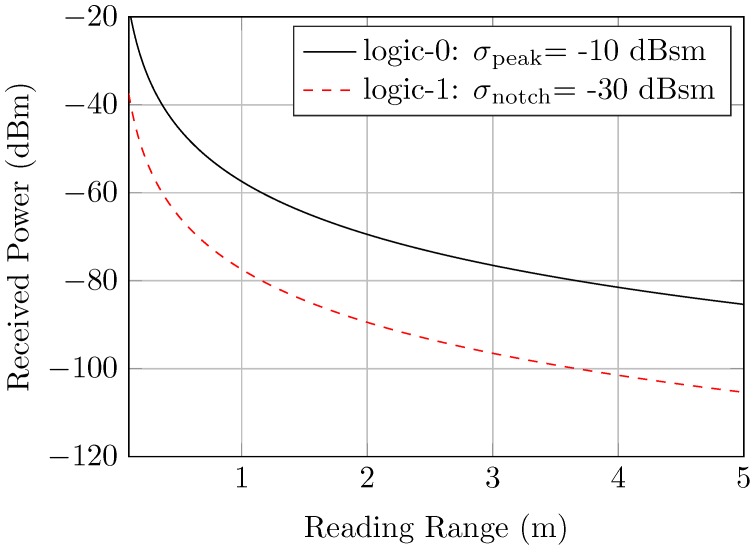
This paper focuses on the frequency coded chipless Radio Frequency Identification (RFID) wherein the tag's information bits are physically encoded by the resonators' notch position which has an effect on the frequency spectrum of the backscattered or retransmitted signal of the tag. In this regard, the notch analytical model is developed to consider the notch position and quality factor. Besides, the radar cross section (RCS) mathematical representation of the tag is introduced to consider the incident wave's polarization and orientation angles. Hence, the influences of the incident wave's orientation and polarization mismatches on the detection performance are quantified. After that, the tag measurement errors and limitations are comprehensively explained. Therefore, approaches to measureing RCS- and retransmission-based tags are introduced. Furthermore, the maximum reading range is theoretically calculated and practically verified considering the Federal Communications Commission (FCC) Ultra Wideband (UWB) regulations. In all simulations and experiments conducted, a mono-static configuration is considered, in which one antenna is utilized for transmission and reception.
本文聚焦于频率编码无芯片射频识别(RFID),其中标签的信息位由谐振器的陷波位置进行物理编码,该陷波位置会对标签反向散射或重传信号的频谱产生影响。在此方面,开发了陷波分析模型以考虑陷波位置和品质因数。此外,引入了标签的雷达散射截面(RCS)数学表示,以考虑入射波的极化和方位角。因此,量化了入射波的方位和极化失配对检测性能的影响。之后,全面解释了标签测量误差和局限性。因此,介绍了测量基于RCS和重传的标签的方法。此外,考虑到美国联邦通信委员会(FCC)超宽带(UWB)规定,从理论上计算并通过实验验证了最大读取范围。在所有进行的仿真和实验中,均采用单静态配置,即使用一个天线进行发射和接收。