School of Public Health and Community Medicine, B.P. Koirala Institute of Health Sciences, Dharan, Nepal.
National Academy of Medical Science, Bir Hospital, Kathmandu, Nepal.
PLoS One. 2020 Mar 30;15(3):e0230960. doi: 10.1371/journal.pone.0230960. eCollection 2020.
Healthcare waste management is a serious issue in context of developing countries. Better assessment of both risks and effects of exposure would permit improvements in the management of healthcare waste. However, there is not yet clear understanding of risks, and as consequences, inadequate management practices are often implemented.
This study primarily aims to assess risk perception towards healthcare waste and secondly to assess knowledge, attitude and identify the factors associated with risk perception.
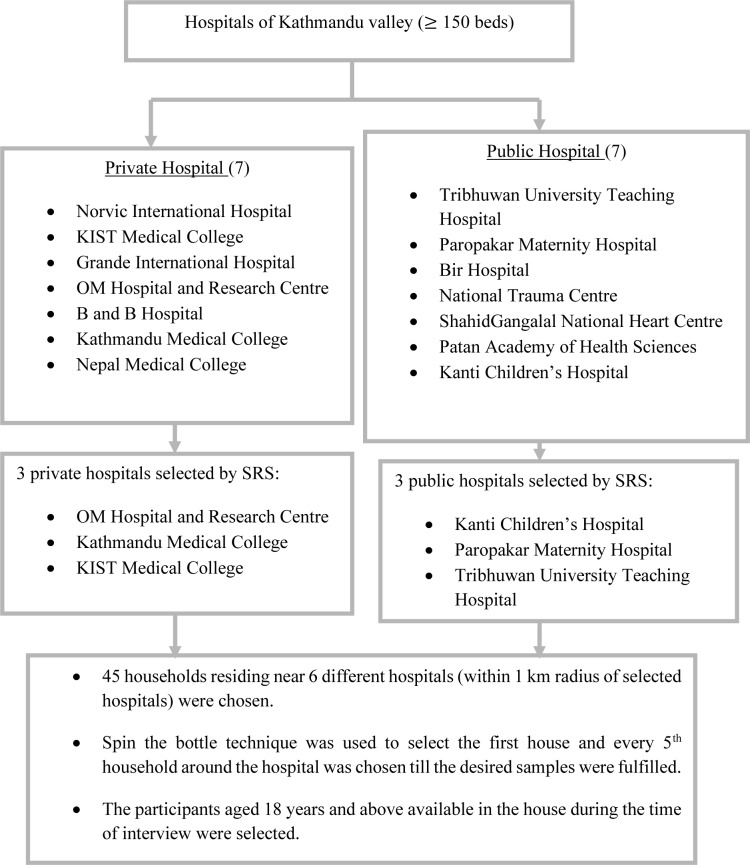
A cross-sectional community based study was carried out among 270 respondents selected through multistage sampling technique. Face-to-face interview was conducted using semi-structured questionnaires. Risk perception was classified as good and poor based on mean score. Bivariate and multivariate analyses were carried out to determine the associates of risk perception. More than half, 52% of the sampled population had a poor risk perception towards healthcare waste. More than a quarter 26.3% had inadequate knowledge and forty percent (40%) had a negative attitude towards health care waste management. Having knowledge (OR = 3.31; CI = 1.67-6.58) was a strong predictor of risk perception towards healthcare waste. The perception of risk towards healthcare waste among community people was poor. This highlights the need for extensive awareness programs. Promoting knowledge on healthcare waste is a way to change the perception in Nepal. Community engaged research approach is needed to address environmental health concerns among public residents.
在发展中国家,医疗废物管理是一个严重的问题。更好地评估接触风险和影响,可以改进医疗废物管理。然而,人们对风险还没有清晰的认识,因此往往实施了不充分的管理措施。
本研究主要旨在评估社区人群对医疗废物的风险感知,其次评估其知识、态度,并确定与风险感知相关的因素。
本研究采用多阶段抽样技术,对 270 名受访者进行了横断面社区基础研究。通过半结构式问卷进行了面对面访谈。根据平均得分,将风险感知分为良好和不良。进行了单变量和多变量分析,以确定风险感知的相关因素。超过一半(52%)的抽样人群对医疗废物的风险感知较差。超过四分之一(26.3%)的人对医疗废物管理知识不足,40%的人对医疗废物管理持负面态度。有知识(OR = 3.31;CI = 1.67-6.58)是对医疗废物风险感知的一个强有力的预测因素。社区人群对医疗废物的风险感知较差。这突出表明需要开展广泛的宣传活动。提高对医疗废物的认识是改变尼泊尔公众对其认知的一种方式。需要采取社区参与式的研究方法来解决公众居民的环境卫生问题。