School of Imaging Sciences & Biomedical Engineering, King's College London, St. Thomas' Hospital, London, SE1 7EH, UK.
Centre for Inflammation Biology and Cancer Immunology, King's College London, New Hunt's House, London, SE1 1UL, UK.
Theranostics. 2020 Feb 26;10(9):3867-3879. doi: 10.7150/thno.40403. eCollection 2020.
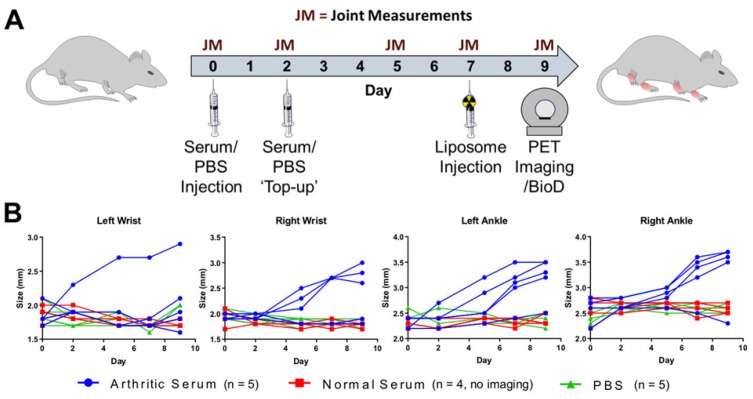
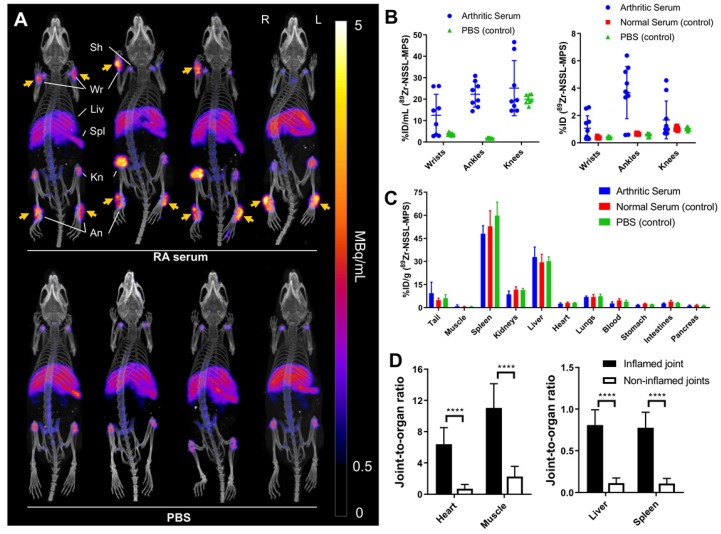
The encapsulation of Glucocorticoids (GCs) into long-circulating liposomes (LCLs) is a proven strategy to reduce the side effects of glucocorticoids and improve the treatment of inflammatory diseases, such as rheumatoid arthritis (RA). With the aim of supporting the development of GC-loaded LCLs, and potentially predict patient response to therapy clinically, we evaluated a direct PET imaging radiolabelling approach for preformed GC-LCLs in an animal model of human inflammatory arthritis. A preformed PEGylated liposomal methylprednisolone hemisuccinate (NSSL-MPS) nanomedicine was radiolabelled using [Zr]Zr(oxinate) (Zr-oxine), characterised and tracked using PET imaging in a K/BxN serum-transfer arthritis (STA) mouse model of inflammatory arthritis and non-inflamed controls. Histology and joint size measurements were used to confirm inflammation. The biodistribution of Zr-NSSL-MPS was compared to that of free Zr in the same model. A therapeutic study using NSSL-MPS using the same time points as the PET/CT imaging was carried out. The radiolabelling efficiency of NSSL-MPS with [Zr]Zr(oxinate) was 69 ± 8 %. PET/CT imaging of Zr-NSSL-MPS showed high uptake (3.6 ± 1.5 % ID; 17.4 ± 9.3 % ID/mL) at inflamed joints, with low activity present in non-inflamed joints (0.5 ± 0.1 % ID; 2.7 ± 1.1 % ID/mL). Importantly, a clear correlation between joint swelling and high Zr-NSSL-MPS uptake was observed, which was not observed with free Zr. STA mice receiving a therapeutic dose of NSSL-MPS showed a reduction in inflammation at the time points used for the PET/CT imaging compared with the control group. PET imaging was used for the first time to track a liposomal glucocorticoid, showing high uptake at visible and occult inflamed sites and a good correlation with the degree of inflammation. A subsequent therapeutic response matching imaging time points in the same model demonstrated the potential of this radiolabeling method as a theranostic tool for the prediction of therapeutic response - with NSSL-MPS and similar nanomedicines - in the treatment of inflammatory diseases.
将糖皮质激素(GCs)封装到长循环脂质体(LCL)中是一种已被证实的策略,可以降低糖皮质激素的副作用并改善炎症性疾病(如类风湿关节炎(RA))的治疗效果。为了支持载药 LCL 的发展,并有可能在临床上预测患者对治疗的反应,我们在人类炎症性关节炎的动物模型中评估了一种用于预形成 GC-LCL 的直接 PET 成像放射性标记方法。使用 [Zr]Zr(oxinate)(Zr-oxine)对预形成的 PEG 化脂质体甲泼尼龙琥珀酸半酯(NSSL-MPS)纳米药物进行放射性标记,并用 PET 成像在 K/BxN 血清转移关节炎(STA)小鼠炎症性关节炎模型和非炎症对照中对其进行特征描述和跟踪。组织学和关节大小测量用于确认炎症。比较了 Zr-NSSL-MPS 的生物分布与相同模型中游离 Zr 的分布。使用与 PET/CT 成像相同的时间点进行了 NSSL-MPS 的治疗研究。NSSL-MPS 的放射性标记效率为 69 ± 8 %。Zr-NSSL-MPS 的 PET/CT 成像显示,在炎症关节中摄取量高(3.6 ± 1.5 % ID;17.4 ± 9.3 % ID/mL),在非炎症关节中摄取量低(0.5 ± 0.1 % ID;2.7 ± 1.1 % ID/mL)。重要的是,观察到关节肿胀与高 Zr-NSSL-MPS 摄取之间存在明确的相关性,而游离 Zr 则没有观察到这种相关性。与对照组相比,接受 NSSL-MPS 治疗剂量的 STA 小鼠在用于 PET/CT 成像的时间点显示出炎症减轻。首次使用 PET 成像来跟踪脂质体糖皮质激素,显示在可见和隐匿性炎症部位摄取量高,与炎症程度有很好的相关性。在同一模型中,与成像时间点相匹配的后续治疗反应证明了这种放射性标记方法作为治疗反应预测的治疗诊断工具的潜力 - 对于 NSSL-MPS 和类似的纳米药物 - 在炎症性疾病的治疗中。