Department of Biological Sciences, Auburn University, Auburn, Alabama, USA.
The First Department of Foot and Ankle Surgery, Tianjin Hospital, Tianjin, China.
Orthop Surg. 2020 Apr;12(2):372-377. doi: 10.1111/os.12635. Epub 2020 Mar 29.
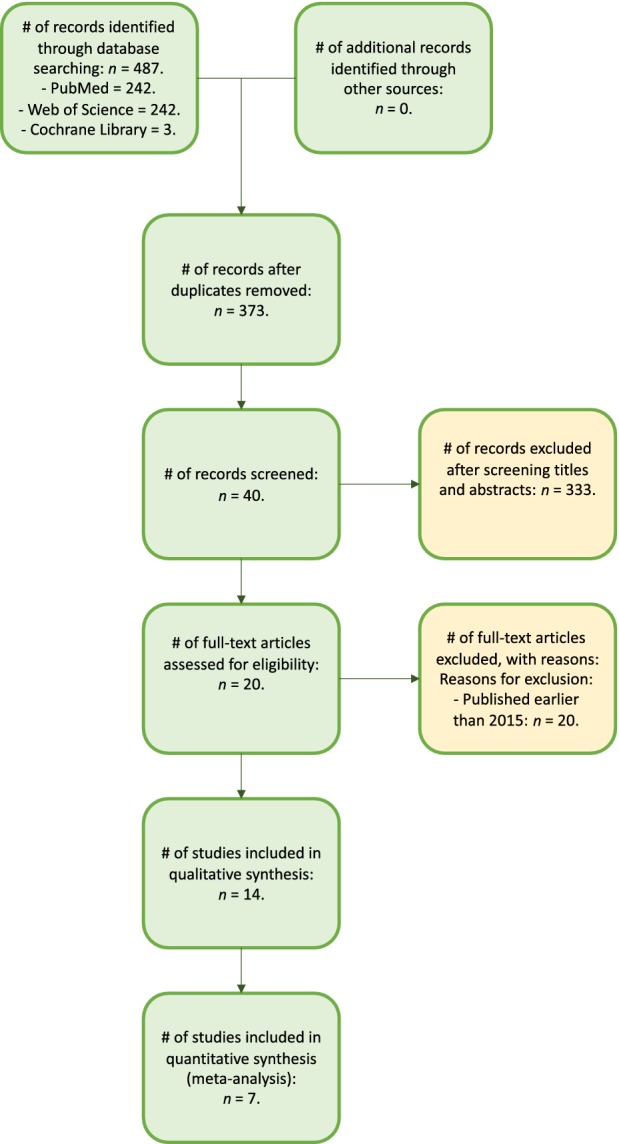
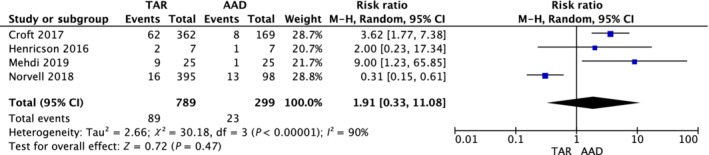
While osteoarthritis is a common degenerative disease, ankle osteoarthritis is a subdivision that has received little attention. Two effective ways to treat osteoarthritis of the ankle are total ankle replacement (TAR) and ankle arthrodesis (AAD). Whether TAR or AAD is more beneficial for treatment is controversial. The purpose of this meta-analysis was to compare the efficiency (clinical outcome and patient satisfaction) and safety (complications and survival) of these two procedures. The Preferred Reporting Items for Systematic Reviews and Meta-Analyses (PRISMA) statement was performed as a guideline for this study. Three electronic databases, PubMed, Web of Science, and Cochrane Library, were searched up to May 2019, with no language restrictions. Prospective or retrospective comparative studies were identified. The outcomes included clinical outcome, patient satisfaction, complications, and survival. Review Manager (Revman) 5.3 software was used to conduct the data analysis. We only selected literature from the past 5 years (no earlier than 2015). Seven comparative studies were included. There were six cohort studies and one cross-sectional study. The Newcastle-Ottawa Scale (NOS) was used to assess the quality of cohort studies, and The Agency for Healthcare Research and Quality (AHRQ) checklist was chosen to assess the quality of cross-sectional studies. No significant difference was observed for efficiency and safety. Clinical outcome was included in five studies with four different scoring systems. Two of them used the American Orthopaedic Foot & Ankle Society (AOFAS) questionnaire scores to assess the two procedures (mean difference, -4.26; 95% confidence interval [CI], -11.37-2.85; P = 0.24; I = 1%). Patient satisfaction (risk ratio [RR], 0.96; 95% CI, 0.65-1.40; P = 0.82; I = 54%), complications (RR, 1.15; 95% CI, 0.16-8.21; P = 0.89; I = 84%), and survival (RR, 1.91; 95% CI, 0.33-11.08; P = 0.47; I = 90%) showed no significant difference between the TAR group and the AAD group. This meta-analysis showed no statistically significant difference between TAR and AAD in clinical outcome, patient satisfaction, complications, and survival. This revealed that TAR and AAD could appear to have similar results in these aspects. Therefore, the present results are not sufficient to conclude which of these two methods is better. Further studies are needed to obtain more clues.
虽然骨关节炎是一种常见的退行性疾病,但踝关节骨关节炎是一个尚未得到充分关注的细分领域。治疗踝关节骨关节炎的两种有效方法是全踝关节置换术(TAR)和踝关节融合术(AAD)。TAR 或 AAD 哪种方法更有益存在争议。本荟萃分析旨在比较这两种手术的疗效(临床结果和患者满意度)和安全性(并发症和生存率)。本研究遵循系统评价和荟萃分析的首选报告项目(PRISMA)声明作为指导。截至 2019 年 5 月,我们在 PubMed、Web of Science 和 Cochrane Library 三个电子数据库中进行了无语言限制的搜索。确定了前瞻性或回顾性对照研究。结果包括临床结果、患者满意度、并发症和生存率。使用 Review Manager(Revman)5.3 软件进行数据分析。我们仅选择了过去 5 年(不早于 2015 年)的文献。共纳入 7 项对照研究。其中 6 项为队列研究,1 项为横断面研究。使用纽卡斯尔-渥太华量表(NOS)评估队列研究的质量,使用医疗保健研究与质量局(AHRQ)检查表评估横断面研究的质量。在疗效和安全性方面没有观察到显著差异。临床结果纳入了 5 项研究,其中 4 项使用了不同的评分系统。其中两项使用美国矫形足踝协会(AOFAS)问卷评分来评估两种手术(平均差值,-4.26;95%置信区间[CI],-11.37-2.85;P = 0.24;I = 1%)。患者满意度(风险比[RR],0.96;95%CI,0.65-1.40;P = 0.82;I = 54%)、并发症(RR,1.15;95%CI,0.16-8.21;P = 0.89;I = 84%)和生存率(RR,1.91;95%CI,0.33-11.08;P = 0.47;I = 90%)在 TAR 组和 AAD 组之间无显著差异。这项荟萃分析显示,在临床结果、患者满意度、并发症和生存率方面,TAR 和 AAD 之间无统计学差异。这表明 TAR 和 AAD 在这些方面可能具有相似的结果。因此,目前的结果还不足以得出哪种方法更好的结论。需要进一步的研究来获得更多的线索。